
Editor with limited desk space
You want to keep your mouse and keyboard close while editing, then clear the workstation easily afterwards. RTINGS.com explains that a smaller layout can free up space for your mouse, but may also leave out some keys.


Choose a keyboard that suits the space available, the way you type and the computer you use at the shared workstation. A curved model usually requires less adjustment to your set-up; a compact model can free up space beside the keyboard, while separate halves give you more freedom to position your hands independently. None of these designs is a substitute for a suitable workstation or taking regular breaks from screen work.
You want to keep your mouse and keyboard close while editing, then clear the workstation easily afterwards. RTINGS.com explains that a smaller layout can free up space for your mouse, but may also leave out some keys.
You’re comparing a curved or split layout and want to consider the position of your hands and forearms, without assuming that a keyboard can prevent health problems. Arboportaal describes the repetitive actions involved in screen work.
You want to know in advance which connections are available on the shared computer and how to switch between devices. Check the connection options for the specific model, such as Bluetooth, a receiver or a cable.
For a short editing task at a shared desk, hand position, available space, connectivity, typing noise and how familiar the keyboard layout feels can all make the difference.
| Buying concern | What should you check? | Who should consider this? |
|---|---|---|
| Hand and wrist position | Compare a wave-shaped design, a fixed split frame and two separate halves. Check that the set-up suits your hands and the space available at your workstation. | When I’m editing text, I want a shape that suits the position I’d like to keep my hands in, without assuming it will lead to a particular health outcome. Around 29% of consumers put hand and wrist position first. |
| Desk space and mouse reach | Check the dimensions, whether there’s a number pad and how much room will be left for your mouse. RTINGS.com notes that a smaller layout can free up space, but may also leave out some keys. | At a shared desk, I want to keep my mouse close and avoid cluttering the workstation unnecessarily. Around 23% of consumers make available desk space their top priority. |
| Connecting and switching | Check Bluetooth, the available USB port, whether a receiver is included, the operating system and whether you’re allowed to install software. | When I work on different computers, I want to know whether I can connect straight away and switch easily. Around 18% of consumers put connectivity first. |
| Typing noise | Look for product-specific information about noise and, if possible, try out how the keys feel. Don’t assume a noise level without a measurement. | When other people are working at the same desk, I want to be mindful of the noise I make while typing. Around 18% of consumers name typing noise as their main consideration. |
| Keyboard layout | Check the physical layout of the version on offer and whether you can find the characters and editing keys you use most often. | When editing names and punctuation, I want to be able to find the keys and shortcuts I’m used to. Around 12% of consumers put a familiar layout first. |
The shape of a keyboard alone doesn’t determine how your whole workstation is set up or how much variation there is in your screen work.
Choose based on your set-up and how you use it. Break up your screen work; Arboportaal also recommends changing your working posture regularly and taking micro-breaks. If you start to experience discomfort, seek advice about your workstation if needed.
A TKL layout doesn’t have an integrated number pad. A smaller layout may also leave out keys you use for editing text.
Check the exact layout and the editing keys you usually use before choosing a model.
If you often use a number pad, you may need a separate one.
Models differ in their connections and operating system support. Whether you can use software may also depend on the workstation’s settings.
Check the available Bluetooth or USB connection, the operating system and whether you’re allowed to install software before you buy.
The Wave Keys has a curved, wave-shaped design; the ERGO K860 has a fixed split keyboard frame. The right choice depends, among other things, on your preferred layout and the space available on your desk.
The KB675 EQ TKL is designed for a compact layout; the KB620-RC has a wave-shaped design and a familiar keyboard layout.
The Split Break Version 2 consists of two separate keyboard halves that you can position independently, then bring together for compact storage.
The KC 4500 ERGO is a full-size wired keyboard with a curved key layout.
These product picks suit different priorities when typing at a shared desk, such as a compact layout, a wrist rest, a wireless connection or a wired keyboard.
 No image available
An option if you’re looking for a wired connection and a wrist rest.
The product name lists 94 keys, a metal case, a phone stand and a wrist rest.
 No image available
Could suit you if you’re looking for a compact keyboard and want to switch between supported devices.
The description lists a TKL layout, quiet keys, three height settings and connectivity via Bluetooth or a USB receiver, for up to three devices.
 No image available
A compact wired option if you’d like adjustable keyboard feet.
The product information lists a 75% layout with 83 keys, adjustable feet and PBT keycaps.
 No image available
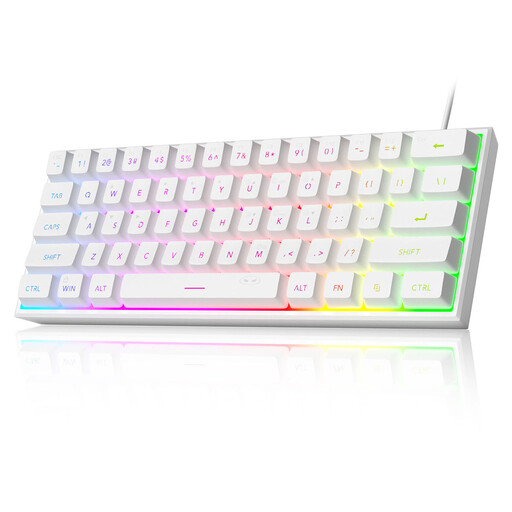
Could suit you if you prefer a compact layout and a wired connection.
The product information lists a 60% layout without a number pad and 61 keys. The product name mentions a mechanical feel and RGB lighting.
 No image available
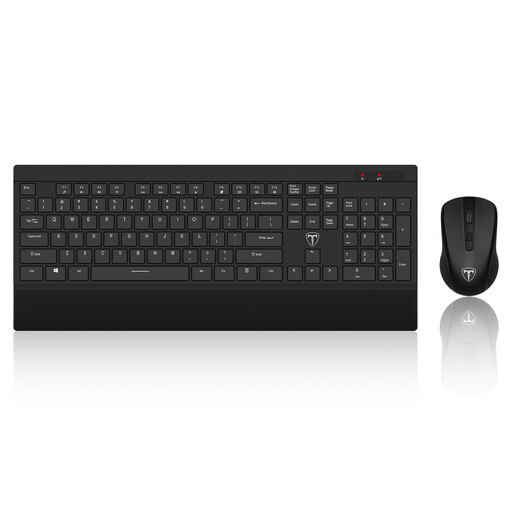
An option if you’re looking for a wireless connection and an integrated wrist rest; bear in mind that you’ll need space for a full-size keyboard.
The product information lists 104 keys and a 2.4 GHz connection via a single receiver for the keyboard and mouse.
Not just for that one task. According to Arboportaal, for employees who work with a screen for more than 2 hours a day, the screen and keyboard must not be attached to each other; if you use a laptop, a separate screen or keyboard must then be available. So the rule is based on the amount of screen work you do each day, not on the length of the biography.
Position your keyboard and mouse so you can work comfortably, and break up screen work with other tasks or breaks. Arboportaal also recommends varying your working posture and taking micro-breaks; an ergonomic keyboard is no substitute for taking regular breaks.
Check the available USB port or Bluetooth, the operating system and whether you’re allowed to install software. Kensington lists support for Windows and macOS for the KB675, but says it does not currently support Windows 11 on Arm. Also check whether you can customise the keys on the work computer.
According to the Dutch government, online purchases from a business often come with a 14-day cooling-off period. For a faulty product, Dutch law provides a statutory guarantee with no fixed legal guarantee period; the seller must offer an appropriate solution. Check the terms that apply to your specific purchase.