
Reviewer who types a lot
You spend long periods writing and rearranging text, and want a key position that suits your hands and workstation without expecting a keyboard to solve health problems.


Start by choosing a layout that gives you easy access to the keys you use for writing and editing, and a size that leaves enough room for your mouse. A wave-shaped keyboard is a smaller change than one with two separately adjustable halves. Those adjustable halves give you more freedom over positioning, but need more desk space and may take some getting used to. A keyboard is no substitute for a well-set-up workstation or regular breaks.
You spend long periods writing and rearranging text, and want a key position that suits your hands and workstation without expecting a keyboard to solve health problems.
You often switch between text and mouse, and want to save space without losing the keys you need to navigate a review.
You use more than one computer or tablet and want to check in advance that the connection and keyboard layout suit your devices.
Best for: a small desk where you want to keep your mouse close to the keyboard.
Trade-off: RTINGS.com notes that smaller layouts may omit keys or require a different way of working; BakkerElkhuizen describes the S-board 840 as compact because it has no numeric keypad.
Best for: anyone who wants to try a different hand position without immediately switching to two separate keyboard halves.
Trade-off: the shape is fixed. Logitech lists Bluetooth or the included Logi Bolt receiver for the Wave Keys; check that the keyboard layout is right for you.
Best for: anyone who wants clearly separated key groups but prefers to keep them on one board.
Trade-off: you can’t adjust the distance between the halves separately. In an RTINGS.com comparison, the Logitech ERGO K860 is larger than the Wave Keys.
Best for: anyone who wants to choose the distance between the key groups themselves.
Trade-off: the halves take up desk space, and the layout may take some getting used to. Check the connection and any included accessories for each version.
| Consideration | What to look for when buying | Who is this important to? |
|---|---|---|
| Hand and forearm position | Compare a wave-shaped, fixed split or adjustable layout, and assess it at your own desk. | If I’m working on a review for a long time, I want a key position that suits my hands without assuming it will produce a health benefit. Around 28% of consumers prioritise hand position. |
| Desk space and distance from the mouse | Measure the available space and check whether you need a numeric keypad. | At a small desk, I want to keep the mouse close to my keyboard. Around 22% of consumers give mouse space top priority. |
| Familiar keys | Check the keyboard layout and make sure it includes the navigation and editing keys you use. | When rewriting, I want to find my usual keys straight away. For around 22% of consumers, easy access to these familiar keys is a top priority. |
| Connecting and switching | Check the connection for the exact version, the available ports and whether a receiver is included. | If I work on more than one device, I want to know whether I can connect the keyboard to them. Around 17% of consumers prioritise compatibility. |
| Typing noise | Try the key action if possible; don’t treat a claim such as ‘quiet’ as a sound measurement. | In a shared home, I want to disturb others as little as possible while typing. Around 11% of consumers name quiet typing as their main consideration. |
A keyboard’s shape is just one part of working with a screen, and it cannot guarantee an individual health outcome.
Choose a layout that suits your workstation, vary your posture and take short breaks regularly.
A smaller layout can free up space for your mouse, but it may also omit keys you use when editing.
Check the physical layout and make sure it has the navigation keys you usually use before choosing.
Missing keys may take some getting used to or require you to change the way you work.
With a fixed split keyboard, you can’t choose the distance between the two key groups independently.
Compare the design and measure the available desk space if you’re considering separately adjustable halves.
Connections and keyboard layouts can vary between versions, so the model name alone isn’t enough to tell you whether a keyboard will suit your workstation.
Check the full version, its connections and which components are included.
If an adapter or receiver isn’t included, you may need to buy an extra component to connect the keyboard.
The Wave Keys and ERGO K860 offer wave-shaped and fixed split layouts, respectively, giving you a choice between the two styles.
The wired S-board 840 is a compact option without a fixed numeric keypad.
The Split Break v2 is designed for anyone who wants to adjust the distance between two separate keyboard halves.
The Freestyle2 has adjustable halves; the Advantage360 range is an alternative if you’re looking for a distinctly different layout.
The Pro Fit Ergo Wireless is a wireless keyboard with a fixed split layout and adjustable reverse tilt.
The PERIBOARD-512 is a wired, fixed split option for a workstation with a USB-A connection.
This selection includes compact keyboards and a full-size option for anyone who is also considering desk space, keyboard layout and connections when editing. For long periods of writing, check that the keyboard has the editing keys you usually use.
 No image available
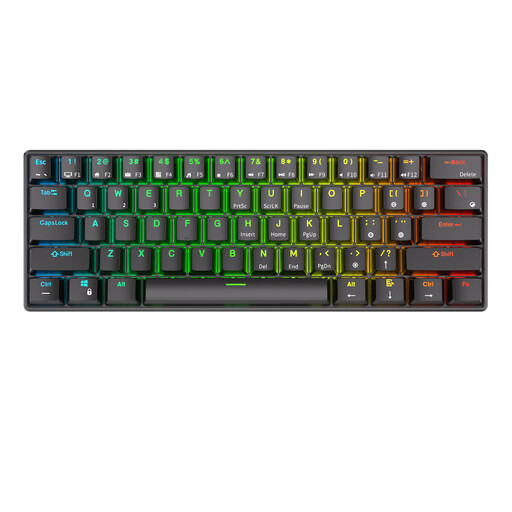
The compact 60% size may suit you if you want to use less desk space for your keyboard; check that the layout includes the editing keys you need.
Wired version. The product name specifies Hall Effect Magnetic Switch.
 No image available
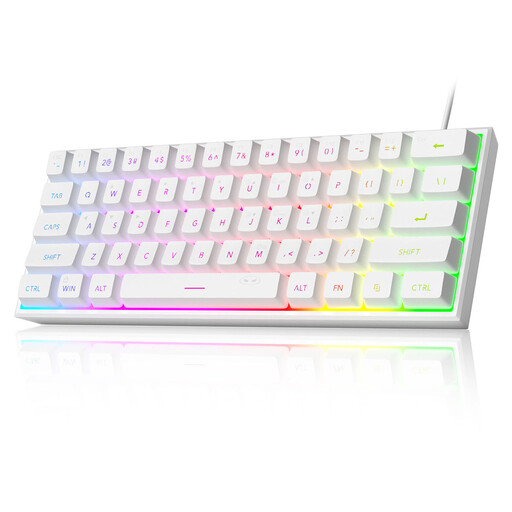
The compact 60% layout can free up space on a small desk; check that the US QWERTY layout suits the way you type before buying.
The product information specifies a wired USB connection and Purple Switch.
 No image available
The compact layout may suit a setup where you want to save space; check that it has the keys you use when editing.
The product information lists USB-C, Bluetooth and 2.4 GHz, with connections to up to three devices. The version is listed with Quiet Red Switches.
 No image available
The compact version without a numeric keypad may suit you if you have limited desk space; check that the US QWERTY layout works for you.
The product name specifies a wired version with 61 keys.
 No image available
The full-size version may suit you if you’re looking for a full-size keyboard and have enough desk space; it isn’t a compact option for freeing up more room for your mouse.
The product name specifies Silent Tactile Switches. This is a product description, not a sound measurement.
For employees who work with a screen for more than 2 hours a day, Arboportaal’s workplace guidance says that the screen and keyboard must not be attached to each other. This means laptop users must be able to use a separate screen or keyboard. This is not a universal buying requirement for every private reviewer or for shorter periods of use.
Adjust your workstation to suit your measurements, vary your screen-based tasks and take short breaks. Arboportaal recommends, among other things, looking away from the screen regularly and taking microbreaks. A different keyboard is no substitute for these work habits.
For a standard online consumer purchase in the Netherlands, you generally have a statutory cooling-off period of up to 14 days after delivery, according to ACM ConsuWijzer. Check the applicable terms for trying and handling the product in advance; any more generous retailer returns policy is separate from the statutory cooling-off period.
In the Netherlands, the retailer is responsible for the statutory guarantee: a product must meet what you could reasonably expect from it. ACM ConsuWijzer explains that, depending on the circumstances, the retailer must put the problem right free of charge. A manufacturer’s guarantee does not replace this statutory right.
The Dutch government says that employers must provide a good and safe home-working environment. Discuss with your employer which setup suits your work; this general duty of care does not in itself mean that every company must provide one specific keyboard model.