
Vandaag of morgen in huis

Kwaliteit gegarandeerd

Welkomstaanbiedingen ontgrendelen: GRATIS bezorging | Tot 80% korting | Gratis 30 dagen JoyPlus-proefperiode
Download de app
An ergonomic baby carrier can be useful when you want to keep your baby close while out for a walk, doing chores or travelling. However, not every baby carrier is right for every age, body shape or situation. A low price or eye-catching claim tells you little about how comfortable it will be day to day.
Look out for these common pitfalls:
First, check the minimum and maximum weight. Some models are designed for babies weighing around 3.2 to 20 kg, and are listed as suitable for ages approximately 3 to 24 months. That doesn’t automatically mean they’re suitable for a newborn.
A newborn baby carrier should provide adequate head and neck support, as set out in the instructions. If your baby can’t yet hold their head up unaided, only use a model that the manufacturer explicitly says is suitable, and follow the instructions carefully. According to the product information, the Chicco EasyFit is suitable from birth up to a maximum of 9 kg; the other models below are listed as suitable from around 3 months.
Before every use, check that:
In a baby carrier with an M-position, your baby’s knees sit higher than their bottom, with their thighs supported. The seat should be wide enough, but mustn’t press into the backs of their knees. An adjustable panel or several size settings can help you adapt the carrier as your child grows.
Bear in mind that “ergonomic” isn’t a fixed quality standard. Look for specific details such as:
A cotton baby carrier often feels soft and is practical if it’s machine washable. On warmer days, a breathable baby carrier made with Air Mesh fabric may feel more comfortable. Check the carrier’s weight too: the Momcozy models listed weigh around 760 to 771 grams.
For longer periods of carrying, soft straps aren’t the only thing that matters. A baby carrier with hip and back support can help distribute the weight more evenly. Look for a waist belt or EVA panel, X-shaped or cross-back straps, and the ability to adjust the straps precisely. Stop carrying your baby if you or your baby experiences pain, pressure or discomfort.
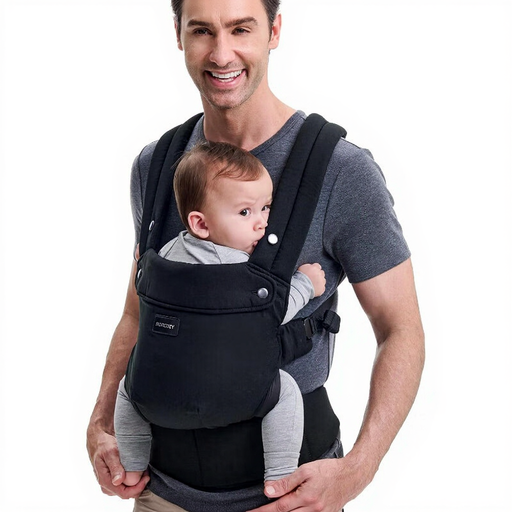
Why it suits this profile: A straightforward front carrier for parents looking for a machine-washable cotton baby carrier for everyday use from around 3 months.
The description gives specific limits of around 3.18 to 19.96 kg, three adjustment settings, an M-shaped seat and a foldable neck support. Always check the instructions and make sure your baby has good head control.
100% cotton, machine washable, around 771 grams, and fitted with EVA lumbar support and cross-back straps, according to the product information.
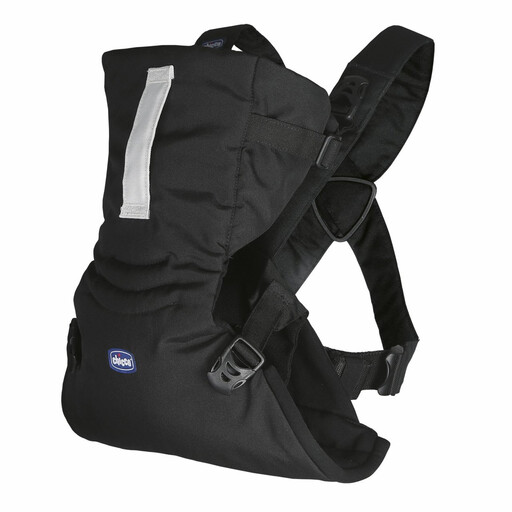
Why it suits this profile: A good choice for parents looking for a simple newborn baby carrier, with clear usage limits and an intuitive fit as their main priorities.
The product information states that it can be used from 0 months up to 9 kg, for front carrying, and has an adjustable seat. For a newborn, the top section must provide extra head and neck support, as stated in the warnings.
T-shirt-style fit, machine washable at 30 °C, and a wide, adjustable seat. According to the product information, the model is recognised by IHDI as hip-healthy.
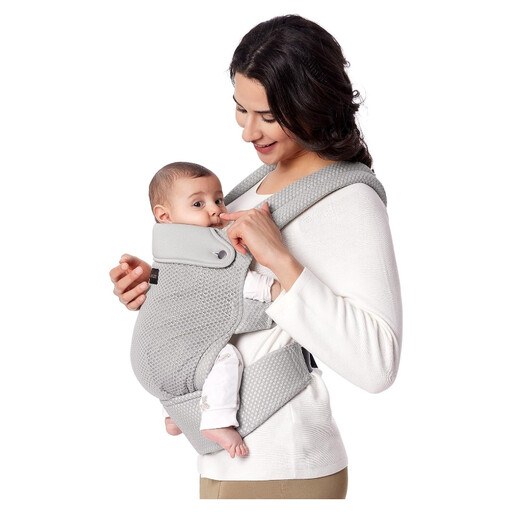
Why it suits this profile: A practical choice for travelling, longer walks and warmer days, when good airflow and hands-free babywearing matter.
The Air Mesh panels make the fabric choice clear. The carrier has three adjustment settings and a weight range of around 3.18 to 19.96 kg; readjust it as your baby grows.
Breathable mesh fabric, cooling neck fabric, X-shaped back straps and built-in EVA hip support, according to the product description. The model is machine washable.
We’ve put together a complete, up-to-date list of products that meet these strict selection criteria and current European safety requirements.
It depends on the model. Some carriers are suitable from birth, while others are only recommended from around 3 months. Check the minimum weight, the required level of head control and the manufacturer’s instructions. A carrier suitable for a baby weighing 3.2 kg isn’t automatically suitable for every newborn.
How long you can use it depends on the material, adjustability and your child’s weight. A model with a weight range up to around 20 kg may suit your child through several stages of growth, but check the buckles, stitching, straps and fabric regularly. Replace the carrier if any parts are damaged, worn or missing.
A low carrier weight helps, but it isn’t the only factor in comfort. Look for an adjustable waist belt, wide shoulder straps, back support and good weight distribution too. Adjust the carrier as your child grows, and stop if you feel pain or pressure. Don’t use a baby carrier while cycling, running, cooking over an open flame or doing other activities where there’s a risk of falling.
