
Vandaag of morgen in huis

Kwaliteit gegarandeerd

Welkomstaanbiedingen ontgrendelen: GRATIS bezorging | Tot 80% korting | Gratis 30 dagen JoyPlus-proefperiode
Download de app
An ergonomic baby carrier can be useful during a walk, a journey on public transport or a busy day at home. You keep your hands free while your baby stays close to you. However, not every carrier is suitable for every baby or parent. An attractive product photo tells you little about fit, carrying comfort or everyday use.
In this guide, you’ll find out which features to check before buying, which marketing pitfalls commonly occur and which type of carrier suits your situation.
A carrier for babies and toddlers may, for example, be suitable for approximately 3 to 20 kg. That does not automatically mean that one setting will be comfortable at every age. Check whether the carrier has several adjustment positions and whether the seat remains wide enough as your child grows.
The models in this selection specify a minimum weight of approximately 3.18 kg and a maximum weight of approximately 19.96 to 20 kg. Always follow the instructions and weight limit for the specific model.
A breathable baby carrier is particularly appealing on warm days. Don’t just look for the word mesh; also check the sections that sit directly against your baby’s neck and back. A fully cotton model may feel soft, while Air Mesh panels can provide better airflow.
According to the product description, the Momcozy mesh models use Air Mesh and cooling fabric around the neck. This is a product specification, not a guarantee that every parent and baby will experience the same temperature.
A carrier with lumbar support can distribute your baby’s weight more evenly across your body, but only if the waistband fits properly. A band that is too loose may reduce the benefit, while one that is too tight can be uncomfortable. Adjust the carrier with your baby in it and check that the straps do not dig in or shift.
First, check your baby’s actual weight. According to the product information, many models in this category are intended for children from approximately 3 months to 24 months, carried at the front. According to the safety warnings for these products, a baby who cannot yet support their head independently must not be placed in these carriers.
Also pay attention to the carrying position. The Momcozy carriers mentioned are designed for front carrying. If you are looking for a model for back carrying or with your baby facing outwards, check that this is explicitly stated in the instructions.
An adjustable baby carrier should fit both the baby and the wearer securely. Check the following:
The M-position is described in the product information as part of the ergonomic design. Treat this as guidance on how to adjust the carrier, not as a medical promise.
A lightweight baby carrier is convenient when you take it with you frequently. The Momcozy models weigh approximately 760 to 771 grams and measure around 36 × 15 × 13.5 cm. This makes them relatively compact for a carrier with a waistband and multiple straps.
For everyday use, ease of care is just as important. The models described are machine washable. Before washing, check the care instructions on the label and allow all parts to dry thoroughly. A cotton baby carrier can be a soft choice for use at home and on the go, while a mesh model may be better suited to warm weather or an active day.
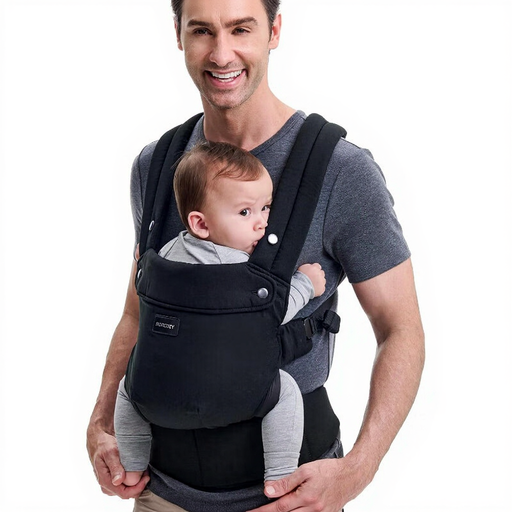
Why it suits this profile: A straightforward front-carrying model made from 100% cotton, designed for babies weighing approximately 3.18 to 19.96 kg. Suitable as a first carrier for short everyday periods and outings.
The product information lists three adjustment positions, an EVA panel and adjustable straps. This allows you to adapt the fit rather than relying solely on the wide weight range.
100% cotton, machine washable, front carrying and a stated carrying range of approximately 3.18 to 19.96 kg.
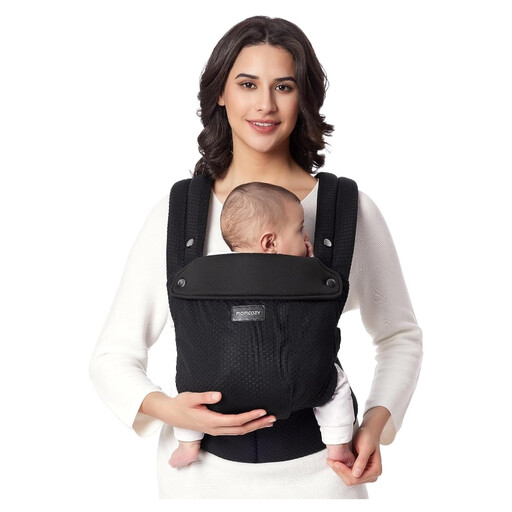
Why it suits this profile: A practical choice for parents who place a high value on material, support and use in warm weather. According to the product description, this model is suitable for approximately 3.2 to 20 kg.
The Air Mesh panels and X-shaped back system are clearly described in the product specifications. This lets you compare ventilation and weight distribution more effectively.
Air Mesh, cooling neck fabric, EVA lumbar support, three adjustment positions and machine-washable material.
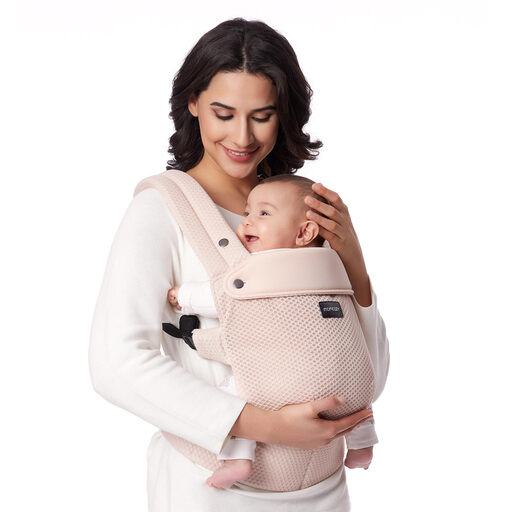
Why it suits this profile: Ideal for parents looking for a carrier for days out, travel or warm outdoor activities. The specifications state a weight of approximately 771 grams and front carrying.
The carrier combines adjustable positions with head and neck support and padded leg openings. However, always check the individual fit and the fastenings.
Breathable mesh, cooling neck fabric, X-shaped straps, EVA waist support and a stated range of approximately 3.18 to 19.96 kg.
A carrier is not protective equipment in the event of a fall or accident. Before every carrying session, check the following:
Do not use the carrier while running, cycling, cooking over an open flame or doing other activities involving a risk of falling or exposure to heat. Never leave your baby unattended. Always follow the manufacturer’s instructions.
We’ve put together a complete, up-to-date list of products that fully meet these strict selection criteria and the applicable European safety regulations.
This varies by model. The Momcozy carriers mentioned specify a minimum of approximately 3.18 kg and a maximum of approximately 19.96 to 20 kg. Minimum weight alone is not enough: according to the safety information, your baby must also be able to support their head independently. Always check the model, instructions and recommended age.
Place your baby in an upright position and make sure their face remains visible. Adjust the waistband first, followed by the shoulder straps. Your baby should sit securely against your body without the fabric covering their airway. Check that their knees are higher than their bottom and that all buckles are fully closed. Start at home with short carrying sessions.
How long it lasts depends on your child’s weight, how often you use the carrier and how well you maintain it. A model with several adjustment positions can grow with your child from babyhood to the toddler stage, but the maximum weight remains the deciding factor. Regularly inspect the seams, straps and buckles. Stop using the carrier if you notice damage, fraying or a fastening that does not click securely into place.
