
Vandaag of morgen in huis

Kwaliteit gegarandeerd

Welkomstaanbiedingen ontgrendelen: GRATIS bezorging | Tot 80% korting | Gratis 30 dagen JoyPlus-proefperiode
Download de app
An ergonomic baby carrier can come in handy on a walk, a day out or a journey on public transport. It keeps your hands free while your baby stays close. However, not every baby carrier is automatically comfortable or suitable for everyday use. A good-looking product photo tells you very little about the fit, weight capacity or support.
As a Joybuy Product Recommendation Officer, I filter out the most important product specifications so you can compare options more easily and are less likely to pay for features you’ll hardly use in practice.
A carrier with a weight range of 3 to 20 kg might seem suitable for a long time. However, that doesn’t mean one setting will work for every age. A young baby needs different support from a toddler. So check:
The Momcozy models in this selection have a stated weight range of around 3,18 to 19,96 kg and a recommended age range of around 3 to 24 months. Always follow the instructions and stay within the stated weight limits.
Seeing the word ergonomic on the packaging doesn’t guarantee that the carrier will fit every parent and baby properly. Look for an adjustable seat, adequate leg support and straps that don’t dig into your neck.
A carrier with an M-position supports a position in which the knees sit higher than the bottom. This is a design feature, not an automatic guarantee of correct positioning. Once the carrier is on, check that your baby is sitting upright, their face is visible and their airway is clear.
A lightweight carrier can be convenient for travel, but a low product weight alone won’t determine how comfortable it feels to wear. Shoulder straps, the waist belt, back design and weight distribution all matter too.
A carrier with lumbar support can help distribute the weight more evenly across your torso. According to Momcozy’s product descriptions, some models have an EVA panel or built-in waist support. This is a product specification; how comfortable you find it will depend on your build and whether the carrier is adjusted correctly.
For everyday use, a clearly stated weight range matters more than a long list of marketing terms. Check that the model is suitable for your baby and whether it is designed for front carry only.
According to the product information, the Momcozy carriers discussed here are designed for front carry. They are not automatically suitable for back carrying or outward-facing carrying. The safety information states that babies who cannot yet support their head independently must not be carried in these carriers.
A cotton baby carrier usually feels soft, and several models are machine washable. Cotton can be a practical choice for everyday use, but in warm weather a breathable carrier with Air Mesh panels may better suit your needs.
Check the specific details:
Wash the carrier according to the care label, then check that the buckles, seams and straps are still in good condition.
A safe carrier should be easy to adjust and fasten securely. Before each use, check that:
A baby carrier is not protective equipment against falls or road accidents. Do not use it while cycling, running, cooking over an open flame or doing other activities with an increased risk of falling.
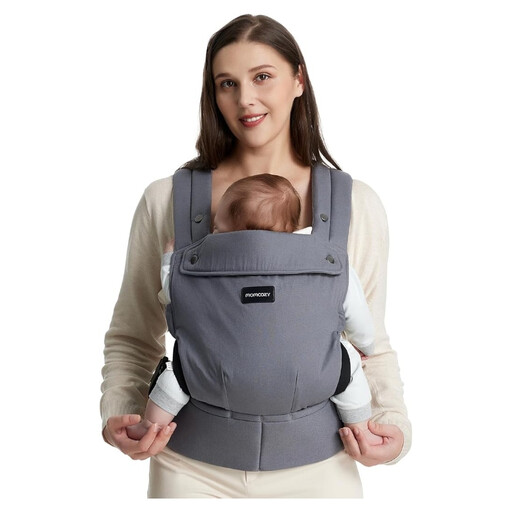
Why it suits this profile: A straightforward option for parents looking for a front carrier for everyday use, without extra accessories or complicated systems.
The product specifications state a weight range of around 3,18 to 19,96 kg, three adjustable positions, an M-shaped leg position and an adjustable neck support.
100% cotton, machine washable, front carry and a stated product weight of around 771 grams.
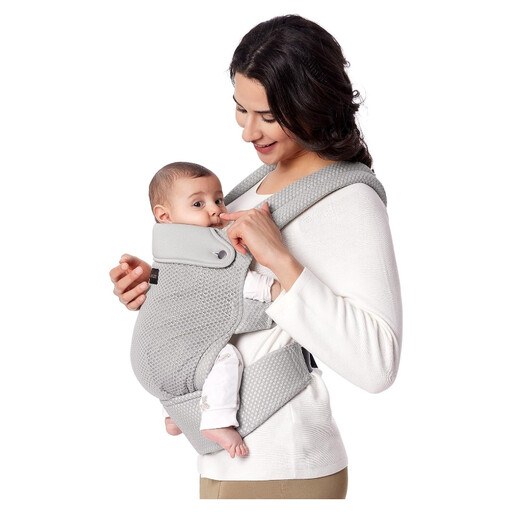
Why it suits this profile: Ideal for parents who value ventilation on warm days, while travelling or on longer walks.
The Air Mesh panels make the ventilation easy to assess. The product information also mentions an X-shaped back and built-in EVA waist support.
Air Mesh, cooling neck fabric, three adjustable positions and a stated carrying range of around 3,18 to 19,96 kg.
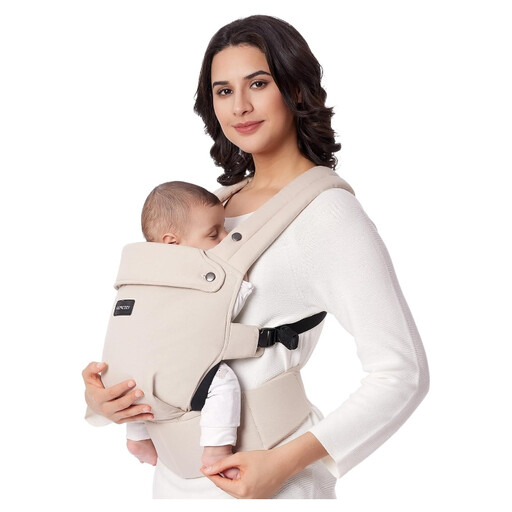
Why it suits this profile: A cotton carrier for parents who regularly want to carry hands-free while shopping, on days out and when travelling.
The description mentions an X-shaped back, padded adjustable straps, EVA waist support and three positions to accommodate your baby as they grow into a toddler.
100% cotton, machine washable, an M-shaped leg position, front carry and support for around 3,18 to 19,96 kg.
We’ve put together a complete, up-to-date list of products that meet these strict selection criteria and the current European safety regulations.
It varies by model. The Momcozy carriers discussed here have a stated minimum weight of around 3,18 kg. Also check whether your baby can support their head independently, and follow the instructions.
Your baby’s knees should sit higher than their bottom, and their legs should not hang straight down. They should be sitting upright, with their face visible and their airway clear. Check the fit again as your baby grows, or if another adult uses the carrier.
How long it lasts depends on the material, how often it is used and your child’s weight. A carrier with a weight range up to around 20 kg can support your child through several stages of development, but check the buckles, seams and straps regularly. Replace the carrier if you notice damage, wear or a fastening that no longer feels secure.
