
Vandaag of morgen in huis

Kwaliteit gegarandeerd

Welkomstaanbiedingen ontgrendelen: GRATIS bezorging | Tot 80% korting | Gratis 30 dagen JoyPlus-proefperiode
Download de app
Keeping your baby close is practical when you’re out for a walk, travelling by train or getting on with household tasks. But in practice, a baby carrier can sometimes disappoint. A strap digs in, your baby slips down or the carrier becomes too small after a few months. If you only look at the colour or a low price, you may miss the features that make a difference to everyday use.
So pay particular attention to these three common pitfalls:
Don’t just look for “baby carrier from 3 months”. Check the minimum and maximum weight in kilograms, and read the instructions for the precise limits of use. According to the product information, several models in this selection are suitable for approximately 3.2 to 20 kg, or around 3 to 24 months.
A carrier for 3 to 20 kg is only practical if the seat, shoulder straps and waist belt can be adjusted properly. Also consider your baby’s development. If a model isn’t suitable for a child who can’t yet support their head unaided, you mustn’t use it based on weight alone.
The ergonomic M-position means that the knees sit higher than the bottom. The product descriptions for the selected Momcozy models mention this leg position as part of the design. This is a product specification, not a guarantee of a medical outcome.
Every time you use the carrier, check that:
A baby carrier isn’t protective equipment in the event of a fall. Don’t use one while cycling, running, cooking over an open flame or doing other activities that involve a risk of falling or burns.
A breathable mesh carrier can be comfortable in warm weather. According to the product information, the Momcozy Breathable Mesh models use Air Mesh and cooling fabric around the neck. Some parents find a cotton carrier more comfortable, and it’s suitable for everyday use, but it may feel warmer than mesh.
A carrier with lumbar support may distribute weight more evenly across your waist, shoulders and back. Look for specific features such as an EVA hip support, X-shaped back straps and padded shoulder straps. A lightweight carrier weighing around 771 grams can be useful for travelling, but a good fit matters more than a small difference in product weight.
Being machine washable is practical for everyday use. Always follow the care label, and check the seams, buckles and straps after washing before using the carrier again.
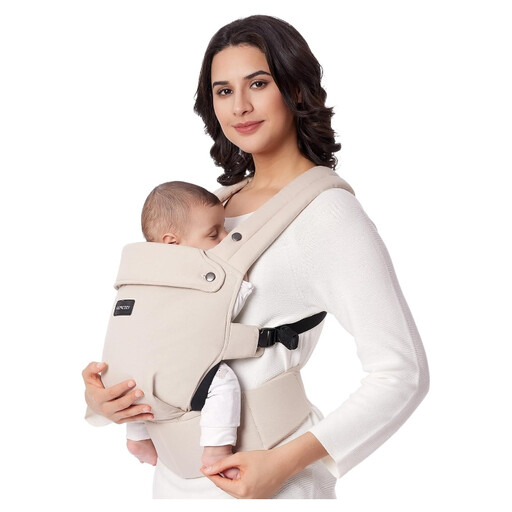
Why it suits this profile: According to the product information, this front-carrying model is suitable for approximately 3.18 to 19.96 kg and has three adjustable positions. It’s a straightforward option for parents looking for their first baby carrier.
The description specifies a padded leg opening, adjustable straps and a foldable neck support, rather than making only a general claim about being ergonomic.
100% cotton according to the product information, machine washable, X-shaped back straps and EVA waist support.
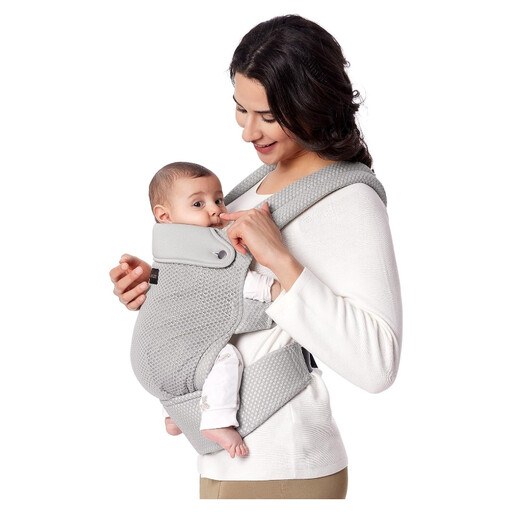
Why it suits this profile: If you’re often outdoors or use a carrier when travelling, you may appreciate the Air Mesh panels and cooling neck fabric described. The model is designed for approximately 3.2 to 20 kg.
The ventilation is linked to a specific material: Air Mesh. The product information also mentions an X-shaped back and built-in EVA lumbar support.
Mesh construction, machine washable, three adjustable positions and a stated carrying range of up to around 20 kg.
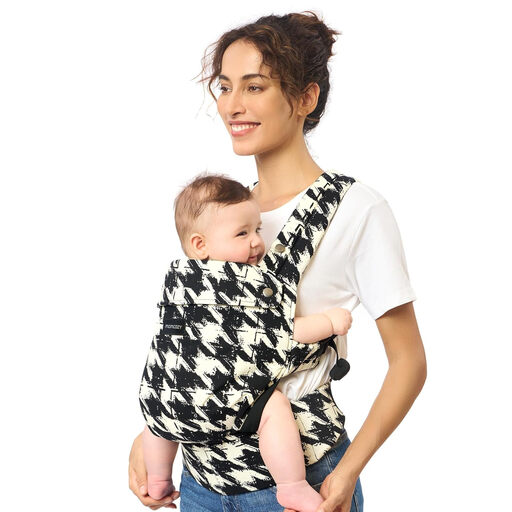
Why it suits this profile: This model is aimed at parents who use a carrier frequently and value clear information about the materials. The description specifies 100% OEKO-TEX Standard 100-certified cotton, a wide seat and cross-back straps.
The product details cover the material, fastenings, carrying positions, weight and care. This lets you assess whether it suits everyday use, rather than judging it by the print alone.
100% cotton, machine washable, cross-back straps, a wide padded seat and a stated range of approximately 3.18 to 20 kg.
We’ve put together a complete, up-to-date list of products that meet these strict selection criteria and the applicable European safety requirements.
It depends on the model. Some carriers are suitable from birth, while others are intended for use from around 3 months, according to the product information. Always check the minimum weight, head support and whether your baby needs to be able to support their head unaided.
How long you can use it depends on the maximum weight, your child’s growth and the condition of the material. A model with a range of up to around 20 kg may suit your child through several stages of development, but check the buckles, seams, straps and fabric before every use. Stop using the carrier if it’s worn or damaged.
Not necessarily. “Machine washable” means it can be washed according to the care label. Drying instructions can vary between models. Only dry the carrier as directed, and don’t use it again until all the straps, buckles and seams are completely dry and in good condition.
