
Vandaag of morgen in huis

Kwaliteit gegarandeerd

Welkomstaanbiedingen ontgrendelen: GRATIS bezorging | Tot 80% korting | Gratis 30 dagen JoyPlus-proefperiode
Download de app
An ergonomic baby carrier can be useful when you’re out for a walk, doing the shopping or travelling on public transport. You’ll have your hands free while keeping your baby close. However, not every baby carrier is suitable for every age, body shape or situation.
Look out for these three common pitfalls:
A carrier for newborns should be explicitly listed as suitable from birth. Not every model with a low weight limit automatically provides enough head and neck support. So check:
According to the product information, the Chicco EasyFit is suitable from birth up to a maximum of 9 kg. It’s designed for carrying your baby facing towards you, and has a foldable upper section for extra support for younger babies. The Momcozy models in this selection are described as suitable for babies aged around 3 to 24 months and weighing 3,18 to 19,96 kg. They’re therefore not necessarily suitable for newborns.
In a carrier with an M-position, your baby’s knees sit higher than their bottom, with their thighs supported. Check that the seat is wide enough and adjustable to several positions. A seat that’s too narrow or not fitted correctly may leave your baby’s legs hanging straight down.
The product descriptions for the Momcozy carriers mention an M-shaped seat and C-shaped back support. Treat these as product features, not medical guarantees. According to the manufacturer, this design is intended to support the recommended position; correct adjustment and following the instructions remain essential.
A lightweight baby carrier is practical for everyday use, but it’s worth looking at how it’s made too. Key things to check include:
The Momcozy models weigh around 771 grams and are made from 100% cotton. The descriptions state that they’re machine washable and have an EVA lumbar panel and adjustable straps. These are features you can check if you’re often out and about or want to carry your baby hands-free every day.
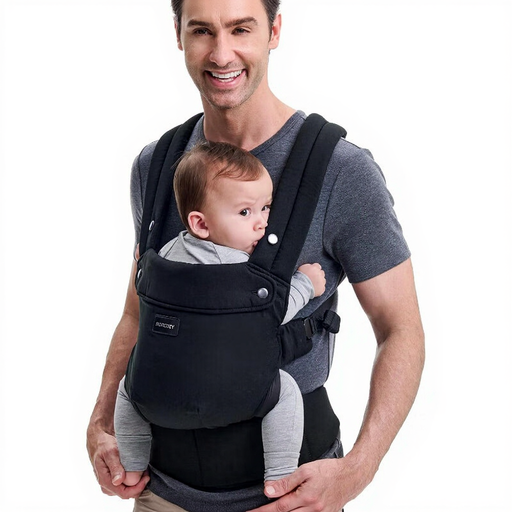
Why it suits this profile: A straightforward option for parents looking for a cotton baby carrier for everyday use, without unnecessary extra features.
The age and weight limits are clearly stated. This carrier isn’t intended for children who can’t yet hold their head up independently.
100% cotton, machine washable, around 771 grams, M-shaped seat and adjustable straps.
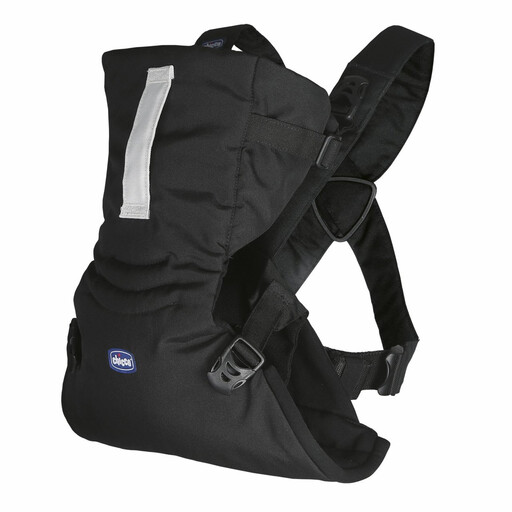
Why it suits this profile: Ideal for parents who want to carry their baby from birth and value an easy, T-shirt-style design.
The product information explicitly states that it can be used from 0 months up to 9 kg, and includes guidance on head support and keeping the airways clear.
T-shirt style, adjustable seat, M-position and machine washable at 30 °C according to the product information.
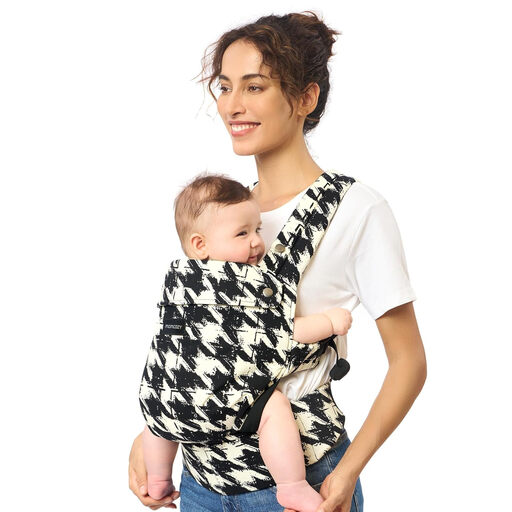
Why it suits this profile: A practical choice for parents who often go for walks, travel or want to carry their baby hands-free for longer periods.
The description mentions adjustable sizing, a wide padded seat, and checking the straps and buckles before every use.
100% OEKO-TEX Standard 100-certified cotton according to the product description, cross-back straps and lumbar support.
An ergonomic baby carrier only works well when it’s adjusted carefully. Before every use, check:
Don’t use the carrier while cycling, running, cooking over an open flame or doing anything else where you could fall. A baby carrier won’t protect your child in a fall or road traffic accident. Stop using it if you or your child experiences pain, pressure or discomfort.
We’ve put together a complete, up-to-date list of products that meet these strict selection criteria and the applicable European safety regulations.
It varies from one model to another. Some models are suitable from birth, while others should only be used from around 3 months. Always check the age and weight limits, as well as the instructions on head and neck support.
Its lifespan depends on use, washing and care. Check the fabric, buckles, straps and seams regularly. Replace the carrier if any parts are damaged, stretched or no longer adjust properly, even if the maximum weight limit hasn’t been reached.
Not necessarily. Lumbar support may make carrying more comfortable, but the overall fit matters more. First adjust the waist belt, shoulder straps and seat. Try the carrier on briefly at home before taking it on a longer walk or trip.
