
Vandaag of morgen in huis

Kwaliteit gegarandeerd

Welkomstaanbiedingen ontgrendelen: GRATIS bezorging | Tot 80% korting | Gratis 30 dagen JoyPlus-proefperiode
Download de app
An ergonomic baby carrier can be useful for a walk, a trip, household tasks or any time you want to keep your hands free. However, not every baby carrier is suitable for everyday use. A nice colour or low price tells you little about the fit, adjustability and safety of use.
Pay particular attention to these three common pitfalls:
Don’t rely on the age guidance alone. Always check the minimum and maximum weight in the product information and user manual. Several models in this guide are designed for around 3.18 to 19.96 kg, which is approximately 3 to 20 kg. The stated age range is usually around 3 to 24 months.
A carrier for babies weighing 3 to 20 kg is only practical if the seat and straps can be adjusted properly as your child grows. Three adjustment positions can help with this. Once the carrier is on, check that your baby is upright and close to your body, with their face visible and airway clear.
In a carrier with an M-position, your baby’s knees sit higher than their bottom, with their legs supported rather than hanging straight down. The exact adjustment depends on your baby’s age and build, as well as the manufacturer’s instructions. Don’t use a carrier for a baby who cannot yet support their own head unless the manual specifically describes a suitable newborn configuration.
A wide, padded leg opening can make the carrier more comfortable. Also check that the neck and head support can be used correctly. The M-position is no reason to skip other safety checks.
A breathable baby carrier with Air Mesh panels can be comfortable on warm days or when travelling. Many people find a cotton baby carrier soft to the touch, and it is often machine washable. Cotton and mesh have different properties: mesh is designed to support air circulation, while cotton is often chosen for how it feels and how easy it is to care for.
For longer walks, a baby carrier with lumbar support or an EVA waist panel can help distribute the weight more evenly across your torso. This doesn’t guarantee that you won’t get backache. Adjust the shoulder straps and waist belt carefully, and stop using the carrier if you feel pain or discomfort.
Use this quick checklist before you order:
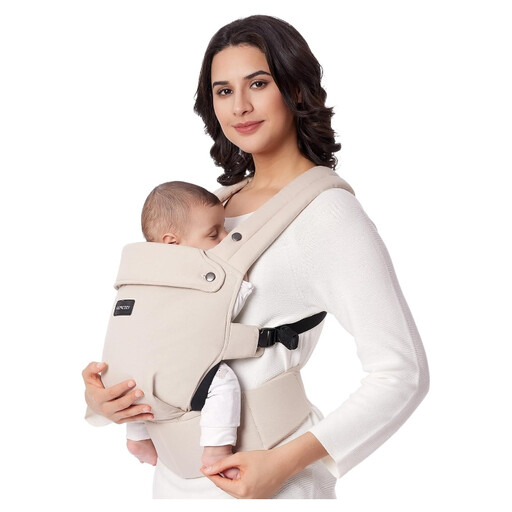
Why it suits this profile: This model combines a 100% cotton construction with three adjustment positions and a recommended weight range of 3.18 to 19.96 kg. That makes it a straightforward choice for parents buying a carrier for the first time.
The product specifications state the carrier’s weight, maximum carrying weight and whether it is machine washable. So you don’t have to rely on promotional copy alone.
100% cotton, EVA lumbar support, padded leg openings and front carrying position.
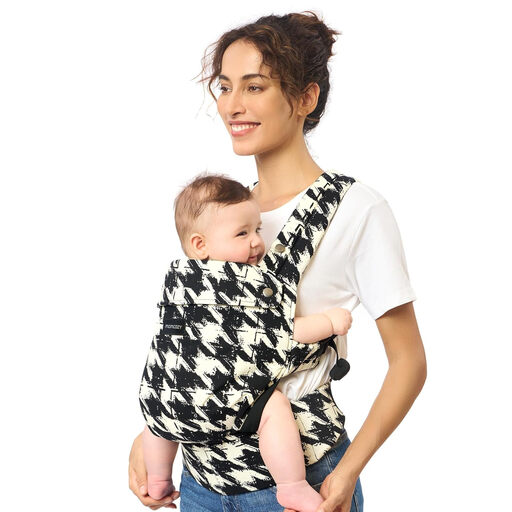
Why it suits this profile: According to the product information, its OEKO-TEX Standard 100-certified cotton, X-shaped back straps and wide seat make it a good fit for parents who consider material and construction details when choosing a carrier.
The product information clearly states the material certification, size, front carrying position and weight range of 3.18 to 20 kg.
OEKO-TEX Standard 100 certification according to the product description, cross-back straps and machine-washable cotton.
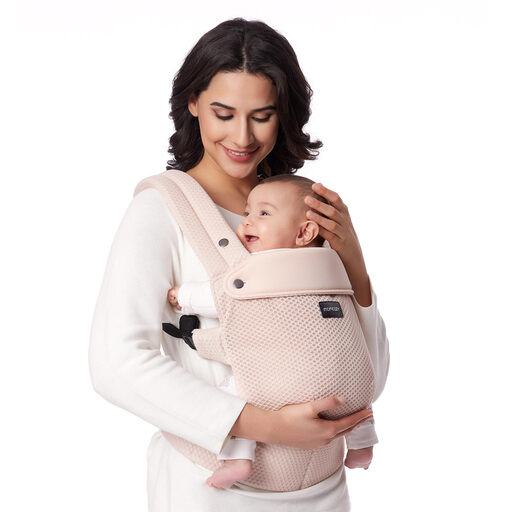
Why it suits this profile: According to the product description, Air Mesh panels and cooling neck-contact fabric are designed to support air circulation. This may make it a good choice for summer outings, travel and active everyday use.
The model features Air Mesh, weighs approximately 771 g, has three adjustment positions and suits babies weighing around 3.18 to 19.96 kg.
Breathable mesh, built-in EVA lumbar support, X-shaped back straps and a machine-washable design.
We’ve put together a complete, up-to-date list of products that meet these strict selection criteria and the applicable European safety requirements.
Before each use, check the buckles, straps, seams and fabric. Don’t use the carrier if any parts are damaged, worn or missing. Listen for the click when fastening the buckles, then check that they are securely fastened.
Keep your baby’s face visible and their airway clear. Your baby should be upright and close to your body. Don’t use the carrier while cycling, running, cooking over an open flame or doing other activities where there is a risk of falling or burns. A baby carrier does not protect your baby in an accident.
It varies by model. According to their product information, the models listed usually have a minimum weight of around 3.18 kg. Also check that your baby can support their own head, and follow the user manual.
Its lifespan depends on how it’s used, washed and stored. Check regularly for fraying, loose stitching, discoloured or stretched straps, and buckles that don’t close properly. Replace the carrier if you notice any damage or if it can no longer be adjusted to fit safely.
A lighter carrier can be more comfortable to wear, but comfort also depends on the waist belt, shoulder straps, fit and your child’s weight. Adjust the straps a little at a time, and take a break as soon as you or your baby feels uncomfortable.
