
Vandaag of morgen in huis

Kwaliteit gegarandeerd

Welkomstaanbiedingen ontgrendelen: GRATIS bezorging | Tot 80% korting | Gratis 30 dagen JoyPlus-proefperiode
Download de app
An ergonomic baby carrier can be useful for short walks, shopping trips, travelling and any time you want to keep your hands free. However, not every baby carrier is equally practical. An adjustable strap, for example, is of little use if the carrier doesn’t fit properly, while “lightweight” doesn’t automatically mean it will stay comfortable to wear.
By Joybuy Product Recommendation Officer
A baby and toddler carrier is often advertised as suitable for a wide weight range, such as 3.2 to 20 kg. That doesn’t mean every baby will be properly supported at every stage. Also check the minimum age, whether your child can lift their head independently and whether the carrier can be adjusted correctly according to the instructions.
The selected Momcozy models have a stated range of around 3.18 to 19.96 kg and are for use from around 3 to 24 months. Always follow the user manual.
The term ‘ergonomic’ only tells you so much: you need to look at the design. Check for:
According to Momcozy’s product information, several models are designed with an M-shaped leg position and C-shaped back support. This describes the product design; it is not a guarantee of any medical or physical benefit.
A cotton baby carrier can feel soft and is often suitable for everyday use. A breathable baby carrier with mesh panels may be a more practical choice in warm weather or when you’ll be out for longer. However, mesh may feel different from cotton and, like any other material, should be checked for wear and tear.
Also consider the weight of the carrier itself. The Momcozy carriers listed weigh around 760 to 771 grams. That puts them in the lightweight carrier category, but overall comfort also depends on how the weight is distributed across your shoulders, back and hips.
If you’re looking for a carrier for 3.2 to 20 kg, don’t compare only the figures in the product title. Check that the model is suitable for your baby’s age and whether it is designed for front carrying only. According to the product information, the Momcozy models mentioned in this article are intended for front carrying.
A carrier for newborns also needs to provide different support from a model for a baby who can already lift their head independently. Don’t use a model outside its stated weight limits.
A carrier with lumbar support can help distribute the weight more evenly across your body. Check how the waist belt fastens, how much room the shoulder straps offer and whether you can adjust the straps yourself.
An X-shaped or cross-back design may distribute weight differently from straight shoulder straps. According to the product descriptions, several of the selected Momcozy models have an X-shaped back, EVA lumbar support and padded leg openings.
A cotton baby carrier is a practical choice if you’re looking for a machine-washable material. According to the product information, the Momcozy cotton models are made from 100% cotton and are machine washable.
A mesh model is worth considering for summer days, travelling or household tasks that are likely to make you feel warmer. According to the product descriptions, the mesh versions in this selection have Air Mesh panels and cooling fabric around the neck. These details come from the brand’s information, so consider which fabric feels comfortable for you and your child.
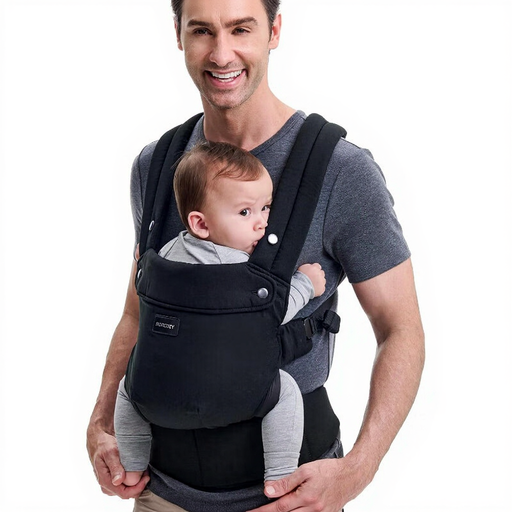
Why it suits this profile: A straightforward model for everyday use, with front carrying, adjustable straps and a stated weight range of around 3.18 to 19.96 kg.
The product information gives specific weight limits, an M-shaped leg position, an adjustable design and machine-washable fabric.
100% cotton according to the product description; EVA lumbar support; weighs around 771 grams.
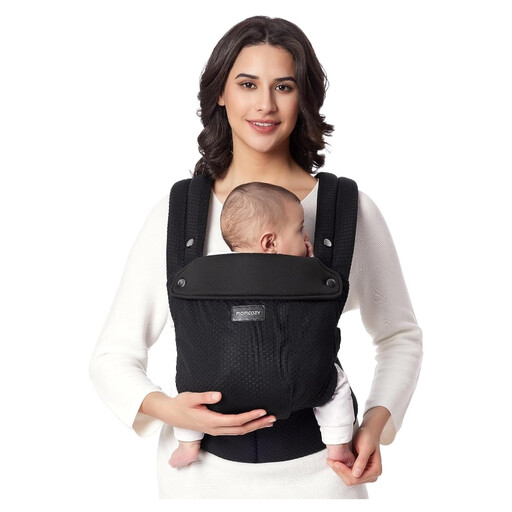
Why it suits this profile: A good option if you want to compare materials, adjustability and support carefully for everyday carrying and outings.
The specifications list Air Mesh, three adjustment positions, a weight range of around 3.18 to 19.96 kg and machine-washable fabric.
Breathable mesh panels according to the product information; X-shaped back; built-in EVA lumbar support.
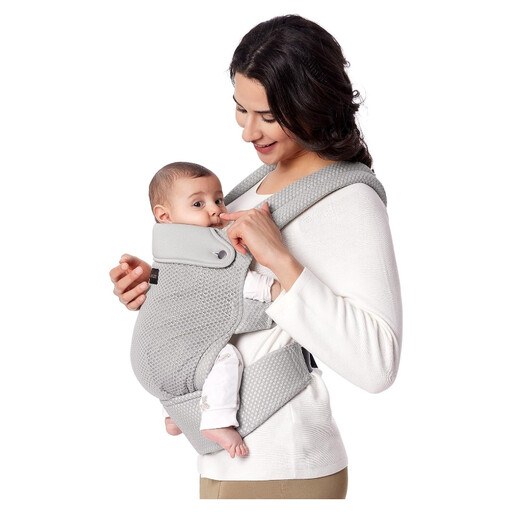
Why it suits this profile: Practical for days out and travelling, especially if you’re looking for a lightweight carrier with a more breathable fabric and hands-free convenience.
The manufacturer lists an adjustable fit with three positions, padded leg openings and safety instructions you can check.
Air Mesh and cooling neck fabric according to the product description; front carrying; around 771 grams.
Before each use, check the buckles, seams, straps and fabric. Fasten every buckle fully and make sure it is secure. Your baby’s face must remain visible and their airway must not be covered. Adjust the carrier so your child sits upright and close to your body, with the fabric clear of their nose and mouth.
Do not use the carrier while cycling, running, cooking over an open flame or doing other activities that involve a risk of falling or burning. The product does not provide protection in a car accident or from a fall. Stop if you feel pain or discomfort and check the fit again. If you’re unsure about the age, position or suitability, consult the manual or a healthcare professional.
We’ve put together a complete, up-to-date list of products that meet these strict selection criteria and the current European safety regulations.
It varies by model. According to the product information, the carriers mentioned are suitable from around 3.18 kg, but age and head control are important too. Don’t use the model before the stated minimum age, and follow the user manual.
The selected models have a stated maximum weight of around 19.96 kg and are intended for use from around 3 to 24 months. In practice, how long you can use one depends on your child’s growth, the fit and your own comfort while carrying. A carrier that is too heavy or poorly adjusted may become impractical before your child reaches the maximum weight.
A breathable carrier can be useful for travelling, walking and warm days. However, consider airflow, adjustability, how easy it is to pack away and the carrier’s weight. For longer journeys, a carrier with lumbar support and well-distributed straps is often more practical than one that is simply compact.
