
Vandaag of morgen in huis

Kwaliteit gegarandeerd

Welkomstaanbiedingen ontgrendelen: GRATIS bezorging | Tot 80% korting | Gratis 30 dagen JoyPlus-proefperiode
Download de app
Neat error correction without a sheet of paper covered in eraser dust: that’s the main advantage of erasable gel pens. They’re popular with school pupils, university students, planners, office professionals and anyone who regularly amends their notes. Yet not every erasable ballpoint pen is suitable for every use.
The biggest mistakes usually come down to three things:
The nib size determines how compact and controlled your writing is.
A needle point gives a precise line. A bullet tip often feels rounder. So check not just the millimetres, but also the type of nib.
If you write a lot, a gel pen set with several identical pens is a good idea. A black erasable pen is practical for business notes and forms. A blue erasable pen works well for schoolwork, planning and everyday use.
When looking at a set, check:
A pack of six pens might look appealing, but check whether it’s six of the same colour or a mixed set.
Erasable ink is handy for rough work, planning, homework and personal notes. For documents that need to last a long time, such as signed forms, official records or important archives, ordinary permanent ink is usually wiser. The heat-sensitive property can, in certain conditions, affect the visibility of the text.
Use the eraser on the back with controlled pressure. Rubbing too hard can damage paper, even if the product description says corrections are possible without paper damage. This is a claim by the brand and not a guarantee for every paper type or writing situation.
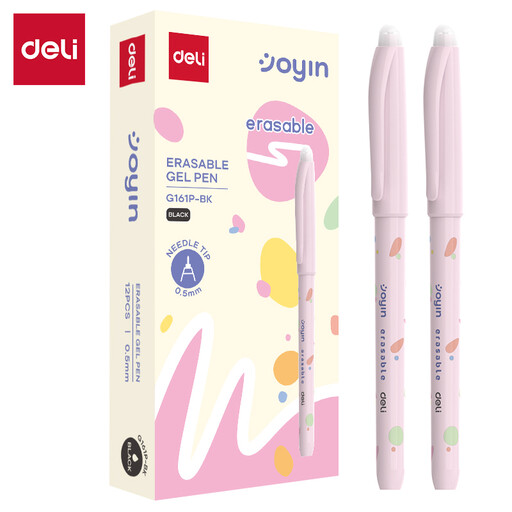
Why this fits the profile: A pack of 12 black pens is practical for home, school, a shared workspace or a pencil case with a spare supply.
The product specification mentions a 0.5 mm needle point and black ink, so you can check the two most important selection criteria in advance.
12 pieces, black colour and a 0.5 mm needle point according to the product name.

Why this fits the profile: For anyone who writes a lot and values a grip, a cap and a consistent black colour, this version is neatly put together.
The description mentions a soft grip, protective cap and quick-drying, heat-sensitive gel ink. This helps with control and reducing smudging, according to the manufacturer.
0.5 mm needle point, black ink, soft grip and 12 pens according to the product specification.
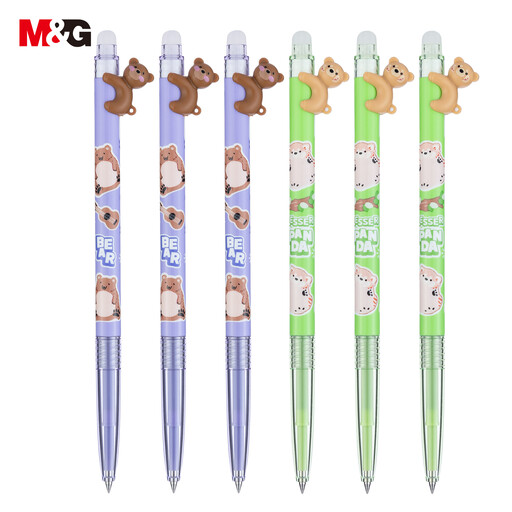
Why this fits the profile: The fine nib is aimed at small, neat notes. The animal design and clip suit planners, journaling and school use.
The 0.4 mm nib is clearly stated. This means the set is aimed at precision work rather than a broader 0.7 mm line.
6 blue pens, 0.4 mm nib, comfort grip and a bear-shaped clip according to the product description.
A gel pen with an eraser is suitable when you want a clear coloured line and regularly correct text. A mechanical pencil is better for sketching, maths, technical drawing and work where line thickness or erasability matters more than colour.
The M&G set with 1.8 mm 2B lead contains, according to the product name, 12 pencils, refills and erasers. Check out the mechanical pencils set if you use drawing or sketching paper alongside erasable pens.
We’ve put together a full, up-to-date list of products that fully meet these strict selection criteria and comply with current European safety regulations.
That’s usually not advisable. Heat-sensitive ink can become less visible under certain conditions. For contracts, official forms and archive documents, it’s better to use permanent ink, unless the recipient explicitly allows otherwise.
The lifespan depends on writing frequency, nib size, paper and storage. A set with several pens prevents you from running out. With capped models, it’s important to close the pen properly after use. With click pens, you can retract the nib to help prevent drying out.
For small boxes and compact diaries, 0.4 mm can offer more control. 0.5 mm is a practical middle ground for school, office and everyday writing. Choose 0.7 mm if you prefer a bolder line. The right choice depends on your handwriting, paper and the amount of space you’re writing in.
