Who is this suitable for?

Practising alternating strokes

Your main focus is practising left–right strokes and timing. In that case, a usable playing surface and a metronome may matter more than an elaborate kit layout. The Percussive Arts Society recommends practising rudiments at a steady tempo, or moving from slow to fast and back again.

Players with limited floor space

You want to know whether the complete playing setup will fit. So don’t just compare the unit or its packaging dimensions: allow space for a stool, pedals and your playing movements too.

Kit players practising at home

You also want to use pedals and cymbals, and need to consider noise in the home. Headphones change the sound of the electronic playback, but they won’t make the sound of strokes and pedal movements inaudible.

What should you consider when choosing?

First decide whether you’ll mainly be practising hand technique or also need foot coordination and transitions between parts of the kit. Then measure the space needed for the complete setup, not just the dimensions of the drum kit itself.

What to consider What should you check? Who is this important for?
Playing feel and timing Check the snare type and whether the exact model has a metronome or coaching features. Yamaha lists eight velocity-sensitive pads and a metronome for the DD-75; Roland lists metronome and coaching features for the TD-02 module. If my main focus is practising left–right strokes and timing, I want a suitable playing surface and tempo practice. This is a priority for around 36% of consumers whose main focus is hand technique.
Space needed to play Measure the available space and compare it with the assembled kit, including room for a stool, your feet and movement. Don’t use the packaging dimensions as a guide to the space needed for the setup. If I have limited floor space, I want to know whether the full setup will fit and still be comfortable to play. Fit is the main priority for around 29% of consumers.
Noise at home Check which type of kick pedal is included, and bear in mind that strokes and pedal movements may still be audible even when you’re wearing headphones. If I practise at home with housemates or neighbours nearby, I want to take the noise in the room into account. Noise at home is the main priority for around 21% of consumers.
Kit layout and foot coordination Check which pedals are actually included and whether the model uses a trigger pedal or has a separate kick pad with a pedal. If I practise footwork and transitions between parts of the kit as well as hand alternation, I need different components from someone who only needs a playing surface. Full-kit coordination is the main priority for around 14% of consumers.

Common buying mistakes

  • Confusing the packaging dimensions with the space needed to play

    The dimensions of a box don’t tell you how much room an assembled kit needs. The Fazley DDK-040 product listing gives the packaging dimensions, while Yamaha gives an average footprint for the DTX402 series.

    Compare dimensions that refer to the same thing, and allow room for your stool, pedals and arms too.

    You may need a different setup or stand if the available space doesn’t suit your playing position.

  • Assuming all kick pedals work and sound the same

    A kick trigger pedal isn’t the same as a pedal with a separate kick pad. Headphones also don’t tell you how much of the sound of strokes and pedal movements will be audible in the room.

    Choose the pedal type to suit the exercises you’ll be doing, and consider the noise in the room if you’ll be playing at home. The Dutch government advises people experiencing noise nuisance to speak to their neighbours and agree arrangements.

    If your chosen exercises require a different pedal type, you may need a different kick setup.

  • Assuming the Fazley DDK-040’s kick setup based on a single description

    The product page and manual describe the included kick setup differently. This difference may affect your footwork and the floor space you need.

    If the kick pedal type is a deciding factor, ask the retailer to confirm exactly which version is included.

Brands to compare

Yamaha

Worth considering if you want to compare a tabletop model such as the DD-75 with a rack kit from the DTX402 series.

  • Yamaha lists eight velocity-sensitive pads, two pedals and a metronome for the DD-75. The unit measures 602 × 411 mm.
  • The unit’s dimensions don’t represent the full playing space. Yamaha lists an average footprint of 800 × 1000 mm for the DTX402 series; these measurements describe different setups.

Roland

Worth considering if you’re looking at a compact rack kit, such as the TD-02K or the TD-02KV with its mesh snare.

  • According to Roland, both models share the TD-02 module, which has a metronome and coaching features. The TD-02K has a rubber PD-4 snare; the TD-02KV has a mesh PDX-8 snare.
  • The distance between the stand’s legs doesn’t give the full setup dimensions. Remember to allow space for your stool and playing movements too.

Alesis

Worth considering if you’re looking for a rack kit with a mesh snare and a separate kick pad with pedal, such as the Nitro Max.

  • Alesis lists a 10-inch dual-zone mesh snare and a kick pad with pedal for the Nitro Max.
  • Alesis estimates the assembled kit’s footprint at around 4 × 3 feet, depending on the layout. This is the manufacturer’s estimate for this model, not a fixed minimum size for every player.

NUX

Worth considering as an alternative with mesh pads and a separate kick drum, such as the DM-210.

  • NUX lists mesh pads and a coaching function for the DM-210.
  • NUX gives 1,5 m² as the space required. Check whether there’s also room for your stool and playing movements in that setup.

Fazley

Worth considering if you want to compare an entry-level rack kit such as the DDK-040.

  • Bax Music lists mesh heads on the snare and toms, and a metronome, for the DDK-040.
  • The stated packaging dimensions aren’t the footprint of the assembled kit. If your choice depends on it, also ask which kick pedal setup is included.

Products at Joybuy

This selection features a children’s drum kit with an electronic keyboard. Check that it suits your practice goals for alternating strokes and the space you have available.
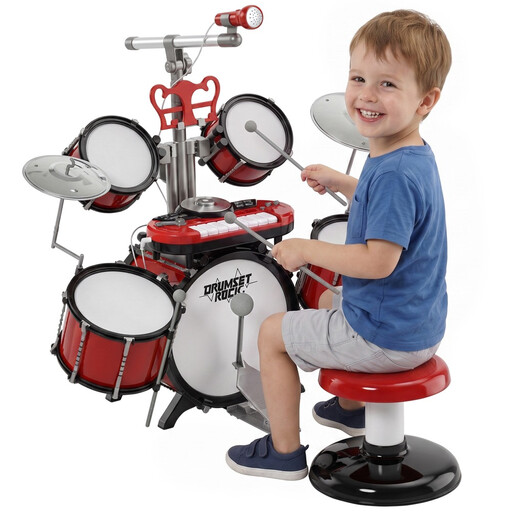
Children’s drum kit with electronic keyboard, stool and microphone, red

Children’s drum kit with electronic keyboard, T1003-01-19621

An option if you’re looking for a children’s drum kit with a keyboard; check that it suits your practice goals and available space.

The product name lists a stool and microphone, USB connectivity and dimensions of 77.5 × 40 × 76.5 cm. The stated colour is red.

View at Joybuy

Frequently asked questions

Which exercise is good for practising alternating strokes?

The single-stroke roll is a rudiment for practising alternating strokes. The Percussive Arts Society recommends playing rudiments from slow to fast and back again, or at a steady, moderate tempo. A metronome can help you keep a steady beat.

Can I put the Yamaha DD-75 on a stand?

Yes. Yamaha lists the separate SS740A and SS662 snare stands as options for the DD-75. If you need a stand, check before buying whether one is included.

Do headphones make drumming silent for the neighbours at any time?

No. Headphones won’t stop the sound of strokes and pedal movements being heard in the room. The Dutch government advises people experiencing noise nuisance to speak to their neighbours and agree arrangements, such as suitable times. This doesn’t mean there are set permitted drumming hours for every home.

What are my rights when buying online in the Netherlands?

According to ACM ConsuWijzer, online purchases generally come with a statutory cooling-off period of up to 14 days after delivery. You’re also entitled to a product that meets reasonable expectations when used normally; a commercial guarantee doesn’t replace your statutory rights.

What safety information should I check for an electronic drum kit?

Check the product information supplied with the specific model, and use an adapter intended for that model and the Dutch power supply. Ondernemersplein explains that electrical and electronic devices placed on the market must comply with the applicable European rules.
