
Vandaag of morgen in huis

Kwaliteit gegarandeerd

Welkomstaanbiedingen ontgrendelen: GRATIS bezorging | Tot 80% korting | Gratis 30 dagen JoyPlus-proefperiode
Download de app
An electric heater can quickly bring a bedroom, home office or study up to temperature. However, the difference between a handy portable heater and an impractical appliance often only becomes apparent after several weeks of use. A high wattage alone says little about comfort, noise or energy consumption.
So don’t just look for rapid heating and a low price. Check the controls, noise level, positioning and safety features too. Below, you’ll find what to look out for and which models suit different situations.
A 2000W heater will generally heat more powerfully than a 1500W heater, but it also uses more electricity when running continuously at full power. Actual consumption depends on how long you use it and the thermostat setting.
A simple calculation:
power in watts ÷ 1000 × number of hours used = kilowatt-hours
A 2000-watt heater running at full power for one hour theoretically uses 2 kWh. A thermostat or ECO mode can limit average consumption by preventing the heating element from operating continuously at maximum power. So a claim such as ‘up to 40% energy saving’ should be understood as a manufacturer’s claim under certain conditions, not as a guaranteed saving in every home.
A quiet electric heater with a fan will always make some noise because it moves air. Check whether the noise level is stated in dB and whether it refers to a range or a single measurement. For example, a stated level of 25–42 dB may vary depending on the setting.
According to the product description, a convector without a permanently running fan may operate more quietly, but it distributes heat differently from a ceramic fan heater. For a bedroom, a low noise level may be more important than an especially strong airflow.
A heater with tip-over protection and overheating protection will, according to the product description, switch off if it tips over or reaches excessive temperatures. That does not make an appliance suitable for use under a duvet, on bedding, close to curtains or in a damp room.
Always place an electric heater on a level, stable and hard surface. Maintain at least the distance specified in the instruction manual; several product descriptions mention at least one metre from flammable materials. Never cover the air inlet or outlet, and use a directly connected wall socket where required by the manufacturer.
A ceramic heater or ceramic fan heater uses a PTC ceramic heating element. The fan blows warm air into the room, so you feel heat quickly in a local area. This is well suited to a home office, workstation or smaller bedroom where direct heat is desirable.
A convector heats the air through natural convection. Some models have an additional fan, such as the Mill SG2000LED. This type is often larger and less easy to move, but may be suitable if you are looking for a permanent appliance for a living room or home office.
Look at the recommended floor area rather than just the wattage. The product specifications include the following guidelines:
These floor areas are indicative only. Ceiling height, draughts, insulation, windows and your desired temperature all have a significant impact on the result.
A heater with a thermostat can maintain the set temperature more effectively than an appliance with just an on/off switch. A heater with a timer is useful when you want the appliance to stop automatically after one to twelve hours. Some models offer a timer of up to 24 hours.
With oscillation, the heater turns from side to side horizontally. This spreads warm air over a wider area, but the function does not automatically increase the floor area being heated. A heater with a remote control or app control is particularly convenient when the appliance is next to your desk, sofa or bed.

Why it suits this profile: This compact model offers fan, 750W, 1500W and ECO modes. This allows you to start on a lower setting in a bedroom, study area or home office.
The four settings mean you do not have to heat exclusively at maximum power. The timer can be set from 1 to 12 hours. According to the product information, tip-over and overheating protection are included.
PTC ceramic element, LED display, remote control, oscillation and 1500W output.

Why it suits this profile: The stated thermostat can be adjusted from 5 to 35°C, and according to the product information, the model is intended for rooms measuring 15 to 25 m².
The noise level is stated as 25–42 dB, making it easy to compare. The product description also mentions a 12-hour timer and multiple safety features.
2000W PTC heating, 70° oscillation, remote control, child lock and CE marking listed in the product details.
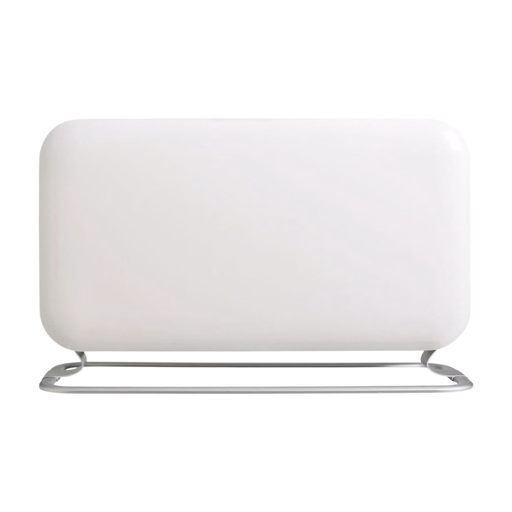
Why it suits this profile: According to the product information, this larger convector model is suitable for rooms of up to 20 m² and has an electronic thermostat and LED display.
The stated 2000W output, three settings and electronic thermostat provide more control than a basic model without temperature regulation. Bear in mind the fixed size and 5 kg weight.
Convector heating, fan for additional air distribution, LED display and a stated cable length of 160 cm.

Why it suits this profile: According to the product details, this compact heater has an output of up to 1500W, weighs 1.51 kg and is intended for rooms of up to 15 m².
The two stated power settings of 600W and 1500W allow you to adjust the output to suit the situation. The product information also lists tip-over and overheating protection.
Compact design, carrying handle, five modes according to the product description and a stated noise level of 24 dB(A).
We’ve put together a complete, up-to-date list of products that fully meet these strict selection criteria and the applicable European safety regulations.
It can be, provided the model is suitable for the room and positioned correctly. Ideally, choose a heater with a thermostat, timer, tip-over protection and overheating protection. Also check the stated noise level. Do not place the appliance on a bed, under blankets or close to curtains.
This depends on the output and your electricity tariff. A 1500W heater theoretically uses 1.5 kWh per hour at full power, while a 2000W model uses 2 kWh. Multiply this by your current price per kWh. In practice, a thermostat can reduce average consumption by switching the heating off periodically.
A ceramic element does not automatically make a heater energy-efficient. Electric resistance heating converts most of the electricity into heat, but consumption is mainly determined by output, usage time, insulation and temperature setting. An ECO mode and thermostat can help prevent unnecessary heating at full power for too long.
