
Vandaag of morgen in huis

Kwaliteit gegarandeerd

Welkomstaanbiedingen ontgrendelen: GRATIS bezorging | Tot 80% korting | Gratis 30 dagen JoyPlus-proefperiode
Download de app
An electric heater may seem straightforward to choose: check the wattage, pick a model that looks good and you’re done. In practice, problems often arise because the room has been assessed incorrectly, essential safety features are missing or the controls do not suit your everyday needs.
A compact 2,000-watt heater can produce heat quickly, but at full power it also uses more electricity than a 1,000-watt model. A quiet ceramic heater is ideal for the bedroom, while a convection heater is better suited to gradually warming a larger room. Below, we cover the most important considerations and some popular options for different uses.
A higher wattage does not automatically mean that a heater is suitable for every room. Also check the stated room capacity, the room’s insulation and how the heat is distributed. A fan heater warms the immediate area quickly, but a larger living room may benefit more from a convection heater or oil-filled radiator.
Also watch out for conflicting product information. If a product title states 2,000 watts but the technical specification lists 1,500 watts, it is wise to check the current product page and manual before buying.
An electric heater converts electricity into heat, but consumption mainly depends on its power rating and how long it is used. An energy-efficient heater does not automatically use less electricity at the same wattage. A thermostat, ECO mode and timer can, however, help prevent unnecessary heating for too long.
Use this simple calculation:
consumption in kWh = power in kW × usage time in hours
A 2,000-watt heater uses a maximum of approximately 2 kWh after one hour of continuous use. Actual consumption may be lower when the thermostat switches off the heating element.
A heater with tip-over protection switches off if the appliance falls over. A heater with overheat protection stops operating if the temperature becomes too high. These features are useful, but they do not replace safe usage.
Place a heater on a stable, dry surface and keep textiles, curtains, bedding and furniture at a safe distance. Never cover the appliance, and connect a powerful model directly to a suitable wall socket wherever possible. Only use a bathroom heater if the model is designed for this purpose and the safety instructions permit it.
A ceramic heater or ceramic fan heater uses a PTC heating element and a fan. This type generally delivers noticeable warmth quickly and is suitable for a workspace, bedroom or seating area. Oscillation helps distribute the warm air more widely.
An electric fan heater is compact and portable, but the fan noise can be disruptive. Check the stated noise level if you plan to use the heater at night or while working.
A convection heater warms the air, which then circulates around the room. This is generally quieter when the fan is not in use. An oil-filled radiator heats up more gradually and continues to give off heat for some time after being switched off. Its heavier design makes it less suitable if you need to move the heater between rooms frequently.
Do not just look at 1,000, 1,500 or 2,000 watts. Compare the power rating with the stated floor area:
The room capacity stated in product descriptions is only an indication. Ceiling height, draughts, insulation and the desired temperature all have a significant effect on performance.
A heater with a thermostat can maintain the set temperature more effectively than a basic model with only on and off settings. A heater with a timer is useful when you want the heating to stop automatically after a set period. A remote control or app offers extra convenience, but check whether these features genuinely add value for you.
For a bedroom, a low noise level, dimmable display and automatic switch-off are often more important than exceptionally high heat output.

Why it suits this profile: A portable heater with straightforward settings for a bedroom, home office or small seating area.
The product description lists two power settings of 600 and 1,500 watts, so you do not always have to heat at maximum power.
According to the product information: 24 dB(A), tip-over and overheat protection, plus a handle despite its weight of 1.51 kg.

Why it suits this profile: For anyone who wants to combine rapid warmth, precise temperature control and remote operation.
According to the product information, the thermostat can be set from 5 to 35 °C, while the model also features a timer and oscillation.
According to DREO’s own information: 25–42 dB, 70° oscillation and multiple safety layers, including tip-over and overheat protection.

Why it suits this profile: A wall-mounted model for anyone looking for targeted heating and programmable scheduling in the bathroom.
The product specification lists IPX2, wall mounting and a built-in towel rail. Always check the installation and bathroom instructions.
Two settings of 1,400 and 2,000 watts, a thermostat from 10 to 49 °C and a programmable weekly timer.
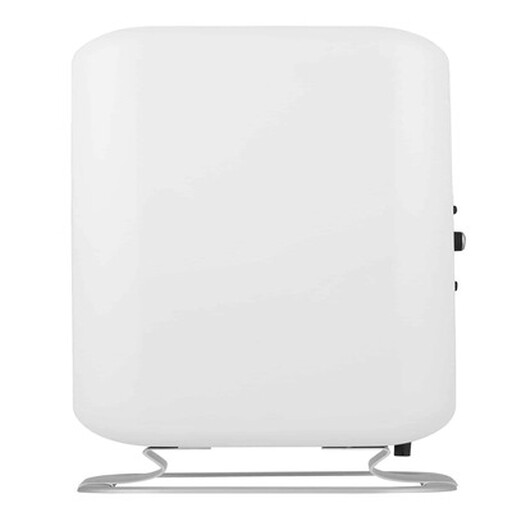
Why it suits this profile: For anyone looking for quiet, even supplementary heating in a medium-sized room and who does not need to move the heater often.
Its lower maximum power of 1,000 watts helps prevent you from automatically choosing a 2,000-watt model for a room that mainly needs extended supplementary heating.
Three settings of 400, 600 and 1,000 watts, an electronic thermostat and a day-and-night program. According to the specification, the model weighs 9 kg.
We’ve put together a complete, up-to-date list of products that fully meet these strict selection criteria and the applicable European safety regulations.
It depends on the floor area, insulation, ceiling height and desired temperature. Use the stated room capacity as a starting point and choose several heat settings if you want to adjust consumption more precisely. A compact model may be enough for localised supplementary heating.
The cost depends on the power rating, number of hours used and your electricity tariff. A thermostat, ECO mode and timer can reduce the number of hours spent operating at full power. Calculate the maximum consumption in advance using: power in kW × hours of use.
Only if the heater has been expressly designed for this purpose and the product specification states a suitable IP rating. A standard ceramic heater or oil-filled radiator should not be used in a damp room. Always follow the manufacturer’s instructions on clearances, installation and earthing.
