
Vandaag of morgen in huis

Kwaliteit gegarandeerd

Welkomstaanbiedingen ontgrendelen: GRATIS bezorging | Tot 80% korting | Gratis 30 dagen JoyPlus-proefperiode
Download de app
An electric food chopper can take over much of the chopping work in the kitchen. Onions, herbs, vegetables, nuts and sometimes meat can be processed more quickly than with a chef’s knife. However, not every model is suitable for the same quantities or ingredients. A compact mini chopper can be useful for pesto, dips and small portions, but become impractical when cooking for a family.
The product name does not always tell you exactly what you are getting, either. A “food chopper” may only chop, while a multifunctional food chopper can also mix, purée or grate. So pay particular attention to the technical specifications rather than relying solely on marketing terms.
A higher wattage does not automatically mean that a food chopper will process every ingredient better. The number of blades, the shape of the bowl, the pulse button and the permitted operating time also play a part. A 200-watt motor may be sufficient for soft vegetables and herbs in small portions. For nuts, meat or ice, a suitable blade and drive system is more important than wattage alone.
Also check the operating time. Some appliances may run for only 30 seconds at a time and must then cool down. This is normal for compact models, but inconvenient if you want to prepare several large portions one after another.
A 1-litre bowl does not always have a usable capacity of 1 litre. Manufacturers sometimes state the total capacity, while the practical filling capacity is lower. For example, the Philips HR1393/00 is listed with a 0.7-litre bowl and a usable volume of 0.5 litres.
Never fill a bowl above the maximum mark. Too many ingredients can result in uneven chopping, leakage or additional strain on the motor. For a household of one or two people, 400 to 600 ml is often sufficient. Families or keen home cooks will benefit more from 1 to 2.7 litres, depending on portion size.
With a dishwasher-safe food chopper, usually only the removable bowl, lid and blades are suitable for the dishwasher. The motor base, plug and cable must not be submerged. So check which parts can be removed and whether the material is suitable for dishwasher cycles.
A food chopper with a glass bowl is less likely to absorb odours and food colouring than some plastic bowls, but glass is heavier and can break if knocked hard or exposed to a sudden change in temperature. Allow the bowl to cool down before cleaning it with cold water.
For everyday chopping of onions, herbs and vegetables, models rated at around 200 to 500 watts are often practical. If you also want to process meat, hard vegetables, nuts or ice, consider a more powerful model with a suitable blade and safety system.
A single-speed model is easy to operate. Two speeds or a pulse function give you more control over the texture: use short pulses for coarse chopping and run it for longer for a finer result. More advanced models may have a control dial with several settings, but only if you will actually use that additional control.
A food chopper with stainless steel blades is suitable for many common preparations and easy to clean. Check how many blades the appliance has and whether they are removable. A four- or six-blade system can process ingredients from different directions, but the result also depends on the quantity and how you pre-cut the ingredients.
Cut large pieces into smaller ones first, for example into cubes of around 1 to 2.5 cm, depending on the instructions. Remove bones, stones and tough skins before using an electric food chopper. Only process hot liquids if the manufacturer expressly permits this; for several models, temperatures above 60 °C are not allowed.
Choose the capacity based on your usual portions:
A vegetable chopper with non-slip feet remains more stable on a smooth kitchen worktop. A lock that prevents the appliance from starting unless the lid is correctly fitted is a useful safety feature. Also read the instructions regarding cooling time, maximum filling level and cleaning the blades.
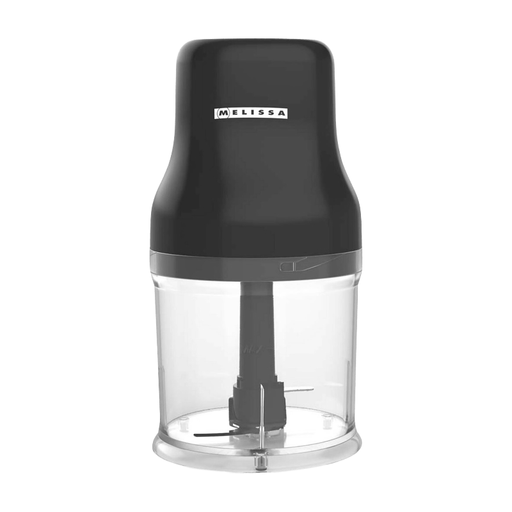
Why it suits this profile: This compact model is designed for small to medium-sized portions and has simple one-button operation.
The product information states a 500 ml bowl, a maximum power rating of 200 W and an operating time of up to 30 seconds per cycle. This makes expectations clear.
Two stainless steel blades, non-slip feet, and a dishwasher-safe bowl and blade set.
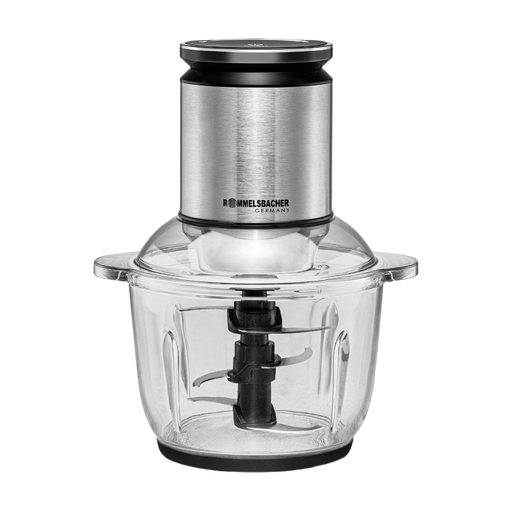
Why it suits this profile: The combination of a 2-litre glass bowl, 600 watts and 22 speed settings offers plenty of flexibility for keen home cooks.
The capacity, speed control and short operating time of up to 0.5 minutes are clearly stated. This helps when planning several portions.
Six stainless steel blades, a 2-litre glass bowl, overheating protection and dishwasher-safe removable parts.

Why it suits this profile: This appliance combines chopping, mixing, grinding, blending and slicing for users looking for one food processor to handle multiple tasks.
The product information specifies a maximum continuous cycle of 60 seconds and a two-minute cooling period for heavy loads. This makes the operating limits clear.
750 watts, 1.8-litre capacity, stainless steel blades and removable parts which, according to the product information, are dishwasher-safe.
We have compiled a complete, up-to-date list of products that fully meet these strict selection criteria and the applicable European safety regulations.
Place the appliance on a flat, dry surface and lock the bowl and lid in place before starting. Cut large ingredients into smaller pieces beforehand and use short pulses. This gives you greater control over the texture and reduces strain on the motor.
Always unplug the appliance before removing the blades or cleaning any parts. The blades of an electric food chopper are sharp; hold them by the plastic central section if the instructions permit this. Clean the motor base only with a slightly damp cloth.
Power consumption per preparation is usually limited because a food chopper only runs for a short time. A 500-watt model used for one minute theoretically consumes around 0.008 kWh. Actual consumption depends on the operating time and the power used during preparation.
You can with models whose product information lists meat as a suitable application. Remove bones and cut the meat into small pieces. Clean the bowl, lid and blades immediately after use to minimise the transfer of odours and flavours.
Its lifespan depends on how often it is used, how it is cleaned and whether the maximum operating time is followed. Overloading, overfilling the bowl and insufficient cooling can place additional strain on the motor and coupling. Also check the statutory guarantee and any manufacturer’s warranty; several of the models mentioned come with at least two years of statutory guarantee in the EU.
A glass bowl is generally less prone to discolouration and absorbing odours. On the other hand, glass is heavier and more fragile. Plastic is often lighter and more convenient for everyday use. Above all, check the capacity, maximum filling level and cleaning instructions for the specific model.
