
Vandaag of morgen in huis

Kwaliteit gegarandeerd

Welkomstaanbiedingen ontgrendelen: GRATIS bezorging | Tot 80% korting | Gratis 30 dagen JoyPlus-proefperiode
Download de app
An electric tyre inflator is handy for motorists, cyclists, motorcyclists and outdoor enthusiasts. Keep a portable tyre pump in your car, cycle bag or rucksack and you won’t have to search for a petrol station with a working air compressor.
However, many models look alike without offering the same features. A compact pump for an air bed, for example, isn’t suitable for a car tyre. And a rating such as 150 PSI doesn’t automatically mean a pump can inflate a flat car tyre quickly. Use the following checks to avoid making the wrong choice.
A maximum pressure of 150 PSI sounds impressive, but it’s mainly an upper limit. The recommended tyre pressure for a car is usually much lower. Inflation speed, airflow, running time and motor cooling are more important.
So don’t just check the maximum pressure. Also see whether the manufacturer provides information about:
Some compact models move a lot of air but don’t produce much pressure. The Baseus PocketGo, for example, lists a pressure of 3,5 kPa, equivalent to around 0.5 PSI. According to the product information, this model is designed for low-pressure applications such as air beds, inflatable toys and certain small inflatables. It isn’t suitable as a compressor for car tyres.
For a car, motorbike or road bike, you need a high-pressure pump. Always check the pressure range and valve type before ordering.
A cordless tyre inflator is convenient at the roadside, but a flat battery leaves you with an unusable device. Check the battery capacity, charging time, charging port and the number of tyres the product description says it can inflate on a single charge.
A 12V model with a cable may be more practical for motorists inflating several tyres. A rechargeable tyre inflator is especially useful when you don’t have access to a mains socket or 12V power outlet.
A tyre inflator with a digital pressure gauge shows the set or measured pressure on a display. Check which units are available: PSI, bar and kPa are all used in the Netherlands, but bar is the most practical option for many motorists.
A tyre inflator with automatic shut-off stops when it reaches the set pressure. This reduces the risk of overinflating the tyre, but after use, check the pressure with a separate gauge if it’s important for your vehicle. Always use the recommended pressure in your car, motorbike or bike manual.
A suitable electric tyre inflator must fit the valve for your intended use:
A model with several adapters is more versatile, but check that they fit securely. Air escaping from the valve makes the pump slower and can affect the pressure reading.
A small pump is easy to carry, but a compact size often means a smaller motor and battery too. Check the following:
A car tyre inflator for occasional top-ups doesn’t need the same capacity as a model for several cars, motorbikes or bikes. For intensive use, a larger model with better cooling is usually the more sensible choice.
The selection below is based on the listed product specifications. Inflation speeds, running times and compatibility details come from the relevant brands’ product information and may vary depending on tyre type, pressure, temperature and battery level.
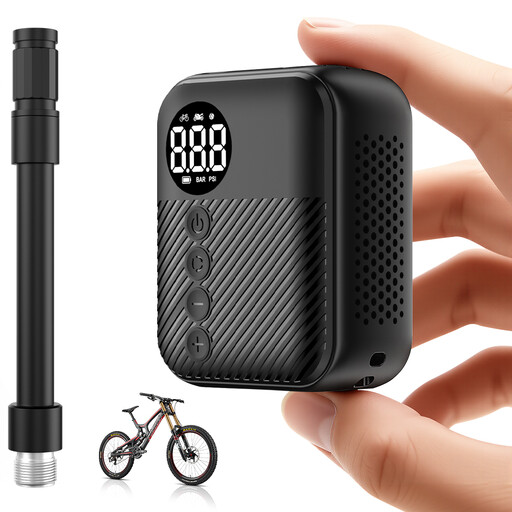
Why it suits this user: A compact rechargeable tyre inflator for cyclists who value a digital pressure display and a small size. The product information lists it for bike, motorbike and car tyres.
The digital gauge makes the pressure easier to read than a basic analogue scale. Check in advance that the battery capacity is sufficient for your tyre size.
150 PSI according to the product name, digital display, pocket-sized design and built-in rechargeable battery.
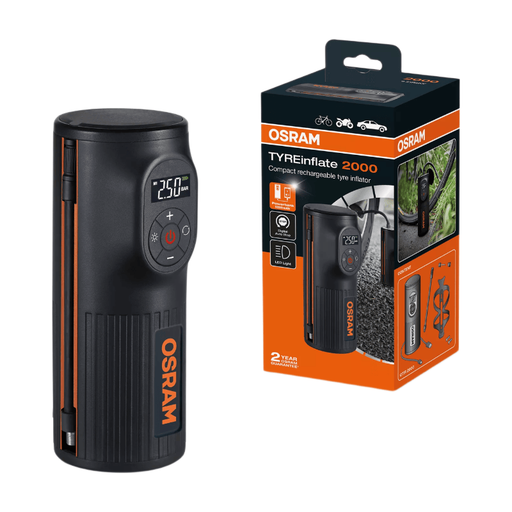
Why it suits this user: A good choice if you value an illuminated display, multiple pressure units and automatic shut-off. According to the product information, it runs on a built-in lithium-ion battery.
You can preset the pressure, and according to the manufacturer, the pump has an automatic stop function. Bear in mind the stated maximum pressure of 5,5 bar.
Display showing BAR, kPa and PSI, memory function, LED light, adapters and a stated weight of 485 grams.
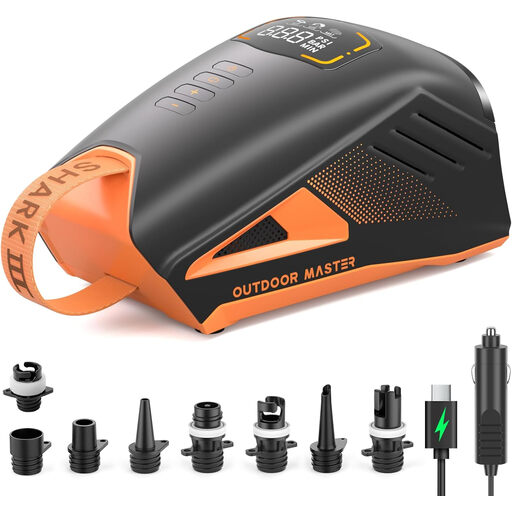
Why it suits this user: A specialist choice for SUP and boat users who want to inflate several boards and need a deflation function too. This isn’t a primary compressor for car tyres.
The product information lists a maximum pressure of 20 PSI and a digital pressure setting. This makes its intended use clearer than that of a general-purpose air pump.
74 Wh battery, Type-C and 12V power, digital pressure control, automatic stop and several nozzles.

Why it suits this user: Designed for cyclists looking for a small model with Presta and Schrader compatibility. The product listing warns that this model is intended for bikes only.
Its intended use is clearly limited to bikes. That way, you won’t accidentally use a compact electric bike pump on a car tyre it isn’t designed for.
150 PSI according to the product information, 5000 mAh battery, automatic shut-off and integrated Presta and Schrader connections.
We’ve put together a complete, up-to-date list of products that meet these strict selection criteria and the applicable European safety requirements.
That depends on its pressure capacity, airflow, connection and running time. Choose a model whose product information specifically mentions car tyres. A pump that only delivers low pressure, such as 3,5 kPa, isn’t suitable. If you need to inflate several tyres one after another, a model with a cable or larger battery is often more practical.
Its lifespan depends on battery capacity, how often it’s used, storage temperature and heat build-up. Don’t run the pump for longer than the manual recommends, and let it cool down when instructed. Store the battery in a dry place and recharge it regularly, even if you don’t use the pump very often.
A small rechargeable tyre inflator uses relatively little electricity while inflating; the exact cost depends on the battery capacity and electricity tariff. A 12V pump draws power from the car battery. If using it for a longer period, only leave the engine running when it’s safe and permitted under the vehicle and product instructions.
