
Vandaag of morgen in huis

Kwaliteit gegarandeerd

Welkomstaanbiedingen ontgrendelen: GRATIS bezorging | Tot 80% korting | Gratis 30 dagen JoyPlus-proefperiode
Download de app
An electric trimmer may seem straightforward at first glance: switch it on, trim and clean it. However, devices differ considerably in what they are designed for. A nose trimmer is not automatically suitable for beard hair, while a powerful hair clipper may be too large for small, sensitive areas.
If you only look at the price or a striking marketing claim, you could therefore run into a few familiar pitfalls. Pay particular attention to these three:
The right choice therefore starts with the intended application. Do you want to trim nose and ear hair, maintain your beard at a certain length, trim body hair or cut your hair at home? Below are the key points to check.
A nose trimmer or ear hair trimmer usually has a narrow, rounded rotary head. It is designed to carefully cut excess hairs around the entrance to the nose or ear. Never push the head deep into a body opening.
For a beard, a beard trimmer with fixed combs is more suitable, for example for lengths of 1, 3 or 5 mm. A body trimmer or body groomer often has a wider head and a protective comb for the chest, armpits or external intimate areas.
A hair clipper and an electric hair trimmer are mainly intended for head hair. Always check the minimum and maximum cutting length. A device supplied only with 3, 6, 9 and 12 mm combs is less suitable for very short detailing.
A waterproof trimmer is easier to rinse, but water resistance does not automatically mean that every component can safely be used under water in all circumstances.
An IP rating is helpful when cleaning the device, but it does not replace the safety instructions. Dry a rechargeable trimmer thoroughly after cleaning and do not charge it in the shower.
A cordless trimmer gives you freedom of movement, especially when travelling. With a rechargeable trimmer, charging time, battery capacity and operating time are all relevant details. A model powered by one AA battery can be practical if you do not want to wait for charging, but you will need to buy spare batteries.
Also check:
For sensitive skin, rounded edges, a protective comb and gentle movements are more important than a high motor speed. Stop if you experience pain, redness or irritation, and do not use a trimmer on damaged skin.
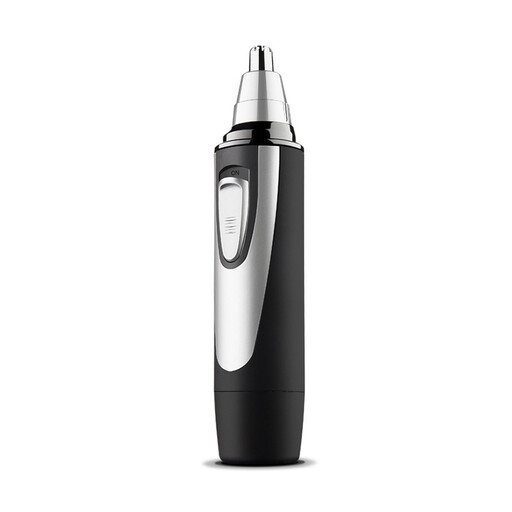
Why it suits this profile: This battery-powered model is designed for the nose, ears and small facial details. According to the product information, it runs on one AA battery and has a removable head for cleaning.
The IPX7 classification is clearly stated. However, use the classification in accordance with the instructions and do not immerse the entire device for prolonged periods.
Rotary stainless-steel blades, protective cap, cleaning brush and a compact size of 3,5 × 3,5 × 14,5 cm.
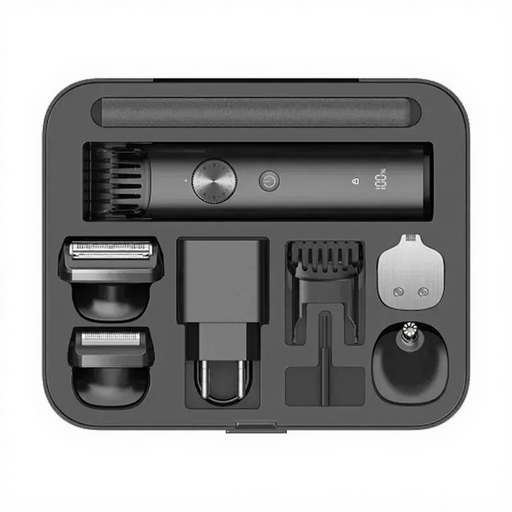
Why it suits this profile: If you are looking for one cordless solution for your face, body and nose, you can use the different attachments. The product information lists four heads and adjustable lengths from 0,5 to 20 mm.
The functions are linked to separate heads. This makes it clearer which component to use for the nose, body or precision work.
800mAh Li-ion battery, up to 90 minutes of use according to the product information, USB-C charging, LED display and IPX7 classification.
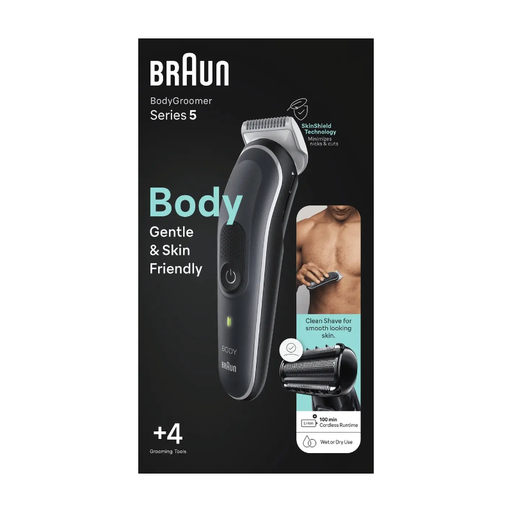
Why it suits this profile: This model is designed for body hair, including the chest, armpits, legs and external pubic area. The product information states that it can be used in the shower and features a Li-ion battery.
The lengths are not mentioned merely as a marketing term: there is a fixed 1 mm comb and an adjustable comb from 3–11 mm. This lets you adjust the trimming length.
Up to 100 minutes of use according to the product information, suitable for wet and dry use, and designed for multiple body areas.
We have compiled a complete, up-to-date list of products that fully meet these strict selection criteria and the applicable European safety regulations.
It is best to store a battery-powered device somewhere dry and out of reach of children. Remove an AA battery if you will not be using the model for an extended period. With a rechargeable trimmer, it is advisable to use the supplied cable or a suitable charger.
A trimmer is generally intended for precision work, beards, noses, ears or body hair. A hair clipper usually has a wider head and is designed to cut larger amounts of head hair to set lengths. A trimmer is more practical for outlining and small areas.
Its lifespan depends on use, cleaning, storage and the condition of the blades. Only rinse models that are designed for it, keep the charging port dry and replace batteries in good time. In the event of a fault, the statutory guarantee in the Netherlands may apply; also check the product’s specific warranty terms.
With an AA battery-powered model, you pay for periodic battery replacement. A rechargeable trimmer uses electricity while charging, but the cost per charge is generally low. Pay particular attention to charging frequency, battery life and whether replacement parts are available.
