
If you want to clean grout and edges
You want to tackle dirt in specific spots, so a suitable precision brush head is more useful than a wide mop head.


For grout, edges and small dirty patches in a rented flat, a dedicated rotating brush is a better fit. For regular cleaning of a larger, suitable tiled area, a floor cleaner that collects dirty water is more suitable. First check the finish of your tiles and grout. Bear in mind that rollers and tanks need cleaning after use, and some accessories are sold separately.
You want to tackle dirt in specific spots, so a suitable precision brush head is more useful than a wide mop head.
Your main aim is to look after a larger, suitable tiled area, and collecting dirty water matters to you.
You want to keep the existing floor and grout in good condition, and will choose a cleaning method only after checking the finish and whether it is suitable for the materials.
Choose this if: dirt is mainly in a few grout lines, along tile edges or in small patches; Bosch lists tiles and grout as suitable uses for the UniversalBrush.
Trade-off: a small brush head is less practical for an entire floor; you’ll need to collect loosened dirt separately.
Choose this if: you want to guide the brush over the floor without bending down repeatedly, and have room to store a handle.
Trade-off: check that the brush is suitable for your tiles and what’s included; the RYOBI R18TPS-0 is supplied without a battery.
Choose this if: you regularly want to clean a larger tiled area and collect dirty water separately.
Trade-off: check that the floor finish is suitable for the model, and expect to clean the rollers and tanks. Philips lists non-textured tiles as suitable; the Kärcher FC 2-4 has a separate stone roller for non-delicate ceramic surfaces.
Choose this if: there’s only a small amount of dirt that can be removed regularly, and you’re not yet sure whether you need an electric appliance; Milieu Centraal lists water and a cloth or brush as options for regular cleaning.
Trade-off: you’ll still need to scrub by hand, which can take longer.
| What to consider | What should you check? | Who is this important for? |
|---|---|---|
| Grout and edges | Check whether the brush head is designed for tiles and grout, and how you’ll remove loosened dirt. | If I mainly want to tackle grout and edges, I’ll choose a head that’s suitable for those areas. Around 31% of consumers say that targeted cleaning of grout and edges is their main need. |
| The whole tiled area | Check which tile finishes are permitted, whether dirty water is collected, and how to clean the rollers and tanks. | For regular mopping of a larger, suitable tiled area, collecting dirty water is important to me. Around 31% of consumers prioritise cleaning the entire floor area. |
| Protecting the floor and grout | Check the finish and condition of the floor and grout; follow the material care instructions and test the method carefully in an inconspicuous spot. | As a renter, I want to know first what’s suitable for my existing tiles and grout. Around 23% of consumers say protecting materials is their main reason for buying. |
| Reach and storage | Check the handle length, storage dimensions, and whether the battery and charger are included with the version you’ve chosen. | If I want to clean the floor without bending down repeatedly, I’ll also consider how much room I have to store the appliance. Around 15% of consumers base their choice mainly on reach and storage. |
A precision brush and a floor cleaner that collects dirty water are designed for different main tasks. A small brush is less practical for cleaning a large floor area.
First work out whether the dirt is mainly in the grout and along the edges, or spread across the tiled area.
When scrubbing specific spots, you’ll need to collect loosened dirt separately, and cleaning a whole floor may take longer.
According to Kärcher, the Kärcher FC 2-4 Battery Set includes a universal roller. The stone roller for non-delicate ceramic surfaces is a separate accessory and fits FC 2-4 variants.
Check the full model code, the roller included and the compatibility information before choosing an accessory.
You may need to buy the suitable stone roller separately.
The RYOBI R18TPS-0 is supplied without a battery.
Check the full variant code and see whether a battery and charger are included with that version.
You may need to buy the battery and charger separately for this version.
Philips lists non-textured tiles as suitable for the OneUp XV5113/01. Kärcher describes the stone roller as suitable for non-delicate ceramic surfaces; these uses are not automatically suitable for every finish or type of grout.
Check the instructions for your floor and test your chosen method carefully in an inconspicuous spot.
The UniversalBrush is a precision electric hand brush for small cleaning jobs.
The R18TPS-0 is a telescopic cordless cleaning brush for jobs where extra reach is useful.
The FC 2-4 Battery Set is designed for cleaning hard floors; Kärcher describes it as having a two-tank system.
The OneUp XV5113/01 is an electric mop for floor care.
This selection includes telescopic and handheld electric brushes, as well as electric mops for tiled floor care. Check each product’s heads, stated suitable surfaces and any limitations.
 Image unavailable
The interchangeable heads make this an option to consider for cleaning tiles and grout.
Rechargeable; seven interchangeable brush heads; LED charging status indicator.
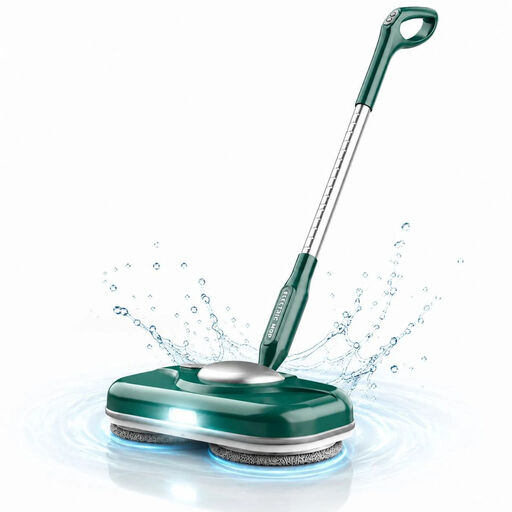 Image unavailable
This mop is an option to consider for cordless care of tiled floors.
Cordless; dual rotation; spray function; swivel head; green finish.
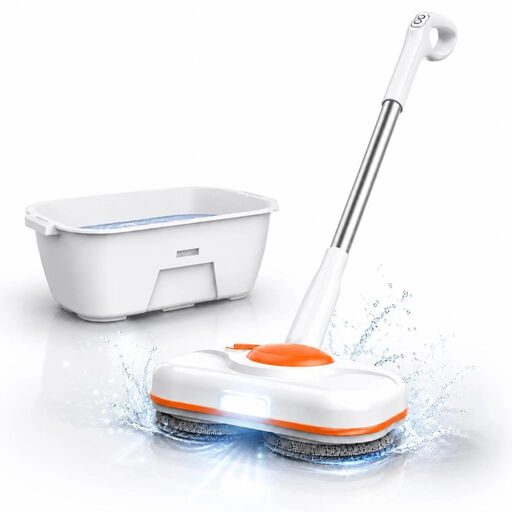 Image unavailable
This version is worth considering for cleaning tiled floors; bear in mind the stated limitation for rough surfaces.
Cordless; dual rotation; spray function; swivel head; white finish.
According to the user information, cleaning may be less effective on rough surfaces.
 Image unavailable
The brush heads make this an option to consider for spot cleaning tiles and reaching tight spaces.
Includes seven brush heads, a stand and a knife sharpener; LCD display; three speed settings.
Do not immerse the main unit in water.
Not always. Milieu Centraal says that regular cleaning with water and a cloth or brush can go a long way. Choose an electric appliance if the specific cleaning task or the way you need to work makes one worthwhile.
No, don’t assume that it can. Philips specifically lists non-textured tiles as suitable; if your floor has a different finish, check the instructions for use before choosing this model.
No. Kärcher lists FC 2-4 variants as suitable for this stone roller and says that it is not intended for other Floor Cleaner models.
With floor cleaners, you need to clean the tank, roller and, where applicable, the filter. According to Consumentenbond, a self-cleaning function doesn’t do all the work for you; follow the instructions for your chosen model too.
Routine cleaning is different from making changes to the property. The Dutch government states that you need your landlord’s permission for renovations. Record the existing condition of the floor, and discuss it with your landlord if it appears to be a fault or needs repair.