
Cook with limited worktop space
You want to steam fish fillets, but need room for the appliance while it’s in use and somewhere to store it afterwards. So compare the full set-up when in use with the space the trays take up when stored.


First, measure the worktop space available and the fish fillet you usually cook: a total capacity in litres doesn’t tell you whether the fillet will fit flat in a single tray. Stackable trays are a good choice if you also want to steam side dishes and store the trays compactly. Independently adjustable zones are most useful when ingredients have different cooking times. Before buying, check the inside dimensions of a tray, the space needed for the lid and the instructions for use and cleaning.
You want to steam fish fillets, but need room for the appliance while it’s in use and somewhere to store it afterwards. So compare the full set-up when in use with the space the trays take up when stored.
You want to cook fish and, for example, vegetables at the same time. Check whether separate trays or adjustable zones suit the portions and cooking times you need.
You want to steam a fillet now and then, and can weigh up an electric appliance against using a steamer basket with a pan you already own.
| What to consider | What should you check? | Who is this for? |
|---|---|---|
| Space while in use and in storage | Measure the available worktop space and height needed for the complete set-up, including opening the lid. | If my worktop is small, I want to know whether the appliance will actually fit while steaming; around 36% of consumers give the space needed for use and storage their top priority. |
| Fitting a whole fillet in one tray | Compare the length and width of your usual fillet with the usable inside dimensions of a single tray. | If you want to steam a whole fillet flat, check whether it fits in one tray without folding or stacking it; around 29% of consumers prioritise space for a fillet. |
| Cooking fish and side dishes at the same time | Work out how many portions you’ll cook at once and whether separate cooking-time settings are important. | If I want to cook fish and a side dish together, I look at how I can arrange the ingredients; around 21% of consumers give cooking different ingredients at the same time their top priority. |
| Controls and maintenance | Look at the controls and check the manual for instructions on cleaning the parts and descaling the appliance. | If you’re mainly looking for an appliance that’s easy to use and maintain, these practical considerations come first; around 14% of consumers do the same. |
The 9 litres stated for the Russell Hobbs 19270-56 is the total capacity of three trays; it doesn’t tell you how much flat space there is inside a single tray.
Check the usable length and width of an individual tray and compare them with your fillet.
A stackable or nesting set-up won’t necessarily take up as little space while steaming as it does when the trays are stored.
Also measure the space needed for the trays in place, opening the lid and accessing the water tank.
An automatic shut-off doesn’t check whether the fish has been heated sufficiently.
Check that each fillet is cooked through and follow the safety and cooking instructions.
According to Tefal, the Ultracompact VC204810 is designed for people who want to steam several ingredients and store the trays compactly.
The KITCHENminis 0415090011 may be worth considering if you want to set ingredients separately, for example when they have different cooking times.
According to Russell Hobbs, the Cook@Home 19270-56 is designed for several portions or ingredients; the manufacturer lists salmon and cod fillets as suitable uses.
These Joybuy products are for anyone who wants to steam fish fillets, with or without other ingredients. The total capacity doesn’t tell you whether a fillet will fit in one tray, so check the tray’s usable inside dimensions.
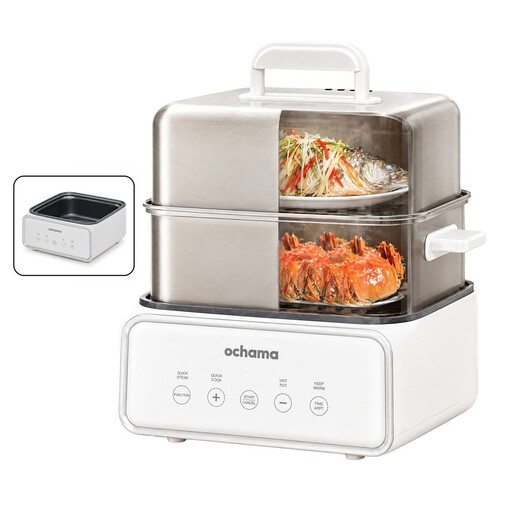 Image unavailable
The product description mentions fish and two steam layers that can be used separately; it says the divider can be removed.
The product name lists 1500 W and a capacity of 12 L.
The description also mentions a timer and boil-dry protection.
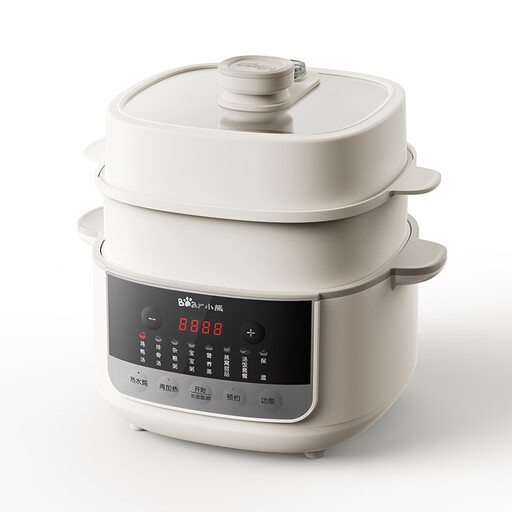 Image unavailable
The product description mentions a steaming basket for steaming ingredients at the same time as food in the pot.
The pot has a capacity of 2.5 L, according to the description, which also lists four 0.4 L pots.
The product description lists ten menu settings.
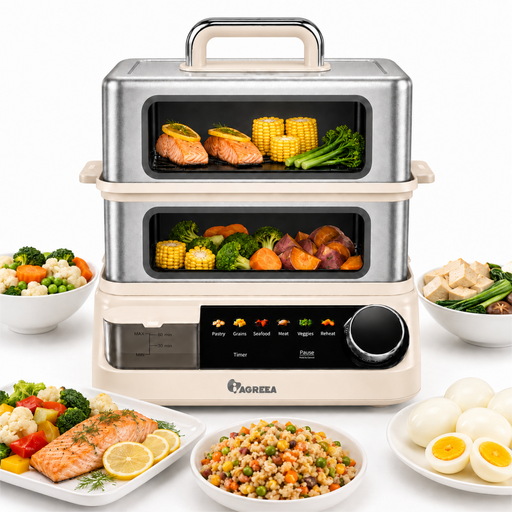 Image unavailable
The product description lists two steam layers for cooking different ingredients at the same time.
The product name lists 2000 W and a capacity of 14 L. The description lists two trays measuring 300 × 230 mm and says each tray can hold a 28 cm fish plate.
The description also mentions viewing windows and an external water tank.
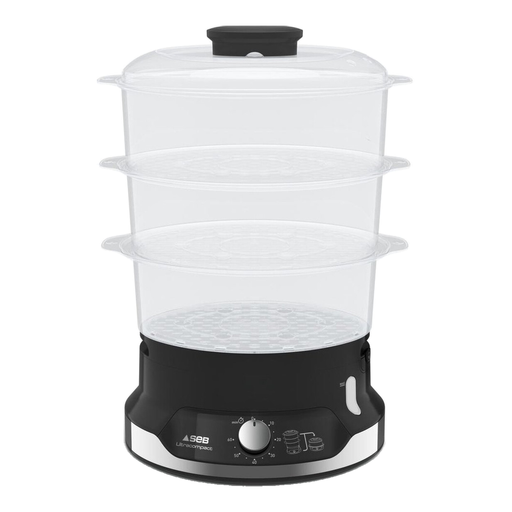 Image unavailable
The product description mentions three trays for cooking ingredients on multiple levels, which can be stacked for storage.
The product name lists 800 W, 9 litres and three tiers.
The description mentions a timer with automatic shut-off, a top-up system and a visible water level. Check separately whether the inside dimensions of one tray are suitable for your fillet.
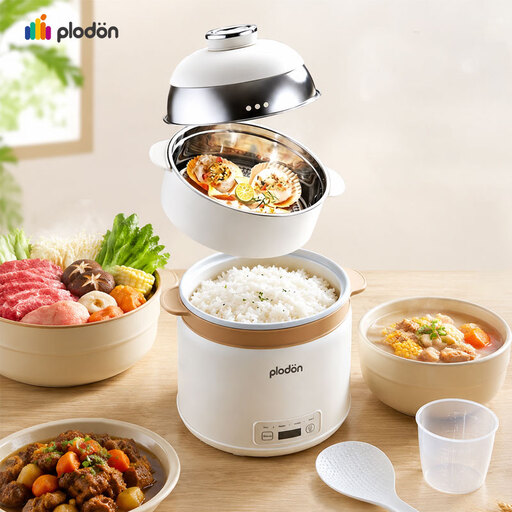 Image unavailable
The product description mentions fish as a suitable use and describes two steam layers that can be used separately; it says the divider can be removed to create one larger space.
The product name lists a capacity of 2.3 L.
The description mentions a timer, a reservation function, a keep-warm function and boil-dry protection.
After steaming, check that the fish is thoroughly cooked; setting a timer doesn’t prove that it is. The Netherlands Nutrition Centre advises cooking fish thoroughly because of possible pathogens. The time needed depends on the fillet and how it’s prepared; also follow your appliance’s instructions.
Compare the full set-up when in use with the available worktop space, and follow the chosen model’s manual for positioning, filling and cleaning. Descale it according to that model’s instructions. Philips says that too much limescale can slow down steaming in its steamers; this maintenance advice doesn’t necessarily apply to other brands.
No. In the Netherlands, if a product is faulty, you have statutory rights against the seller in addition to any commercial warranty. ACM ConsuWijzer explains that, under the applicable conditions, a product that breaks too soon during normal use must be put right free of charge; there isn’t simply a fixed two-year Dutch warranty period for every appliance.
For electrical equipment within the scope of the EU Low Voltage Directive, EUR-Lex sets out requirements relating to electrical safety and safety information. According to the European Union, CE marking is only required for products covered by harmonised EU rules that require the marking. CE marking isn’t an independent performance test; check the identification and safety information for the specific appliance.