
Making bao with limited cupboard space
You usually make a small portion and mainly want to know whether the complete appliance will fit in your cupboard when put away. Compact compartments and nesting baskets are two different solutions.


Start by deciding how many bao you want to steam at once, then measure whether the complete steamer will fit in your cupboard when put away. Nesting tiers can help with larger portions, while separate, smaller compartments may suit you if you usually steam smaller quantities. A stated capacity in litres doesn’t tell you how many bao will fit on a tier. Before buying, also check that the specific model has the applicable CE marking: the Netherlands Enterprise Agency and the Dutch government state that this is mandatory for electrical appliances covered by the rules and sold on the EU market.
You usually make a small portion and mainly want to know whether the complete appliance will fit in your cupboard when put away. Compact compartments and nesting baskets are two different solutions.
You want to steam several buns at a time without placing them too close together, and may be happy to make room for more parts in your cupboard.
You also use the steamer for other ingredients, so you’ll want to consider topping up the water, cleaning and the availability of replacement parts.
| What to consider | What to look for | Who is this most important for? |
|---|---|---|
| Storage | Measure your cupboard and compare it with the storage dimensions of the complete steamer, including the base and lid. | If I have limited cupboard space, I want to know whether the base and lid will fit too. Around 36% of consumers say storage is their main buying priority. |
| Room for bao | Compare the usable interior dimensions of each tier with your bao, and allow space between them. | If I want to steam several bao at once, I want to know how many will fit side by side. Around 29% of consumers give bao capacity top priority. |
| Use and care | Check the manual to see how to top up the water and clean the parts; also check whether parts are available for the exact model. | If I use the steamer often, I look at topping up the water, cleaning and replaceable parts. Around 21% of consumers put ease of use first. |
| Cost and support | Compare the model and the availability of parts; if something goes wrong, check what support the seller offers. | If I’m weighing up the purchase cost and support, I want to know what happens if the appliance develops a fault. Around 14% of consumers name cost and support as their main priority. |
A capacity in litres doesn’t tell you how many buns will fit side by side on a tier. Bao can expand as they steam, so you may need to cook them in several batches.
Measure your usual bao and compare them with the usable area of each tier. Don’t just look at the total capacity in litres.
If they don’t all fit at once, you may need extra time to steam several batches.
Nesting tiers can save space, but the base and lid also need to fit in your cupboard.
Measure your cupboard space and compare it with the dimensions of the complete steamer when packed away.
An additional plan doesn’t replace the statutory rights you have against the seller.
Read what an additional plan covers, and if there’s a problem, first check who you can contact to exercise your rights.
According to WMF, the KITCHENminis 0415090011 has two independently adjustable compartments for smaller portions.
The Ultracompact VC2048 has three tiers and a stackable storage system.
According to Braun, the TributeCollection FS 3000 has baskets that fit inside one another.
The Cook@Home 19270-56 has three tiers with a stated combined capacity of 9 litres.
These electric steamers are options for steaming bao and other ingredients. Compare the tier space and storage dimensions with your needs, and check the applicable CE marking on the specific model.
 No image available
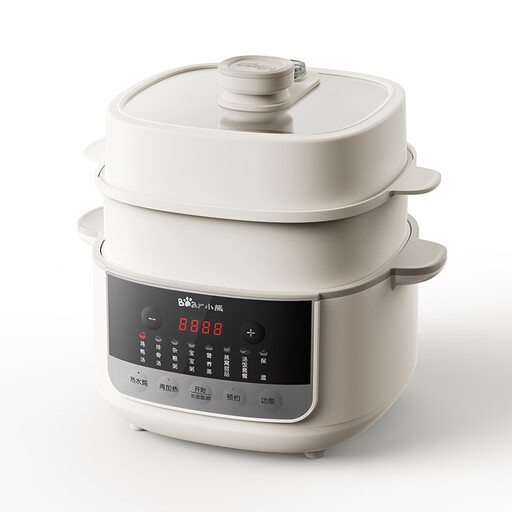
An option if you’d also like to use the included pots as well as steam; check that the parts suit the amount of bao you’re making.
The product description lists a 2.5-litre pot, four 0.4-litre pots and a steaming basket.
Before buying, check the applicable CE marking on this model.
 No image available
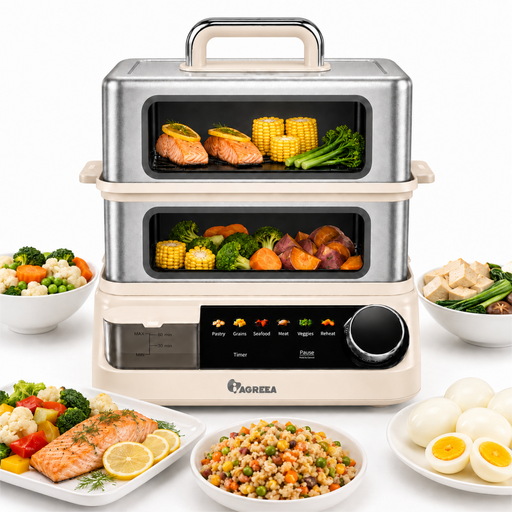
The two tiers may suit you if you want to steam different ingredients at the same time; compare their dimensions with your bao and available cupboard space.
The product title lists a capacity of 14 litres and 2000 W. The description specifies two 300 × 230 mm stainless steel tiers, a 2.5-litre external water tank and six programmes.
Before buying, check the applicable CE marking on this model.
 No image available
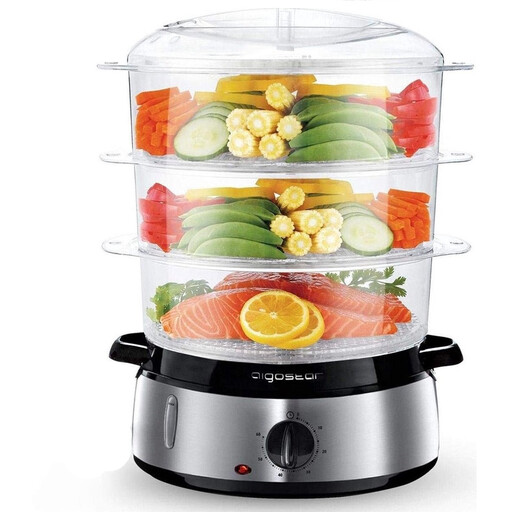
The stackable tiers are useful if you want to steam several ingredients and store the parts compactly after use.
The product title lists 800 W; the description specifies three 3-litre tiers and a timer of up to 60 minutes with automatic shut-off.
The product description says the removable parts are dishwasher-safe. Before buying, check the applicable CE marking on this model.
 No image available
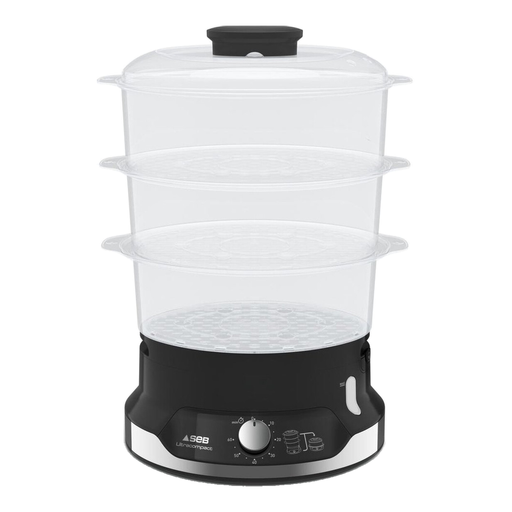
An option if you want to use three tiers and stack them for storage after steaming; check the internal dimensions against the size of your bao.
The model has three tiers and a stated total capacity of 9 litres; the product title lists 800 W. The product description specifies a timer of up to 60 minutes, automatic shut-off and the option to top up the water while in use.
The total capacity doesn’t tell you how many bao will fit on a tier. Also check the applicable CE marking on this model.
Yes. A pan with a steaming basket is an alternative to an extra electrical appliance. The Netherlands Nutrition Centre also suggests using a heatproof colander with a well-fitting lid; check that the pan and basket are large enough for your bao.
Place each bun on its own piece of baking paper and, if needed, steam them in several batches. A recipe for fresh bao uses this method; for frozen bao or bao with a raw filling, follow the relevant product or recipe instructions.
Make sure the filling is thoroughly cooked; don’t rely on the appearance of the dough alone. The Netherlands Nutrition Centre advises heating meat thoroughly, so follow suitable cooking instructions for the bao you’re using.
CE marking is compulsory for electrical appliances where EU rules require it. The Netherlands Enterprise Agency and the Dutch government state that the applicable requirements depend on the product. Check the specific model, and don’t treat a model name on a retail page as proof that it complies.
If there’s a problem with a product, the seller must provide a solution. The Dutch government states that the statutory guarantee period isn’t fixed at two years. For an online purchase from a business, you generally have a 14-day cooling-off period, subject to legal exceptions.