
Anyone who wants to slice roast beef thinly
You want control over the slice and to know in advance exactly which blade is included. Severin lists a deli blade for the AS 3915; FRITEL describes the SL 3080 as having a serrated blade.


If you mainly want to slice roast beef thinly, first check whether the exact model comes with a suitable smooth deli blade, and whether the blade and other food-contact parts are easy to reach for cleaning. An adjustable slice thickness alone doesn’t tell you which blade is included. A folding model can save storage space, but you should also check the instructions and applicable safety documentation for any machine you’re considering.
You want control over the slice and to know in advance exactly which blade is included. Severin lists a deli blade for the AS 3915; FRITEL describes the SL 3080 as having a serrated blade.
You want to know whether the blade and other parts that come into contact with food are easy to reach for cleaning, and to chill the roast beef promptly afterwards. The Netherlands Nutrition Centre advises keeping opened, cooked roast beef in the fridge for up to two days.
You’re weighing up a folding machine against the space it takes up while slicing, as well as how easy it is for you to operate. Severin describes the AS 3912 as foldable; compare the dimensions of the exact model with your kitchen.
A good fit if: your main task is slicing roast beef thinly; Severin lists an included deli blade and an adjustable range of 0–15 mm for the AS 3915.
Bear in mind: the manufacturer’s specifications don’t prove how the machine will slice in your kitchen; check the blade type and cleaning instructions.
A good fit if: you’re short on storage space or want to slice bread as well as meat; FRITEL and DOMO describe folding models with a serrated blade.
Bear in mind: a serrated blade isn’t the same as a smooth deli blade; check whether the exact model is suitable for the way you want to slice roast beef.
A good fit if: you regularly slice deli meats and have enough worktop and storage space; Magimix lists a meat clamp and removable parts for the T250.
Bear in mind: Magimix lists a weight of 14 kg and dimensions of 365 × 480 × 363 mm. The same product page gives both 25 cm and 19 cm for the blade size, so confirm the measurement before deciding.
| What to consider | What should you check? | Who should pay particular attention? |
|---|---|---|
| Blade and roast beef slices | Check which blade is included and what slice thickness the exact model can be set to. | If I mainly want to slice roast beef thinly after an evening class, I want to know first which blade is included; around 29% of consumers put roast beef slicing first. |
| Cleaning and storage | Check the manual to see how to remove and clean the blade, carriage and food holder. Then put the cooked roast beef back in the fridge promptly. | If I want to clean up quickly after slicing and put the roast beef away chilled, I’m looking for parts that are easy to reach; around 24% of consumers prioritise tidying up and storage. |
| Space | Compare the dimensions when the machine is in use and when folded with the space available on your worktop and in your cupboard. | If I have little room on the worktop or in a cupboard, the size when stored matters a lot; around 18% of consumers let the space available in their kitchen determine their choice. |
| Controls and protection | Check the food holder, finger guard, switch or lock, and the instructions for safe cleaning. | If I value a secure grip and keeping my fingers away from the blade while slicing, I look at the controls and protection; around 17% of consumers prioritise safe operation. |
| Versatility | Compare the stated uses and blade type with what else you actually want to slice besides roast beef. | If I want to slice other foods too, I compare the included blades with those extra tasks; around 12% of consumers make versatility their top priority. |
For cooked roast beef, the Netherlands Nutrition Centre advises keeping your fridge at 4 °C and leaving food out of the fridge for no more than two hours. This is storage advice, not instructions for slicing with a specific machine.
For electrical appliances placed on the market in the Netherlands, Ondernemersplein describes the applicable European safety requirements: after carrying out a conformity assessment, the manufacturer applies a CE marking and draws up an EU Declaration of Conformity. Check the documentation for the exact model you’re considering.
An adjustable thickness setting doesn’t tell you which blade comes in the box. FRITEL describes the SL 3080 as having a serrated blade, while Severin lists a deli blade for the AS 3915.
First check what’s in the box and which blades are available for the exact model. Then consider the thickness settings.
A different suitable blade may only be an option if it’s available for that model; check before relying on it.
A product title for the Clatronic MA 3585 lists 500 W, while Clatronic states 150 W. The Magimix T250 page also gives both 25 cm and 19 cm for the blade size.
If the model code or key specifications differ, ask for the exact model and relevant measurement to be confirmed before you buy.
Magimix lists a weight of 14 kg and dimensions of 365 × 480 × 363 mm for the T250. A machine of this size needs a suitable space both when in use and when stored.
Measure your worktop and storage space, and check which parts you’ll need to clean after slicing.
Compare the AS 3915 with the foldable AS 3912 to decide whether an included deli blade or compact storage matters more to you.
The SKS100 is worth comparing if you also want to slice bread.
The T250 is worth comparing if you regularly slice deli meats and have enough space.
The foldable SL 3080 is a space-saving all-purpose slicer to compare with models designed for deli meats.
The foldable DO523S is worth comparing if cupboard space is limited.
These models are designed for electric slicing of meat. The range includes models with a smooth blade and foldable models with a serrated blade. Before buying, check the blade type, user manual and safety documentation for the exact model.
 No image available
Worth comparing if you’re looking for an electric meat slicer; before buying, check the exact blade type and accompanying documentation.
The product name mentions an all-metal construction, an angled design and electronic speed control.
 No image available
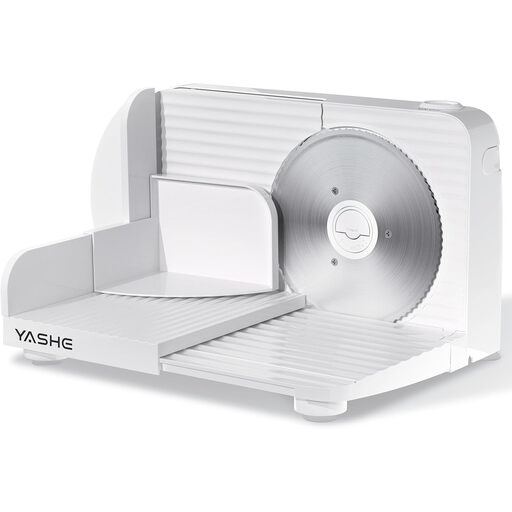
The foldable design is worth considering if you want to store the machine compactly after use; check whether the blade type is suitable for roast beef.
The product name lists 180 W, an adjustable range of 0–15 mm and a 17 cm stainless steel blade. The description specifies a serrated blade, which isn’t the same as a smooth deli blade.
 No image available
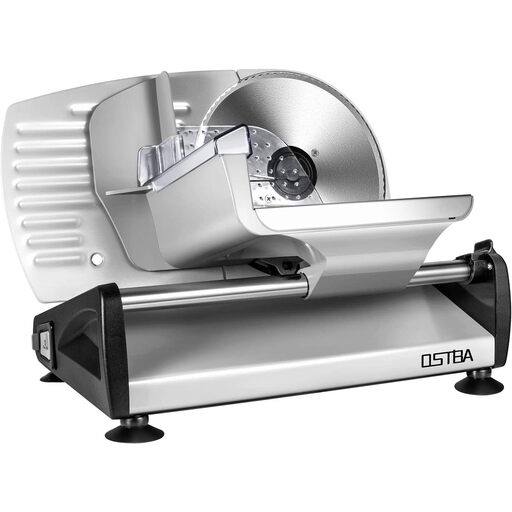
Compare this model if you’re looking for an adjustable slice thickness, but first check whether the blade type is suitable for the way you want to slice roast beef.
The product name lists a 19 cm blade, a 0–15 mm setting, a child lock and 150 W. The description specifies a serrated blade, not a smooth deli blade.
 No image available
The foldable design is worth considering if storage space is a factor; check whether the serrated blade is suitable for the roast beef you want to slice.
The product name lists 100 W, an adjustable range of 0–15 mm and a 17 cm blade. The blade specified is serrated, not smooth.
No. Don’t leave perishable meat out of the fridge unnecessarily. The Netherlands Nutrition Centre advises keeping your fridge at 4 °C, leaving food out of the fridge for no more than two hours, and keeping opened, cooked roast beef chilled for up to two days. This is storage advice, not instructions for slicing with a specific machine.
Follow the manual for the exact model when removing and cleaning parts, and unplug the machine before taking it apart or cleaning it. Check in advance which food-contact parts are removable and easy to reach.
No. According to the Dutch Government, there’s no fixed statutory warranty period in the Netherlands; what matters is what you can reasonably expect from the product. If a product is faulty, the retailer is your point of contact, and a manufacturer’s warranty is in addition to your statutory rights.
For electrical equipment placed on the market in the Netherlands, Ondernemersplein describes the applicable European safety requirements. After a conformity assessment, the manufacturer must apply a CE marking and draw up an EU Declaration of Conformity; check the documentation for the exact model you’re buying.