
Host serving thin slices of roast beef
You’ll mainly use the machine to slice a joint thinly for several guests. The type of blade and adjustability are especially important in this case. GRAEF describes smooth blades as suitable for fine slicing.


For thin slices of roast beef, a suitable smooth blade, adjustable slice thickness and enough room for the joint are important things to consider. Wattage alone won’t tell you whether a machine is suitable. If you also slice bread, a serrated blade may be more practical, but check whether the version you choose also includes a smooth blade. You should also consider how the meat is guided, how easy the machine is to clean and how much space it takes up.
You’ll mainly use the machine to slice a joint thinly for several guests. The type of blade and adjustability are especially important in this case. GRAEF describes smooth blades as suitable for fine slicing.
You’ll want to know in advance whether the meat will fit on the carriage and can be guided easily while slicing. DOMO and ritterwerk publish dimensions for specific models, which can help you assess the available space.
You want to use the machine for more than just special occasions, so you’ll look at which blade is included. GRAEF describes a serrated blade as suitable for bread crusts; Severin lists both a smooth and a serrated blade for the AS 3915.
| What to consider | What should you check? | Who is this important for? |
|---|---|---|
| Thin, even slices | Check which blade is included and what slice thickness range can be set. GRAEF describes smooth blades as suitable for fine slicing. | If I mainly want to serve roast beef in thin slices, I look at the blade and the slice thickness I need. Slice precision is the top priority for around 31% of consumers. |
| Room for the joint | Measure the height and shape of the meat, then compare them with the food clearance, carriage travel and dimensions of the exact model. | With a larger joint, I want to know whether it will sit securely on the carriage and move easily. Around 25% of consumers give capacity and stable guidance the highest priority. |
| Cleaning and operation | Check the manual to see how parts are removed and cleaned. Also check which food holder or finger guard comes with the version you’re considering. | After slicing meat, I want to be able to clean the parts that came into contact with it thoroughly and keep my hands away from the blade. Cleaning and safe operation are the main considerations for around 25% of consumers. |
| Use and storage | Decide whether you also want to slice bread and check which blade is included. Compare the machine’s dimensions with the space available in your kitchen. | If I want to use the machine more often than just for a special occasion, I consider other uses as well as storage space. This is the main consideration for around 19% of consumers. |
For the standard serano⁷, ritterwerk describes a serrated blade; another version may come with a different combination of blades. So don’t rely on the model name alone.
Before buying, check the full model name, the manufacturer and what’s included in the box.
The blade diameter doesn’t tell you how much room there is for the joint. For example, DOMO separately lists a maximum food height of 14 cm for the DO521S.
Measure your joint and compare it with the food clearance and carriage specifications for the exact model.
ACM ConsuWijzer explains that your statutory guarantee can apply alongside a manufacturer’s or retailer’s guarantee. What you can expect from a product depends, among other things, on the product and the circumstances.
Check what any additional guarantee covers. If there’s a fault, contact the retailer.
The Master M20 is worth considering if fine meat slicing is your priority.
The AS 3915 is a metal all-purpose slicer with adjustable slice thickness.
The serano⁷ is a metal all-purpose slicer with an angled carriage and a standard serrated blade.
The DO521S is an all-purpose slicer for foods including bread and meat.
The T190 is worth considering if model-specific replacement parts are an important factor in your choice.
This selection includes electric meat slicers with different blade types, slice thickness settings and food-guiding systems. For each model, check whether the blade is suitable for the roast beef slices you want and which version is supplied.
 No image available
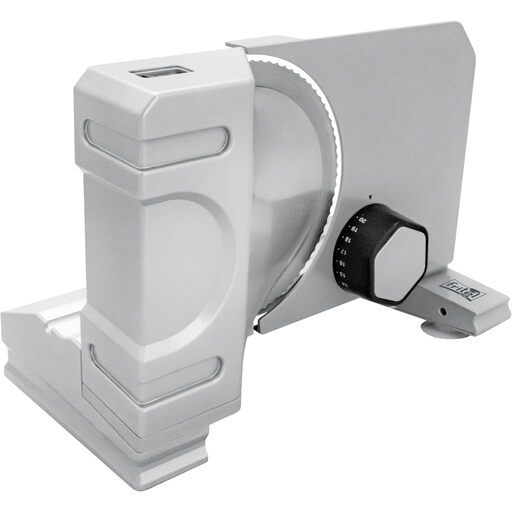
Could suit you if you want to adjust the slice thickness and compare the space available for your joint. Check the exact version and included blades before making your choice.
Adjustable slice thickness up to 23 mm; removable carriage with a 24 cm slicing path.
The description also mentions a food holder and safety switch.
 No image available
Could suit you if you want to adjust the slice thickness and take the angled carriage into account when guiding food. Check which blade comes with the version you choose.
Slice thickness 0–20 mm; blade diameter Ø 19 cm; power 150 W; universal blade and carriage at 15°.
The stated operating time is a maximum of 10 minutes at a time; allow the motor to cool for 30 minutes afterwards.
 No image available
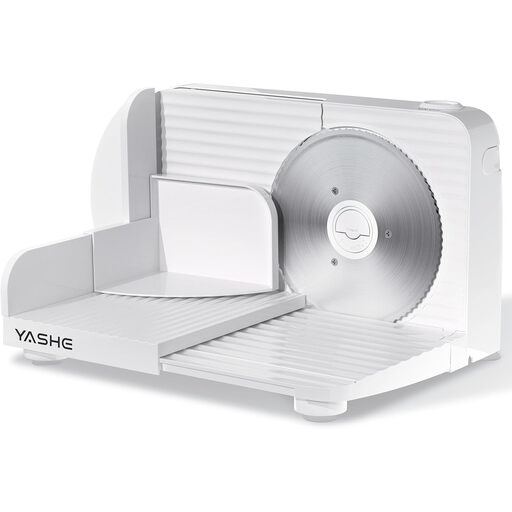
Could suit you if you want to slice bread, cheese or vegetables as well as meat, and a foldable design is important to you. The title specifies a serrated blade; consider whether that suits your preference for thin roast beef slices.
Slice thickness 0–15 mm; 17 cm stainless steel blade; power 180 W.
The title also mentions a foldable design and non-slip feet.
 No image available
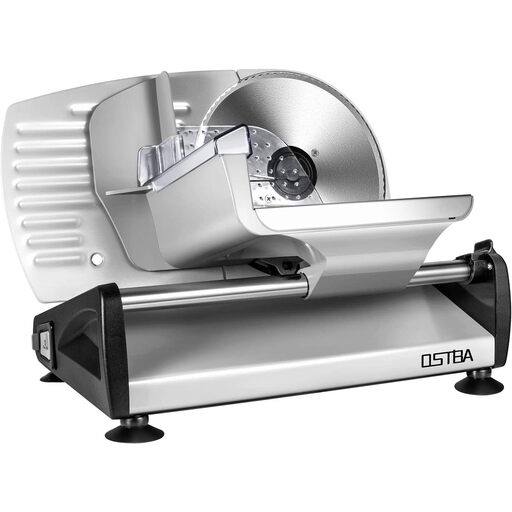
Could suit you if you want adjustable slice thickness and good food guidance while slicing. The title specifies a serrated blade, so bear this in mind if you want thin slices of roast beef.
Blade diameter 19 cm; slice thickness 0–15 mm; power 150 W.
The description mentions a safety lock, food pusher, non-slip feet and removable food carriage.
 No image available
Could suit you if you’re looking for a foldable model for meat and bread. The title specifies a serrated blade; check whether that blade type is right for the way you want to slice roast beef.
Slice thickness 0–15 mm; blade diameter Ø 17 cm; power 100 W.
The description mentions a removable blade and removable carriage.
A smooth blade is a good choice if you mainly want to cut meat into very thin slices: GRAEF describes this use for its smooth blades. The same manufacturer says a serrated blade is suitable for bread crusts. Check which blade comes with the exact model and version.
Keep cooked food separate from raw meat and clean used kitchen utensils between tasks. The Voedingscentrum advises keeping cooked meat covered at 4 °C and eating it within two days. Refrigerate leftovers within two hours of cooking.
Follow your model’s manual for safely removing, cleaning and refitting parts. DOMO lists a removable blade for the DO521S; Severin also lists a removable support table for the AS 3917. Don’t assume other models come apart in the same way.
According to the NVWA, CE marking is compulsory for electrical products. For products covered by the low-voltage directive mentioned, this includes a rated AC voltage of 50–1000 V. The NVWA also states that a separate inspection is not compulsory for electrical consumer products. CE marking is not an independent performance test.
You may. ACM ConsuWijzer explains that statutory guarantee applies alongside a manufacturer’s or retailer’s guarantee: when used normally, a product must meet what you could reasonably expect from it. There is no fixed two-year period for statutory guarantee; discuss the fault and the circumstances with the retailer.