
For slicing roast beef finely
You want to cut cooked roast beef into thin, even slices, so you’ll want to consider the blade, adjustable thickness and how the meat moves along the carriage.


For thin slices, choose a slicer with a blade suited to cold cuts and an adjustable thickness setting. For larger batches, also consider the carriage space, operating time, cleaning and the worktop space available. A larger blade or higher wattage alone does not prove that a machine will slice better.
You want to cut cooked roast beef into thin, even slices, so you’ll want to consider the blade, adjustable thickness and how the meat moves along the carriage.
You’re slicing several portions in one go and want to know whether the joint will fit on the carriage and whether the permitted operating time suits the way you work.
You’re looking for a machine that fits in your kitchen and is easy to clean after contact with meat. A compact design may leave less room for a larger joint.
First, decide which matters most to you: thin slices, a batch you can work through efficiently, cleaning or the space the machine takes up.
| What to consider | What to look for | Who should pay particular attention? |
|---|---|---|
| Thin, even slices | Check the blade type supplied and the adjustable thickness range for the exact model. | If thin slices are my priority, I compare the blade and thickness setting for cold cuts; around 31% of consumers put slicing precision first. |
| Size of the joint and slicing sessions | Compare the dimensions of your joint with the carriage and stated capacity; also check the operating time. | For multiple portions, I want to know whether the joint will fit and whether I’ll need to pause between batches; around 25% of consumers prioritise batch capacity. |
| Cleaning after slicing | Check the instructions for your specific model on removing and cleaning parts; use clean kitchen utensils. | After portioning, I want to be able to clean the parts around the meat thoroughly; around 25% of consumers put ease of cleaning first when buying. |
| Worktop space and other uses | Measure the available space and check the machine’s dimensions and which blades are included. | If I also plan to use the machine for other foods, I weigh that versatility against the space it takes up; around 19% of consumers prioritise space or uses beyond roast beef. |
Size or wattage alone doesn’t tell you how well a model will cut thin slices of cooked roast beef. The blade type, slicing thickness, space available for the joint and permitted operating time are all separate factors to consider.
Check these features for the exact model and compare them with how you plan to slice your batch.
For the ritter E 16, the manufacturer specifies an operating time of 5 minutes. This model-specific limit does not automatically apply to other slicers.
Before portioning, read the operating and cooling instructions for the model you’ve chosen.
If the instructions require breaks, a larger batch may take longer as a result.
According to the Dutch government, there is no fixed statutory warranty period in the Netherlands. What you can expect from a product depends, among other things, on the product itself and the information provided by the seller.
Compare any additional warranty terms with your legal rights and keep your proof of purchase. If a product is faulty, the seller is your point of contact.
The Netherlands Food and Consumer Product Safety Authority explains that CE marking is mandatory for electrical products covered by the applicable rules. A product listing alone does not prove that a particular appliance complies with those rules.
Check the marking on the model you’re considering; CE marking is not proof of slicing quality.
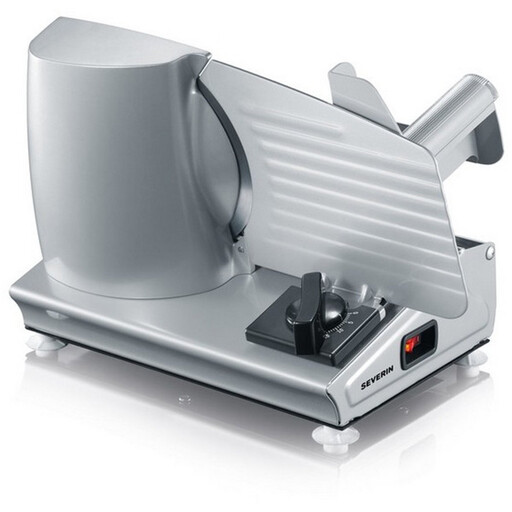
Severin describes the AS 3915 as a multi-purpose slicer supplied with a cold-cut blade and offering continuously adjustable slicing thickness from 0 to 15 mm.
Graef describes the Master M20 as having a smooth, hollow-ground 170 mm blade, designed for fine slicing of foods including cold cuts.
DOMO specifies a 22 cm blade, a maximum food height of 16 cm and an adjustable slicing thickness from 0 to 15 mm for the DO522S.
The ritter E 16 is a compact metal domestic slicer with a 17 cm serrated blade.
The Home Line 200 PLUS is an electric domestic slicer with a stop plate that, according to Berkel, can be set to 18 positions.
This selection features electric slicers to consider for portioning cooked roast beef, with a focus on blade type, adjustable thickness and storage.
 No image available
Worth considering if you’re looking for an electric slicer with electronic speed control; also check that the design and dimensions suit your worktop and portion sizes.
Fully metal construction and angled design, according to the product name.
DC motor with electronic speed control, according to the product name.
 No image available
Worth considering if you want to slice cooked roast beef and other foods; check which of the included blades to use for each task.
Severin specifies a cold-cut blade and continuously adjustable slicing thickness from 0 to 15 mm for the AS 3915.
Two blades, a finger guard and a stainless steel carriage, according to the product name.
 No image available
Worth considering if storage space is a factor, as this model folds away. For thin roast beef slices, weigh up whether the serrated blade suits the cut you want.
17 cm serrated blade.
Adjustable slicing thickness from 0 to 15 mm, folding design and 100 W, according to the product name.
Start by considering what you’ll mainly use it for and check the exact model. Graef describes the Master M20 as having a smooth blade for finely sliced cold cuts; the ritter E 16 comes with a serrated blade as standard. If you also want to slice bread, check which blade is included.
Unplug the machine before cleaning and follow the dismantling instructions for your model. Use clean kitchen utensils for cooked meat, and clean utensils that have touched raw meat before using them again.
The Netherlands Nutrition Centre advises cooling cooked leftovers within 2 hours, storing them covered at 4 °C and eating chilled leftovers within two days. For frozen leftovers, the Netherlands Nutrition Centre recommends three months. These are storage guidelines, not features of the slicer.
No. According to the Dutch government, the Netherlands has no fixed statutory warranty period. What you can expect in terms of a product’s lifespan depends, among other things, on the product itself and the information provided by the seller. If a product is faulty, the seller is your point of contact.
CE marking is compulsory for electrical products covered by the applicable rules. The Netherlands Food and Consumer Product Safety Authority explains that the manufacturer uses it to declare that the product meets the relevant European requirements; it does not mean that every appliance must undergo a compulsory independent inspection.