
Host with limited cupboard space
If you only slice cheese for guests occasionally, a foldable model can be practical to store after use. FRITEL describes the SL 3110 as foldable.


Choose a model whose manufacturer lists cheese as a suitable food, then check the blade supplied, the adjustable slicing thickness and whether your piece of cheese will fit on the carriage. If you only use it occasionally, compact storage may be a higher priority; if you slice more often, the carriage, food holder and ease of cleaning also matter. Manufacturer specifications don’t prove that every model will slice every hard or crumbly cheese neatly.
If you only slice cheese for guests occasionally, a foldable model can be practical to store after use. FRITEL describes the SL 3110 as foldable.
If you want to use the machine for other foods too, compare the stated uses and the blades supplied with the exact version. Severin’s manual lists a smooth blade and a serrated blade for the AS 3915.
Check that your piece of cheese will fit in the slicing area. DOMO gives the DO522S a maximum food height of 16 cm.
Start with the blade and whether it’s suitable for your cheese, then check that the piece will fit on the machine and consider where you’ll store it. If you also want to use the slicer for other foods, check the blades and cleaning requirements too.
| What to consider | What should you check? | Who is this important for? |
|---|---|---|
| Blade and suitability for cheese | Check which blade is supplied with the exact version and what the manual says about your type of cheese. An adjustable slicing thickness alone says nothing about the result. | If I mainly slice hard cheese for guests, I want to know whether the blade and instructions are suitable for my cheese. Around 31% of consumers say blade and cheese suitability are their main reasons for buying. |
| Worktop space and storage | Compare the dimensions of the machine and the piece of cheese with the available worktop and cupboard space. DOMO lists a maximum food height of 16 cm for the DO522S. | If cupboard space is limited or I have a large piece of cheese, I want to know in advance whether the machine can be put away after use and whether the cheese will fit. Around 19% of consumers cite space and storage as their main reasons for buying. |
| Safe operation and cleaning | Check whether the machine has a carriage and food holder, and how to clean the blade according to the manual. Follow the model-specific instructions for use and cleaning. | If I want to remove food residue and keep my hands away from the blade while slicing, I look at how the machine is operated and cleaned. Around 25% of consumers prioritise this. |
| Use with other foods | Check the stated uses and whether any extra blades are supplied with the machine. Changing blades also means extra work when switching between foods and cleaning. | If I want to slice other foods as well as cheese, I compare the blades supplied and the stated uses. Versatility is the main reason for buying for around 25% of consumers. |
A manufacturer listing cheese as a suitable food doesn’t tell you how the machine will slice a particular hard or crumbly cheese.
Check the manual, the blade supplied and the dimensions of your piece of cheese before choosing a model.
The blades supplied vary by model and version. You may need to buy any additional blade you want separately.
Compare the exact model code with the contents listed on the packaging, and don’t assume a separately available blade is included.
An adjustable slice thickness doesn’t tell you whether the whole piece of cheese will fit on the carriage or how much space the machine takes up.
Measure the cheese and the available worktop and cupboard space, then compare them with the stated capacity and dimensions.
The features mentioned apply to the specific product ranges and versions below; they are not a general recommendation for an entire brand.
The AS 3915 is worth comparing if you’re looking for an adjustable slicing thickness and a choice of blades.
The DO522S may be worth considering if you want to compare the dimensions of a larger piece of cheese with the stated slicing capacity.
The SL 3110 is a foldable option for occasional use and limited cupboard space.
GRAEF presents the G50 as suitable for slicing cheese, among other foods.
The E 16 is worth considering if you’re comparing a metal model with a stated maximum slicing thickness of around 20 mm.
These electric slicers differ in several ways, including their stated slicing thickness, blades and storage options. For each model, check whether the manufacturer lists your type of cheese as a suitable food and whether the stated components are included with the exact version.
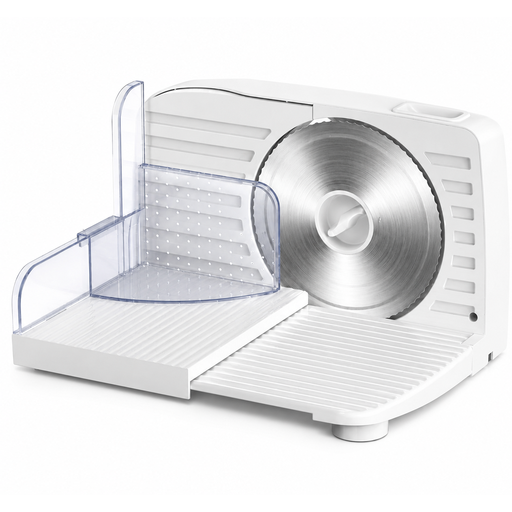 No image available
The product title mentions two blades and an adjustable slicing thickness; check whether the manufacturer lists your type of cheese as suitable for this version.
Listed in the product name: 250 W, adjustable from 0 to 15 mm and 2 blades.
 No image available
The product name mentions a removable carriage; check the product information and manual to see whether the model is suitable for your cheese.
The product name mentions a metal construction, a removable carriage and a shatter-resistant glass base. It also states that the product is made in Germany.
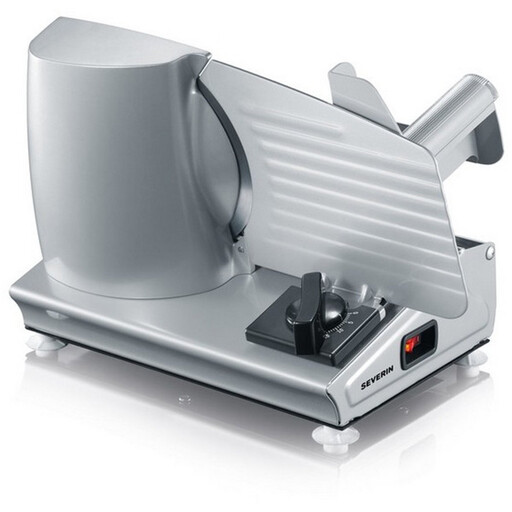 No image available
Severin lists cheese as a suitable food. The manual mentions a smooth blade and a serrated blade; this doesn’t prove that both will give the same result with every hard cheese.
Listed features: slicing thickness of 0–15 mm, two blades, sliding plate and pusher. According to the product information, the model is not suitable for children; unplug it before changing the blade or cleaning.
 No image available
FRITEL lists cheese as a suitable food and describes the model as foldable, which may be useful if you want to store the machine compactly after use.
Listed features: slicing thickness of 0–15 mm, a Ø 17 cm serrated blade, a removable carriage with food holder and a collection tray. Check the manual for instructions on use and cleaning.
There’s no general rule. DOMO lists cheese as a suitable food for the DO522S, which has a lightly serrated blade; the Severin AS 3915 manual mentions both a smooth blade and a serrated blade. Check the guidance for your type of cheese and the blades supplied with the exact version.
Follow the manual for your model. The Severin manual says to use the carriage and food holder unless the size or shape of the food makes this impossible. Unplug the machine before cleaning and don’t immerse it in water.
Not automatically. According to the Dutch government, statutory consumer rights apply in the Netherlands, with no fixed statutory warranty period; if a product is faulty, the retailer is your point of contact. First check whether a paid extended warranty genuinely offers you any additional rights.
According to the Dutch government, electrical appliances placed on the market in the EU must carry a CE mark. Check the marking and safety information; a claim in an advert is not an independent safety test.
According to the Dutch government, you can return an old household appliance to the shop or online retailer where you buy a new, similar appliance, or take it to a collection point or your local council recycling centre.