
Slicing crusty bread
You want to serve a loaf with a hard crust in slices of your chosen thickness. So compare the blade type, thickness setting and carriage space. GRAEF and DOMO list these features for their respective models.


For a loaf with a firm crust, choose an electric slicer whose manufacturer specifies a serrated blade, enough space for the loaf and the slice thickness you need. If you’re slicing several loaves in a row, check the permitted operating time too. A foldable model is handy if cupboard space is limited, but that doesn’t tell you whether it can accommodate a large loaf. Check the manual for safe use and cleaning instructions. The Dutch Government’s Business.gov.nl portal states that manufacturers must apply a CE mark and draw up an EU declaration of conformity for electrical appliances that meet the relevant requirements.
You want to serve a loaf with a hard crust in slices of your chosen thickness. So compare the blade type, thickness setting and carriage space. GRAEF and DOMO list these features for their respective models.
You’re preparing slices for several guests and want to know how long the machine can run continuously, as well as its slicing capacity. Ritter specifies a 10-minute operating time for the serano⁷; check the manual for other models.
You want to put the machine away after the meal and be able to clean its parts. FRITEL and DOMO describe foldable models; also check that your loaf will fit on the carriage.
Start by checking the blade and the space available for the loaf. Then make sure the slice thickness and operating time suit the amount you want to prepare.
| What to consider | What to look for when buying | Who is this important for? |
|---|---|---|
| Firm crust and slice thickness | Check the type of blade supplied and the thickness setting. GRAEF specifies a 170 mm serrated blade and a 0–20 mm range for the SKS110; DOMO states that the DO523S can accommodate food up to 15 cm high. | If I want to serve slices from a loaf with a firm crust, I’ll consider the blade and thickness setting, as well as the space for the whole loaf. Around 36% of consumers prioritise the crust and slice thickness. |
| Slicing several loaves in a row | Check the manual for the exact model to find its permitted operating time and whether it needs to cool down between uses. Ritter specifies a 10-minute operating time for the serano⁷. | If you’re preparing several loaves for guests, you’ll want to know whether you need to pause between them and plan your work accordingly. Around 29% of consumers prioritise operating time and the ability to slice several loaves. |
| Safe operation and cleaning | Check whether the machine has a food holder or pusher, and how to remove parts according to the manual. The GRAEF manual says to unplug the appliance before dismantling or cleaning it. | If I want to clean the parts after slicing, I need to know how to switch the machine off and dismantle it safely. Around 21% of consumers prioritise safe operation and cleaning. |
| Worktop and cupboard space | Measure the space where you’ll use and store the machine, then compare it with the appliance’s overall dimensions. Check the maximum size of the food to be sliced separately. | If you have limited cupboard space, you’ll want to be able to put the machine away without assuming that a large loaf will fit while slicing. Around 14% of consumers say limited kitchen space is their main reason for buying. |
Wattage is an electrical specification, not a measure of how well the machine will slice your bread. Blade type, adjustable thickness and permitted operating time are separate points to compare.
Check the blade description and the manual for the exact model. Treat claims about slicing hard crusts as claims made by the manufacturer, not as a guarantee for every loaf.
Foldable describes how the machine can be stored, not the maximum size of loaf that will fit on the carriage. DOMO states that the DO523S can accommodate food up to 15 cm high.
Measure your loaf and compare its dimensions with the stated space for the food before choosing a model.
The Joybuy listing using the names ‘Ritter Sport’ and ‘Duo Plus’ doesn’t, by itself, make it clear that it’s the ritter serano⁷ version. The brand, version and blades supplied may all matter.
Compare the full model name and version with the manufacturer’s information before linking a product to a specific model.
The serano⁷ is a larger domestic multi-purpose slicer for anyone comparing different slice thicknesses and the stated operating time.
The SL 3110 is a foldable bread and food slicer to compare if storage space is limited.
The SKS110 is a compact multi-purpose slicer to compare if you’re looking for a serrated blade and a wide range of slice thickness settings.
The foldable DO523S combines easy storage with a stated maximum height for the food to be sliced.
The AS 3915 is a multi-purpose slicer to compare if you want to slice other suitable foods as well as bread.
This selection includes foldable slicers and multi-purpose slicers for bread. Compare the blade type and slice thickness, and consider how much space the machine takes up when in use and in storage.
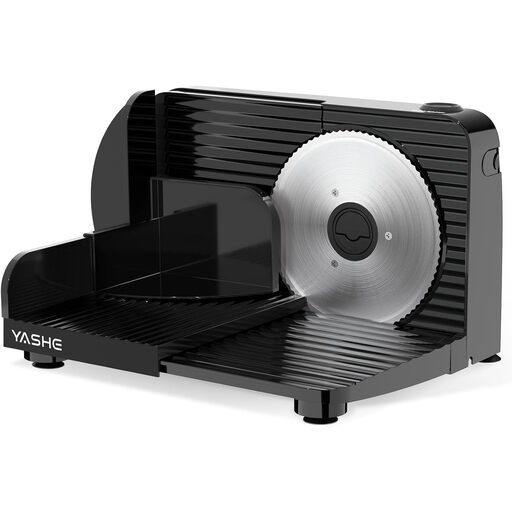 No image available
A foldable slicer to compare if you want to put the machine away after use.
17 cm serrated blade; adjustable slice thickness of 0–15 mm; 180 W.
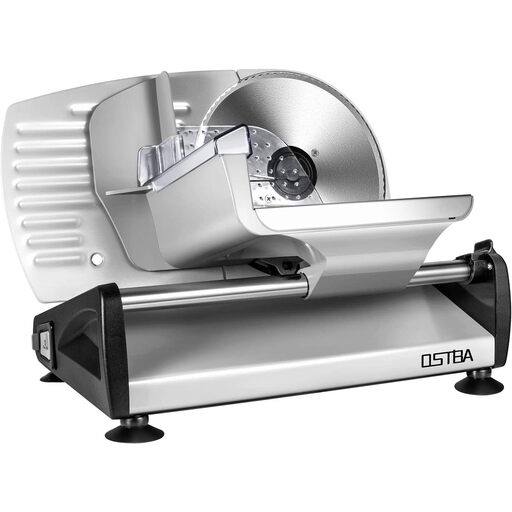 No image available
A multi-purpose slicer to compare if you want to slice bread and other listed foods.
19 cm serrated blade; adjustable slice thickness of 0–15 mm; 150 W; safety lock.
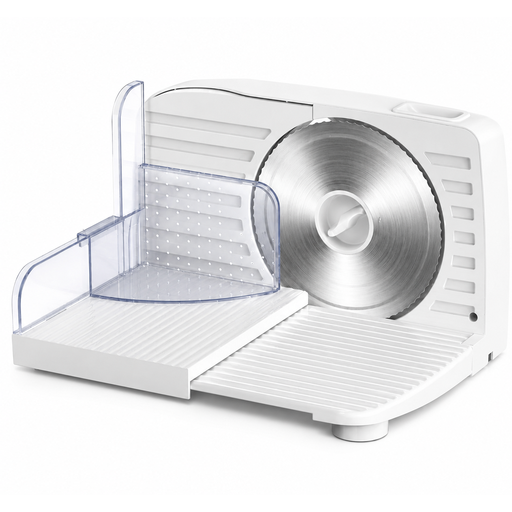 No image available
A foldable slicer to compare if you want to slice bread and store the machine compactly.
Two blades, including a serrated blade; adjustable slice thickness of 0–15 mm; 250 W.
 No image available
A multi-purpose slicer to compare if you want to slice bread and consider the controls too.
Serrated blade; slice thickness up to 20 mm; continuous and intermittent operation.
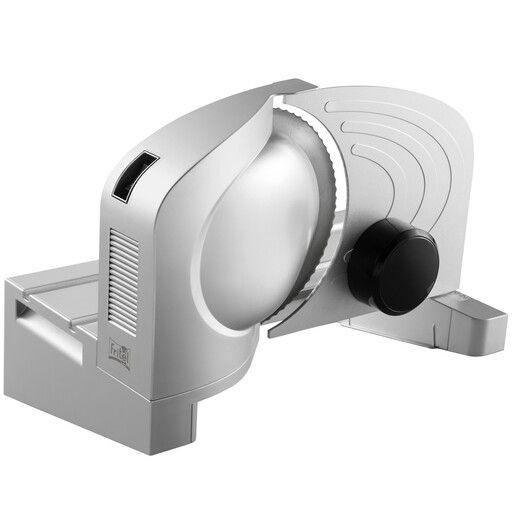 No image available
A multi-purpose slicer to compare if you want to slice bread with an adjustable slice thickness.
17 cm serrated blade; slice thickness of 0–20 mm; removable blade.
Measure the height and shape of your loaf, then compare them with the stated maximum dimensions for the food and the space on the carriage. For example, DOMO specifies a maximum height of 15 cm for the DO523S; the blade diameter doesn’t tell you how large a loaf will fit on the carriage.
Follow the manual for your model and unplug the machine before dismantling or cleaning it. The GRAEF manual gives this precaution for models including the SKS110. Clean any parts that come into contact with food, and use clean kitchen utensils if you’re going to slice other food afterwards.
Not automatically. According to the Dutch Government, if there’s a valid problem with a faulty product, the seller must provide a solution; there’s no fixed statutory warranty period in the Netherlands. Before deciding, compare the terms of any extra cover with your existing rights.
Electrical appliances placed on the market in the Netherlands must meet the relevant European requirements. The Dutch Government’s Business.gov.nl portal states that, after carrying out an assessment, the manufacturer applies the required CE mark and draws up an EU declaration of conformity. Check the information for the exact model; a CE mark isn’t a slicing test.
Yes. If you sell food to consumers from home, you must follow business rules on food safety. The Netherlands Food and Consumer Product Safety Authority sets out requirements for preparing, selling and storing food safely and hygienically. Those rules don’t automatically apply to a private meal where no food is sold.