
Anyone slicing crusty bread
You want to slice a bakery loaf evenly at home, so you’re looking at the blade, thickness setting and space for the whole loaf.


When choosing an electric slicer for crusty bread, start by looking at the blade, adjustable slice thickness and space for your loaf. Wattage alone doesn’t tell you how well a machine slices. A foldable model may suit you if storage space is limited, while a larger or metal multi-purpose slicer may be worth considering for bigger loaves or slicing other foods. Manufacturer specifications are not an independent comparative slicing test.
You want to slice a bakery loaf evenly at home, so you’re looking at the blade, thickness setting and space for the whole loaf.
You use the slicer occasionally and want to be able to put it away and clean it after use.
You compare the blade, carriage and cleaning method for each model, based on the foods you want to slice.
Start with the blade and the slice thickness you want, then check whether your loaf will fit on the carriage. Next, consider cleaning and storage to make sure the machine is practical for your kitchen.
| What to consider | What to look for | Who is this most important for? |
|---|---|---|
| Crust and slice thickness | Check the blade type and adjustment range for the exact model. Manufacturers describe different blades and thickness ranges. | If I want to slice crusty bread to my preferred thickness, I compare the blade and setting. Around 33% of consumers say crust and slice thickness are their top buying priority. |
| Space for the loaf | Measure the height and length of your loaf and compare them with the relevant dimensions of the machine. DOMO lists a maximum height of 16 cm for the DO522S; ritter gives a carriage travel of approximately 18 cm for the E 16. These are different measurements. | If my loaf is large, I want to know whether it will fit on the machine before choosing. Around 25% of consumers say loaf size is their top buying priority. |
| Operation and cleaning | Check which parts can be removed and read the safety and cleaning instructions for the exact model. Graef advises unplugging the appliance before dismantling or cleaning the series mentioned. | If I want to clean the blade and parts safely, I check how the machine works and read the instructions. Around 25% of consumers say operation and cleaning are their top buying priority. |
| Storage or versatility | Check the folded dimensions if cupboard space matters, or see which blades are actually included if you also want to slice other suitable foods. | If I have limited cupboard space or want to slice other foods too, I consider which of these features matters most to me. Around 17% of consumers say storage or versatility is their top buying priority. |
Blade diameter, the maximum height of the food being sliced and carriage travel are different measurements. A larger blade diameter alone doesn’t tell you how much room your loaf will have on the carriage.
Measure your loaf and compare its dimensions with the space specified for the model. DOMO and ritter publish different types of measurements for this.
A foldable design doesn’t mean the spinning blade is guarded during use. A switch, food holder and foldability are separate features.
Use the carriage and food holder provided, and follow the safety and cleaning instructions for the exact model. Only fold the machine away when the manual says it is safe to do so.
In the Netherlands, statutory rights apply alongside any manufacturer’s guarantee. According to ACM ConsuWijzer, the seller must resolve the issue at no cost if a faulty product breaks too soon during normal use. What you could reasonably expect from the product is also taken into account.
Keep your purchase and model details, and contact the seller if there’s a problem with a faulty product.
FRITEL describes the SL 3070 as a foldable bread slicer for anyone who wants to put the appliance away after use.
The DO522S is a larger multi-purpose slicer to consider if space for your loaf is a key buying factor.
The E 16 is a metal multi-purpose slicer to compare if you also want to slice other foods or cut thicker slices.
Graef describes the SKS100 as a compact multi-purpose slicer and says its blade is suitable for bread with a hard crust.
The AS 3915 is a metal multi-purpose slicer to compare if you want to slice other suitable foods as well as bread.
These product picks are aimed at slicing bread, with differences in thickness settings, blades and storage. Before buying, check with the seller whether the exact version carries the required CE marking and whether an EU Declaration of Conformity is available. Ondernemersplein explains that electrical appliances sold in the Netherlands must comply with the applicable European rules.
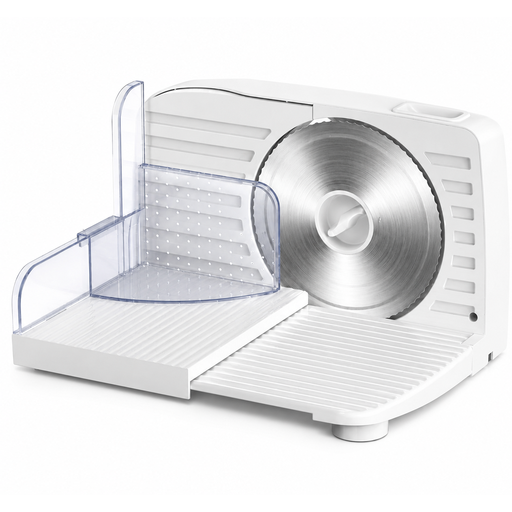 Image unavailable
An option if you want to slice bread and adjust the thickness of each slice.
The product name lists 250 W, a range of 0–15 mm and 2 blades.
 Image unavailable
An option if you’re looking for a food slicer for bread and more.
The product name lists a metal construction, an angled design, a DC motor and electronic speed control.
 Image unavailable
An option if you want to slice other suitable foods as well as bread.
The product name lists a metal construction and a removable carriage.
 Image unavailable
An option if you want to slice bread and fold the machine away after use.
The product name lists a serrated blade, an adjustment range of 0–15 mm, a blade diameter of 17 cm and 100 W.
 Image unavailable
An option if you want to slice bread and need a wider slice thickness range.
The product name lists an adjustment range of 0–20 mm, a 19 cm blade, 150 W and a carriage angled at 15°.
Don’t treat wattage as proof of slicing quality on its own. First compare the blade, thickness setting and available space for your loaf. Manufacturers’ product specifications are not a directly comparable slicing test.
Measure the height and length of your loaf and compare them with the dimensions given by the manufacturer for the exact model. Maximum height and carriage travel are different measurements and can’t be used interchangeably.
Follow the instructions for the exact model. For the series mentioned, Graef advises unplugging the appliance before dismantling or cleaning it. For other models, check their instructions for removing the blade and other parts.
According to Ondernemersplein, electrical appliances sold in the Netherlands must comply with the applicable European rules. After carrying out a conformity assessment, the manufacturer affixes the CE marking and draws up an EU Declaration of Conformity. A CE marking alone is not an independent safety test.
In the Netherlands, statutory rights apply alongside any manufacturer’s guarantee. According to ACM ConsuWijzer, the seller must resolve the issue at no cost if a faulty product breaks too soon during normal use. What you could reasonably expect from the product is taken into account when assessing the issue.