
Vandaag of morgen in huis

Kwaliteit gegarandeerd

Welkomstaanbiedingen ontgrendelen: GRATIS bezorging | Tot 80% korting | Gratis 30 dagen JoyPlus-proefperiode
Download de app
An electric slicer can be useful for fresh bread, cheese, cold meats, charcuterie and some vegetables. However, not every model is suitable for regular use in a British kitchen. A low price means little if the blade quickly becomes blunt, the appliance moves around on the worktop or cleaning is unnecessarily difficult.
Pay particular attention to these three common pitfalls:
An adjustable slicing thickness of 0-20 mm is suitable for a range of uses. Thin slices work well for cold meats, cheese and charcuterie. A thicker setting is more practical for bread or substantial sandwiches.
Check whether the setting is continuously adjustable. This allows you to match the thickness more precisely to the food. An electric bread slicer should also provide enough room for the size of your loaf. So, do not only look at the maximum thickness; also check the dimensions of the carriage and stop plate.
A blade with a diameter of 17 to 19 cm offers a useful balance between capacity and appliance size in many homes. A larger blade can be useful for wider loaves and larger pieces of meat, but it also takes up more space.
A slicer with a serrated blade is practical if you want to slice both bread and firm charcuterie. The serrations grip the crust or solid food. A universal blade may be more appealing if you want to process a variety of ingredients, including cheese, vegetables and meat. Always check whether the blade is removable. This makes cleaning easier, but always unplug the appliance before removing it.
A metal housing, metal stop plate and motor with geared drive can contribute to a more stable construction. These are verifiable product specifications, but they do not guarantee that every product will provide the same experience in every kitchen.
Also look out for:
A Fritel slicer, such as the models below, combines several of these features. Pay particular attention to which size, blade design and controls best suit the way you intend to use it.
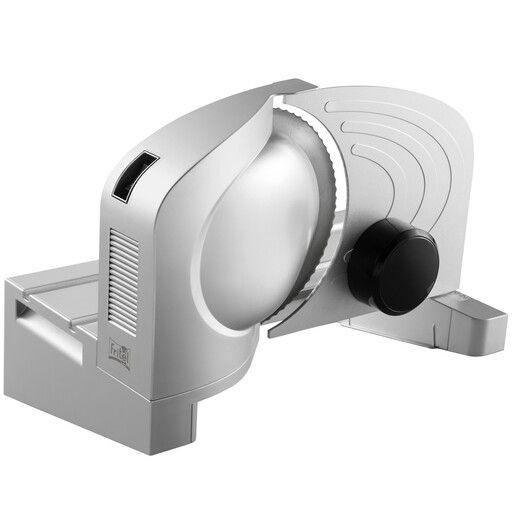
Why it suits this profile: This model is suitable for households that regularly slice bread, cheese, cold meats and vegetables without choosing an extra-large appliance.
The continuously adjustable 0-20 mm setting means you are not restricted to fixed slicing thicknesses. According to the product specifications, the serrated stainless-steel blade is removable.
160 W, a 17 cm blade diameter, metal housing and a carriage angled at 15°.

Why it suits this profile: The larger carriage and 19 cm blade are ideal for users who regularly process large loaves, blocks of cheese or pieces of charcuterie.
The non-slip feet, angled carriage and food holder help position the food more securely. The slicing thickness remains adjustable from 0-20 mm.
190 mm universal blade, metal construction, collection tray and three settings: off, continuous and pulse.
Why it suits this profile: If you slice several types of food one after another, the larger blade provides extra working space. However, bear in mind the specified usage and cooling times.
The manual specifies a maximum of 10 minutes of continuous use, followed by 30 minutes of cooling. This prevents you from using a domestic appliance as a continuously running machine.
Geared drive, 15° angled carriage, 0-20 mm slicing thickness and included food holder and collection components.
We have compiled a complete, up-to-date list of products that fully meet these strict selection criteria and the applicable European safety regulations.
A slicer has a sharp blade. Always use the supplied food holder when a piece of food becomes smaller. Never push food towards the blade with your bare fingers, even when the motor is switched off.
Practical habits for home use:
The statutory guarantee within the European Union applies when the product does not conform to the sales contract. Keep your purchase details and contact the seller if a fault occurs.
That depends on the blade and food holder. A serrated blade is practical for bread with a hard crust and firm charcuterie. For meat, cheese and vegetables, also check the permitted product description and clean the blade carefully between different ingredients.
With models offering a range of 0-20 mm, you can continuously adjust the thickness within that range. Thin slices are suitable for sandwich fillings; thicker slices work better for bread or sandwiches. The actual result also depends on the firmness and shape of the food.
Power consumption depends on the motor rating and how long the appliance is used. A 150 or 160 W model mainly uses electricity while the motor is running. Short slicing sessions using the pulse setting limit the operating time. Do not leave the machine running unnecessarily and observe the specified cooling period.
