
Vandaag of morgen in huis

Kwaliteit gegarandeerd

Welkomstaanbiedingen ontgrendelen: GRATIS bezorging | Tot 80% korting | Gratis 30 dagen JoyPlus-proefperiode
Download de app
An electric slicer can save you a lot of time at home. It cuts bread, cold meats, cheese, vegetables and fruit more evenly than a standard kitchen knife. However, not every model is suited to every task. A compact bread slicer works differently from an electric knife, while a food slicer for everyday use requires more attention to construction and maintenance.
Most disappointing purchases usually result from three misconceptions:
An electric knife uses two moving blades and is useful for roasts, baguettes and some vegetables. You move the knife through the food while the motor supports the sawing action. This type is usually compact and quick to store away.
A fixed electric slicer, also known as an electric meat slicer, bread slicer or food slicer, generally has a rotating blade and a carriage. You slide the food past the blade in a controlled manner. This is particularly practical when you want to make lots of evenly sized slices of bread, cheese or cold meats.
So don't choose an electric meat slicer based solely on the product name. Check which blades are included, the maximum cutting thickness and how you need to hold the appliance.
For everyday use at home, an adjustable cutting thickness is more important than impressive motor power. The FRITEL SL 3110, for example, offers a range of 0 to 15 mm and has a serrated blade with a diameter of 17 cm. This suits bread, cheese, cold meats and certain vegetables or types of fruit.
According to the product specifications, the ritter Sono¹ cuts up to 20 mm, while the ritter serano⁷ is listed as reaching 23 mm. A wider range gives you more flexibility, but it also requires sufficient workspace and a firm, stable position.
Bear in mind:
A serrated blade makes sense for bread, but not every serrated blade performs the same way with cheese or meat. Some models are supplied with multiple blades. According to the product information, the Fritel EK 3180 includes a meat blade and a blade for frozen products.
With a fixed slicer, the carriage and drive system are at least as important as the blade. A removable carriage makes cleaning easier. A metal housing may be heavier and more stable, but it often takes up more space than a plastic model.
The ritter models are described in the product information as German electric slicers with a metal construction. When buying, always check which parts are actually included and whether spare parts or servicing are available.
A slicer has sharp blades and therefore requires clear safety features. Check for:
With an electric knife, a double safety switch is a useful feature. The Fritel EK 3180 lists such a double switch to help prevent accidental activation. Always unplug the appliance before fitting or removing blades, and do not touch the cutting edge.
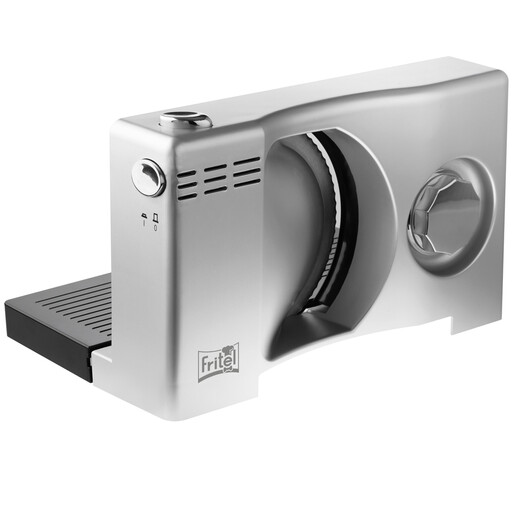
Why it suits this profile: A compact choice for anyone who occasionally wants to slice bread, cheese or cold meats and store the appliance away easily.
The machine folds down and has a removable carriage and serrated stainless-steel blade, making storage and maintenance straightforward.
Cutting thickness from 0–15 mm, a child-safe on/off switch and a plastic collection tray.
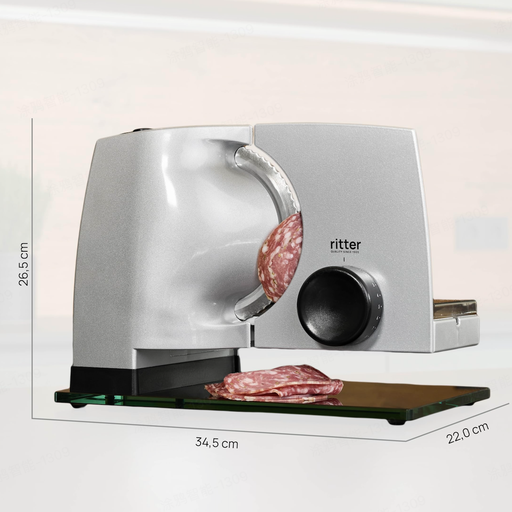
Why it suits this profile: Suitable for home cooks who prepare several types of food and value the choice of materials and a polished finish.
The removable carriage makes cleaning easier. The metal construction and glass base plate are clearly described in the product information.
Cutting thickness of up to 20 mm, ECO motor, momentary and continuous switches, and a serrated blade.
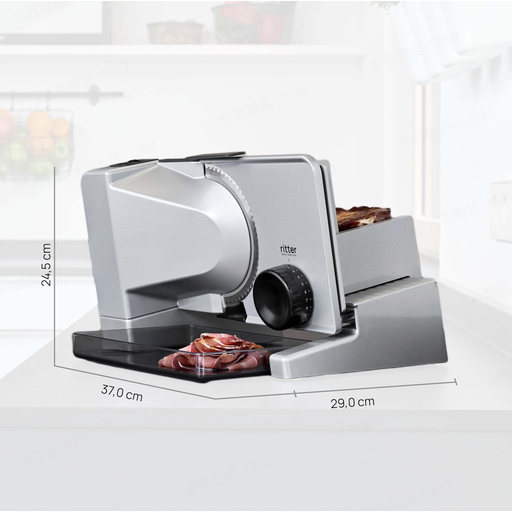
Why it suits this profile: An option for anyone who regularly prepares large pieces of bread, meat or cheese and wants more control over the cutting speed.
The product description mentions electronic speed control, a removable carriage and two blade versions for different applications.
Cutting thickness of up to 23 mm, metal construction, smooth and serrated blades, and a collection tray.
If you mainly want to slice roasts, roulades, baguettes or cabbage, an electric knife may be a better choice than a fixed food slicer. According to the product description, the Fritel Electric Knife EK 3180 has a power rating of 150 W, an ergonomic handle and two blades. The double safety switch is particularly useful in households where the appliance is regularly stored away and used again.
Use an electric knife slowly and without applying pressure. Let the moving blades do the work and keep your fingers away from the cutting line. Do not immerse the motor handle in water; clean the outside with a damp cloth and follow the instructions for the blades.
We have put together a complete, up-to-date list of products that fully meet these strict selection criteria and the applicable European safety regulations.
An electric slicer generally uses little energy during a short slicing session. Actual consumption depends on the power rating and how long the appliance is used. A 100 W model running for a few minutes uses less energy than a more powerful machine used for a longer period. For normal use at home, the difference on your energy bill is usually smaller than the difference in purchase price.
Clean the blade, carriage and collection tray after use according to the instructions. Remove crumbs and grease before they dry. Regularly check the cord, plug and blade attachment. A blunt or damaged blade can affect performance and control; only replace parts with suitable replacements.
That depends on the construction and the recommended usage time. A compact slicer with a folding design is suitable for occasional use. For daily slicing of bread, cold meats and cheese, a sturdy carriage, removable parts and a good cutting-thickness range are important.
For bread, around 10 to 15 mm is often practical, although the preferred thickness varies depending on the type of bread. Many users choose a thinner setting for cold meats. So check whether the machine can be adjusted continuously or in small increments, and whether the product information states the full range.
Its lifespan depends on how often it is used, cleaning, storage and the availability of blades and other parts. A metal construction may feel stable, while a compact plastic model is easier to move. As well as checking the warranty, look at the maintenance information and whether parts can be replaced.
