
Vandaag of morgen in huis

Kwaliteit gegarandeerd

Welkomstaanbiedingen ontgrendelen: GRATIS bezorging | Tot 80% korting | Gratis 30 dagen JoyPlus-proefperiode
Download de app
An electric slicer can be useful for fresh bread, cheese, cold meats, vegetables and fruit. However, there are significant differences between models. Some appliances are mainly designed for slicing a few pieces of bread occasionally, while others offer more space, a more powerful motor or multiple blades.
Marketing often focuses on power or sleek design. For everyday use, other factors are just as important: the adjustable slicing thickness, how you hold the food and how easy the machine is to clean.
Higher power does not automatically mean that you will slice faster or more evenly. The machine’s construction, drive system and the stability of the carriage also play a part. A compact electric bread slicer with a lower wattage may be perfectly adequate for occasional use, while frequent users may benefit more from a model with metal components and a suitable motor.
As well as the power rating, check:
For example, the Fritel SL 3710 is listed with a 150W motor with gear drive. The instructions also state that the motor should not be used for more than 10 minutes at a time, followed by a cooling period.
A bread slicer for thin slices needs different settings from a meat slicer for charcuterie or cheese. Do not just look for the word “adjustable”; check the actual range in millimetres.
For many households, 0 to 15 mm is suitable. If you also want to slice thicker pieces, larger cuts of meat or firm vegetables, a range of up to 20 or 23 mm may be more useful. Bear in mind that the actual result also depends on the shape and firmness of the food.
A food slicer has a sharp, rapidly rotating blade. A machine without a good food holder or stable non-slip feet can therefore be awkward to use. Always use the supplied food holder and keep your fingers away from the blade.
Also look for:
Unplug the machine before removing the blade or cleaning any components. The motor housing must not be immersed in water.
A serrated blade is practical for bread and products with a firm outer layer. A smooth blade may be better suited to finely sliced cold meats and cheese. Some models include both blades, making them more versatile than a basic home bread slicer.
Also check whether a collection tray, removable carriage and food holder are included. These accessories may seem minor, but they make the machine easier to use and reduce contact with the blade.
A 15° inclined position can help you move food along the guide in a controlled way. More importantly, the appliance must remain firmly in place on the worktop. Non-slip feet, a metal carriage and a sufficiently wide base are practical features.
A folding electric slicer saves storage space. On the other hand, you must check each time that the appliance has been unfolded fully and is stable.
An electric knife uses blades that move back and forth and is particularly suitable for foods such as roast meat, baguettes or cabbage. It is less focused on producing identical, thin slices of a set thickness.
An electric meat slicer or universal slicer uses a round rotating blade and a carriage. This arrangement generally gives you more control over the slicing thickness. If you mainly slice bread, cheese and cold meats, a kitchen slicer will usually be more useful than an electric knife.

Why it suits this profile: This compact model is designed for bread, cheese and cold meats and can be folded away after use. That makes it a good choice for households that do not want to leave a large appliance on the worktop.
The slicing thickness can be precisely adjusted from 0 to 15 mm. The food holder, removable carriage and non-slip features help ensure controlled use.
Folding design, 170 mm serrated blade and plastic collection tray.

Why it suits this profile: The metal construction and glass base are well suited to anyone who values materials, finish and a permanent place for the appliance on the worktop.
The removable carriage makes cleaning after use easier. The safety switch and continuous-operation switch offer two operating options.
Slicing thickness of up to 20 mm, metal mounting construction and a carriage with an 18 cm cutting path.

Why it suits this profile: This model is designed for a wide range of products, including bread, charcuterie, cheese, vegetables and meat. It is suitable for users looking for one machine to handle multiple slicing tasks.
The slicing thickness is clearly specified as 0 to 20 mm. The angled housing, food holder and non-slip feet help guide food steadily.
190 mm blade diameter, 150W gear drive and included collection tray and food holder.
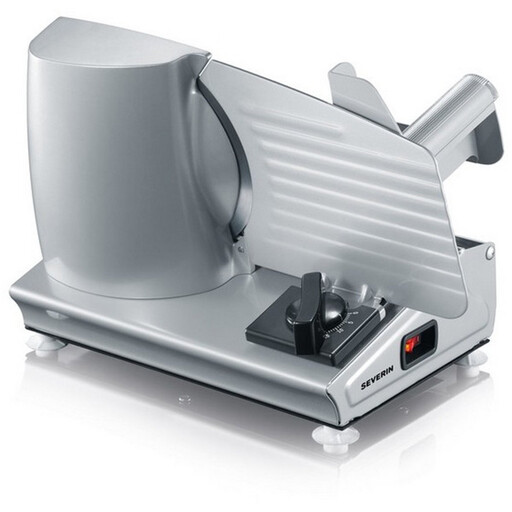
Why it suits this profile: The combination of two blades makes this model appealing to households that want to slice both bread and finer cold meats.
You get both a smooth blade and a serrated blade. The metal carriage, finger guard and rubber feet address three practical considerations.
180W power, slicing thickness from 0 to 15 mm and a 131 cm cable.
We have put together a complete, up-to-date list of products that fully meet these strict selection criteria and the applicable European safety regulations.
That depends on the operating time and the manufacturer’s instructions. Check whether the model is suitable for short or longer slicing sessions. Some appliances require the motor to cool down after a certain period. Do not use the machine continuously for longer than stated in the instructions.
For standard slices of bread and cold meats, a range of 0 to 15 mm is often practical. For thicker slices of cheese, larger pieces of meat or certain vegetables, a range of 20 mm or more may be more useful. An electric meat slicer with a smooth blade is particularly suitable for fine, even slices.
Consumption depends on the power rating and how long the motor runs. A 100 to 180-watt model uses relatively little electricity while slicing, and the appliance usually only needs to run for a short time. More importantly, choose the right model for your needs so that you do not have to slice unnecessarily slowly or with extra force.
