
Vandaag of morgen in huis

Kwaliteit gegarandeerd

Welkomstaanbiedingen ontgrendelen: GRATIS bezorging | Tot 80% korting | Gratis 30 dagen JoyPlus-proefperiode
Download de app
An electric shaver for men can save you time and make a handy choice for everyday use, travelling or tidying up stubble. But a long list of features doesn’t automatically mean a device will suit your routine. A men’s shaver might, for example, boast impressive battery life but feel awkward to hold. Or a model might be advertised as waterproof, without making it clear whether it’s safe to get wet while charging.
This buying guide will help you compare the key specifications and find the type of shaver that suits the way you use it.
A waterproof shaver with an IPX rating is designed to offer a certain level of protection against water. IPX6 means protection against powerful water jets; according to the relevant classification, IPX7 refers to temporary immersion under specified conditions. This doesn’t automatically mean you can use the device while it’s connected to the charger.
So always check:
A rechargeable shaver might, for example, claim 90 or 120 minutes of use. Actual running time depends on how often you shave, how dense your beard is and the condition of the battery. Charging time matters too. A cordless shaver with a long run time but a slow charging time may be less suitable if you often forget to charge it.
A battery indicator, travel lock and USB-C charging are practical features. Just check whether an adapter is included. Some models come with a cable only.
A rotary shaver with several flexible shaving heads is mainly designed to shave short growth efficiently. A beard trimmer works differently: it keeps your beard at a chosen length. An electric shaver with a trimmer can do both, but check whether it has a separate comb attachment, a pop-up precision trimmer or a proper adjustable trimmer.
A rotary head typically moves in circles across your face. According to the product description, a floating or adaptive head may follow the contours of your jaw and neck more closely. This can be useful if your facial contours are uneven, but results vary depending on your beard type and shaving technique.
Check the blade material, whether the head can be cleaned and whether replacement parts are available. Stainless steel is used in various models, but lifespan also depends on maintenance and wear.
A wet and dry shaver may be suitable for dry use or for use with shaving gel and foam. Only use water when the product information explicitly says it’s safe to do so. Let a cleaned device dry completely before putting it away or connecting it to a power source.
An IPX6 or IPX7 rating tells you about water resistance, not shaving comfort, blade quality or battery life. Treat the rating as one factor in your decision, not as a general guarantee of quality.
A USB-C shaver is handy if you already use a compatible cable and adapter. Check the input specifications and always charge it with a compatible power supply. If the model has a lithium-ion battery, don’t continue using it if the cable or casing is damaged.
For a travel shaver, these points are particularly useful:
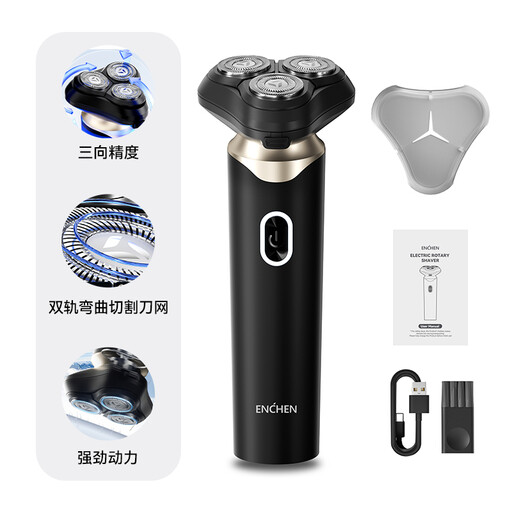
Why it suits this profile: This model is a straightforward choice if you’re looking for a rechargeable rotary shaver without lots of extra parts. According to the product information, it has a lithium-ion battery and a Type-C port.
The product description clearly states the charging type and that it has a rotary head. It isn’t specified as fully waterproof, so don’t assume you can use it in the shower.
Rotary design, cordless use and Type-C charging, according to the product details.
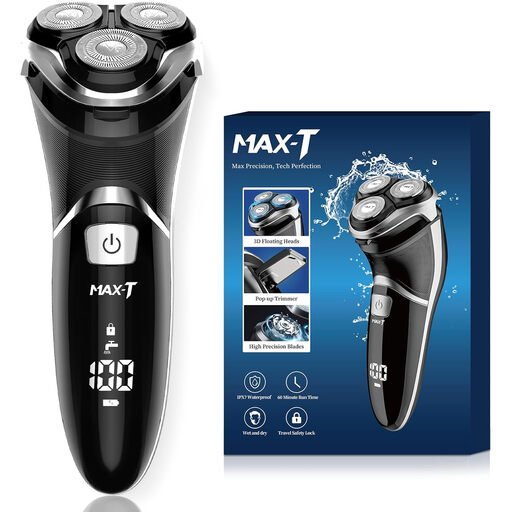
Why it suits this profile: Suitable for users who want to shave wet or dry and value a longer stated run time. According to the product description, this model is IPX7 water-resistant and has a pop-up trimmer.
The specifications include the IPX7 rating as well as charging and cleaning instructions. This makes it easier to assess how to use water and maintain the shaver than relying on the word ‘waterproof’ alone.
Up to 120 minutes of use, around 60 minutes to charge, an LED indicator and a pop-up trimmer, according to the product information.

Why it suits this profile: A practical choice if you want to do more than just shave smoothly and need to maintain different beard lengths too. The product information lists 40 settings, a Type-C port and up to 90 minutes of use per charge.
The length settings are clearly specified rather than described simply as ‘versatile’. According to the product information, the IPX7 rating allows you to clean it under running water; the port must be dry before charging.
40 length settings from 0.5 mm, two adjustable combs, Type-C charging and a stated run time of up to 90 minutes.
Clean the shaving head after use according to the manual, and remove hairs with the supplied brush if recommended. Let the parts dry before putting them back in place. Don’t use a damaged device, and stop shaving if you experience redness or discomfort. Blades and attachments are wear parts; replace them when they become blunt or damaged.
If you mainly want a close shave, you could choose an electric shaver. If you maintain stubble or a longer beard, a beard trimmer is often a better option. For a classic wet shave, separate Gillette Fusion5 or ProGlide blades are an alternative, but you’ll need to keep buying replacement blades.
We’ve put together a complete, up-to-date list of products that meet these strict selection criteria and the applicable European safety regulations.
That depends on your skin, beard growth and shaving technique. Start with short strokes and clean the head regularly. Only use a model wet if the manufacturer says it’s suitable for this in the product information.
Run time per charge varies between models. The stated 90 or 120 minutes is a product specification, not a fixed guarantee for every user. Overall lifespan depends on factors including battery use, cleaning, storage and replacing blades or shaving heads in good time.
Not necessarily. USB-C can be handy if you already have a suitable adapter, but check that it provides the correct voltage and current. Also check whether an adapter is included, and avoid charging with damaged cables.
