
Anyone cleaning a small tiled surface
You want to reach grout, corners and the areas around the tap without having to handle a large floor scrubber. Bosch DIY lists tiles, grout and tight spaces among the uses for the UniversalBrush.


For a small tiled vanity top, a compact handheld model with a head for both the tile surface and the grout around the tap is usually the best fit. An adjustable handle is worth considering if you also want to clean floor or wall tiles, or reduce the need to bend. Match the head to the tile finish, keep used attachments in a clearly labelled place and let them dry before putting them back in the shared cupboard. Also check what’s included in the exact set, along with the instructions for use, charging and product safety.
You want to reach grout, corners and the areas around the tap without having to handle a large floor scrubber. Bosch DIY lists tiles, grout and tight spaces among the uses for the UniversalBrush.
You want to be able to clean attachments after use, let them dry and store them somewhere clearly identified. RIVM KIDDI offers guidance on dry storage in childcare settings; this is practical background here, not a household requirement.
You also want to clean lower or larger tiled surfaces, so you’re considering a model with a handle. Hulpmiddelenwijzer describes an electric cleaning brush as an aid for people who find it difficult to bend, kneel or reach.
First decide which surfaces you want to clean with the brush and what finish your tiles have. Then check that the heads, instructions and storage options are suitable for the job.
| What to consider | What should you look for? | Which consumers should consider this? |
|---|---|---|
| Reaching the vanity top and tap | Check whether the heads supplied are suitable for the tiled surface, narrow grout lines and the area around the tap. A small head requires more passes over larger surfaces. | If I mainly clean the vanity top and the grout around the tap, I want a head that can reach those areas. Around 36% of consumers say reach is their main reason for buying. |
| Tile finish | Identify the material and finish, follow the tile manufacturer’s care advice and check whether the set includes a suitable soft pad. A soft pad isn’t necessarily suitable for dirt deep in the grout. | If you want to avoid scratching delicate or polished tiles, you’ll need to match the head carefully to the surface. Around 29% of consumers put the tile finish first. |
| Sharing and storing attachments | Check whether the heads can be detached, how to clean them according to the instructions, and where they can dry and be stored so they’re easy to identify. Also check whether replacement heads are available for the exact model. | If several people use the same cupboard, I want to know which head is for which job and be able to let them dry properly after use. Around 21% of consumers say shared use is their main reason for buying. |
| Extra reach and less bending | Decide whether you’ll clean floors or wall tiles as well as the vanity top. Check whether the head remains practical for those surfaces and whether the handle will fit in the cupboard. | If you want to clean lower or more distant surfaces as well as the vanity top, extra reach may be important. Around 14% of consumers prioritise reducing bending and reaching further. |
A head that’s useful for grout may not be suitable for the tile surface. Atlas Concorde advises against using hard brushes on polished porcelain; this warning doesn’t automatically apply to every type of tile.
Identify the finish, follow the tile manufacturer’s care advice and carefully test a suitable head in an inconspicuous area.
Bosch describes the UniversalBrush’s IPX5 rating as protection against water splashes. This doesn’t mean the appliance or charging area can be submerged.
Follow the instructions for the exact model when using, cleaning and charging it.
A handle is most useful for larger or lower surfaces. For a small vanity top, a well-fitting head and easy access around the tap may matter more.
Before buying, decide which surfaces you actually want to clean with the same appliance.
Attachments may be designed for different surfaces or jobs. For the Clatronic ERB 3815 A, the manufacturer describes a separate replacement set, but that doesn’t tell you which parts are included with a different model.
Check what’s included and which replacement heads are available for the exact model, and create a clearly labelled storage system in the shared cupboard.
The UniversalBrush is a compact handheld model for tiles, grout and tight spaces, among other uses.
An option to consider if you want to reach floor or wall tiles as well as the vanity top using a handle.
The ERB 3815 A is a compact model for which the manufacturer also describes a separate replacement-head set.
The Versa PC10-1/10 is a compact appliance with interchangeable brushes and pads for small cleaning jobs.
These products are selected for cleaning tiles and bathrooms. Compare them by the number of heads supplied, the information on extra reach and how you can store the set in a shared cupboard.
 No image available
A rechargeable brush for anyone looking to tackle tile and bathroom cleaning with interchangeable heads.
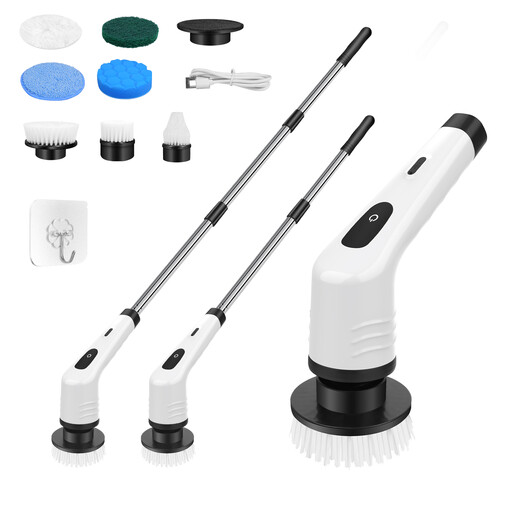
The product name lists 7 interchangeable heads and a rechargeable design. Check exactly which heads are included and whether the instructions for use and charging suit your needs.
 No image available
A rechargeable brush for cleaning tiles and bathrooms; the white design distinguishes this listing from the other version in this selection.
The product name lists 7 interchangeable heads. Check what’s included with this model and whether the shape of the head suits the vanity top, grout and area around the tap.
 No image available
The stand mentioned may be useful if you want to keep the appliance and accessories together; check that there’s room for it in the shared cupboard.
The product name lists 7 heads, an LCD screen and 3 speeds. Don’t immerse the main unit in water, even though the product information states an IPX6 rating.
Use a head that can reach the grout, and match the head for the tile surface to its finish. Atlas Concorde advises against hard brushes on polished porcelain; Bosch DIY also describes a non-abrasive microfibre pad. Check whether that pad is included with your model.
Clean used attachments according to the product instructions, make sure it’s clear what each one is for, and give them room to dry before putting them away. RIVM KIDDI’s guidance on dry storage comes from childcare guidelines and is a practical suggestion here, not a household requirement.
Don’t assume so from the appliance’s IPX rating: follow the charging and drying instructions in the manual for the exact model. Brandweer Nederland lists battery damage as a fire risk.
As well as any manufacturer’s or seller’s guarantee, you’re entitled to a legal guarantee. ACM ConsuWijzer explains that a product must meet the expectations you’re entitled to have of it when used normally; if it’s faulty, the seller is responsible for providing an appropriate remedy free of charge. There isn’t a fixed legal warranty period of two years for every appliance.
Electrical appliances placed on the market in the EU must meet the applicable safety requirements and carry a CE marking. The Dutch Government advises checking the marking and product information on the actual item; a general product listing doesn’t prove this.