
Grout and corner cleaner
You mainly want to reach the narrow edges and internal corners of a tiled niche during your weekly clean. So, start by checking the shape of the detail head.


For narrow grout lines and internal corners, a compact brush with a suitable detail head is a sensible starting point. A versatile handheld brush may be a better fit if you also want to clean accessible tiled surfaces, while an extension pole can help with a niche positioned high or low on the wall. Check the tile finish, the heads and battery included with the exact model, and the instructions for water exposure and charging. A splash-resistance rating does not mean a brush can be submerged.
You mainly want to reach the narrow edges and internal corners of a tiled niche during your weekly clean. So, start by checking the shape of the detail head.
You want to protect the tile finish and need a brush and cleaning product that are suitable for it. Atlas Concorde specifically warns against using hard brushes on polished porcelain; this advice does not automatically apply to every type of tile.
Your niche is high or low, so extra reach matters more than a compact handle. Also check that the head has enough room to move inside the niche when attached to the pole.
Best for: narrow grout lines, edges and internal corners in a small niche.
Keep in mind: check that the head fits inside the niche and is compatible with the machine. RYOBI supplies the RDS4-0 without a battery; Dremel lists the Versa PC10-1/10 we reviewed as discontinued.
Best for: anyone who wants to clean accessible tiled surfaces as well as the niche, and switch between suitable attachments.
Keep in mind: a general-purpose brush head won’t necessarily reach every internal corner. Bosch lists the UniversalBrush as IPX5-rated; this does not mean you can submerge the machine.
Best for: a niche at an awkward height where extra reach is needed.
Keep in mind: a pole does not automatically give you more room to manoeuvre inside a narrow niche. RYOBI states that the RTS4-0 is supplied without a battery.
| What to consider | What to look for | Who is this important for? |
|---|---|---|
| Grout and internal corners | Compare the head shape, fitting and included accessories with the available space in your niche. | If I mainly want to reach narrow grout lines and internal corners, I prioritise the shape of the detail head. Around 36% of consumers put access to grout lines and corners first. |
| Tile finish | Find out what type of tile and grout you have and follow the care advice. Carefully test a suitable head in an inconspicuous spot. | If I want to protect the visible finish, I first check which brush is suitable. Around 29% of consumers give protecting the tile finish top priority. |
| Water exposure and charging | Read the instructions on water exposure, cleaning and charging for the exact model you choose. | If water is involved in cleaning, I want to know how to use the machine and charger in line with the instructions. Around 21% of consumers prioritise moisture resistance and safe use. |
| Reach and complete set | Check that the pole and head fit inside the niche, and that the required battery and accessories are included. | For a niche positioned high or low, I first check the reach and what’s in the box. Around 14% of consumers give reach and a ready-to-use set top priority. |
A brush that covers a large tiled area may not reach narrow edges or internal corners. Bosch and Dremel describe separate brushes for detail work.
Compare the head shape and included accessories with the space you have to work in your niche.
Atlas Concorde advises against hard brushes on polished porcelain because they may cause scratches. This warning applies to that finish; it is not a general statement about all tiles.
Check the type of finish you have and follow the relevant care advice before choosing a brush.
RYOBI states that the battery is not included with the RDS4-0 and RTS4-0.
Check the exact model, what’s included and compatibility before choosing a set.
You may need to buy a compatible battery or a required accessory separately.
Bosch describes the UniversalBrush as suitable for a range of tile and grout cleaning tasks, and mentions a precision brush for hard-to-reach areas.
The RDS4-0 is a compact detail scrubber, while the RTS4-0 has a telescopic pole for extra reach.
Dremel describes Versa detail and corner brushes for grout and hard-to-reach areas.
These Joybuy products are electric scrubbers for tiles and grout, including models with a telescopic pole.
 No image available
The adjustable telescopic pole may suit a niche positioned higher up; check that the brush head can move inside the niche.
The product description lists seven interchangeable brush heads, two speeds and an LED charging indicator.
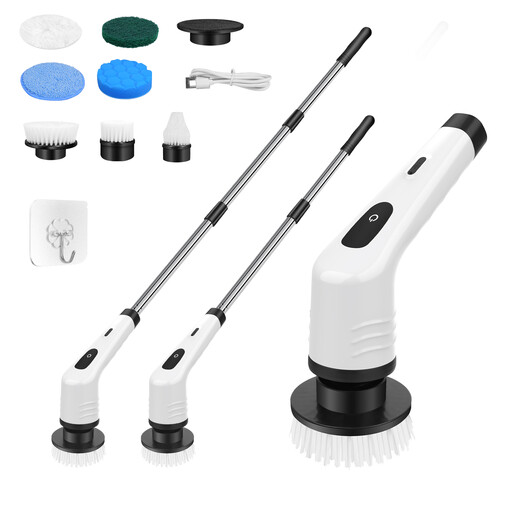 No image available
The adjustable telescopic pole may suit a niche positioned higher up; check that the brush head can move inside the niche.
The product description lists seven interchangeable brush heads, two speeds and an LED charging indicator.
 No image available
The product description lists tiles, bathrooms and tight spaces as suitable uses; check that the included head is right for your tile finish.
The description lists three speeds, seven brush heads and an IPX6 rating. Do not submerge the main unit, even with this rating.
No, you can’t tell that from the product category alone. Bosch lists splash resistance to IPX5 for the UniversalBrush, while RYOBI lists an IPX7 rating for the RDS4-0. Follow the instructions on water exposure, cleaning and charging for the exact model, including those for a separate battery and charger.
Philips recommends ventilating the room after showering, and rinsing and drying tiles to help limit moisture and build-up. This care advice does not mean that an electric brush or a particular cleaning routine is essential for every niche.
The Netherlands Food and Consumer Product Safety Authority states that CE marking is compulsory for electrical products, and that the manufacturer uses it to indicate that the product complies with the relevant European legislation. The safety rules that apply depend, among other things, on the product and its voltage. A CE mark is not an independent performance test.
According to ACM ConsuWijzer, online consumer purchases generally come with a cooling-off period of up to 14 days after delivery, subject to legal exceptions. You’re also covered by the statutory guarantee: how long you can reasonably expect the product to last depends on the product and normal use. In the Netherlands, there is no fixed statutory two-year guarantee period for every appliance.