
Grout and corner cleaner
Before changing rooms, you mainly want to tackle grease or dirt along grout lines and edges around the cooker. How easily you can reach these areas and the shape of the brush head are key factors for you.


For narrow grout lines and corners around the cooker, a compact detail brush is better suited to the job; for a larger, open area of tiles, a wider head is more practical. Before buying, check the surface, the attachments included and whether you’ll need a battery: a brush designed for tiles is not automatically suitable for glass, coatings or natural stone. Manufacturers’ application information does not compare cleaning performance under identical test conditions.
Before changing rooms, you mainly want to tackle grease or dirt along grout lines and edges around the cooker. How easily you can reach these areas and the shape of the brush head are key factors for you.
You have a larger area of hard tiles to clean and want a head that suits the surface, without overlooking narrow edges.
There may be glass, a coating or another delicate material next to the tiles. You want to check which brush and cleaning product are suitable for that finish first.
| What to consider | What to look for | Who is this important for? |
|---|---|---|
| Narrow grout lines and corners | Compare the shape of the head with the grout lines and the space around the cooker. | If dirt is mainly in narrow grout lines and along edges, you’ll want a head that can reach those areas. Around 36% of consumers prioritise grout lines and corners. |
| A larger area of tiles | Measure the available working area and compare it with the head; also check that the tiles and grout are suitable for that brush. | For a larger, accessible area, you’ll want to focus less on detailed work and choose a head that suits the space. Around 29% of consumers prioritise the tiled area. |
| Adjacent surfaces | Identify the material and finish, check the care instructions and try a suitable method on an inconspicuous area first. | If there are delicate materials next to the tiles, you’ll want to avoid damaging them with an unsuitable head or cleaner. Around 21% of consumers make protecting surfaces their top priority. |
| Complete set and additional purchases | Check whether the battery, charger and any attachments you need are included with the specific version. | If you want to use the brush straight away, you’ll want to know in advance what’s in the box. Around 14% of consumers prioritise a complete set and predictable additional purchases. |
According to the manufacturer, the RYOBI R18CPS-0 has a 15 cm head, which is shaped differently from a detail brush designed for hard-to-reach areas. The shape of the head determines how well you can tackle narrow edges.
First work out where most of the dirt is, then check that the head you choose is suitable.
A head that isn’t suitable may mean you still need a detail brush or extra manual scrubbing.
According to the manufacturer, the RYOBI RDS4-0 and R18CPS-0 reviewed here are sold without a battery.
Check what’s included with the exact version and whether you already have a compatible battery, charger and attachment.
There may be several different surfaces next to one another around a cooker. Kärcher warns that products containing acids or solvents can damage natural stone.
Check the finish and care instructions for each surface, then choose a brush and cleaning product.
Bosch describes the UniversalBrush as suitable for tiles, grout and tight spaces, among other uses.
The models mentioned differ in features such as their head shape and battery system.
According to Clatronic, the ERB 3815 A is a compact battery-powered brush, listed for use on bathroom tiles and cookers, among other surfaces.
The Versa PC10-1/10 is a compact cleaner with a replaceable brush and pads, offering a point of comparison for different head types.
This selection includes brushes with interchangeable heads for tiles and grout, plus a model whose description mentions a separate cleaning pad for hobs. Check which head is intended for your surface for each product.
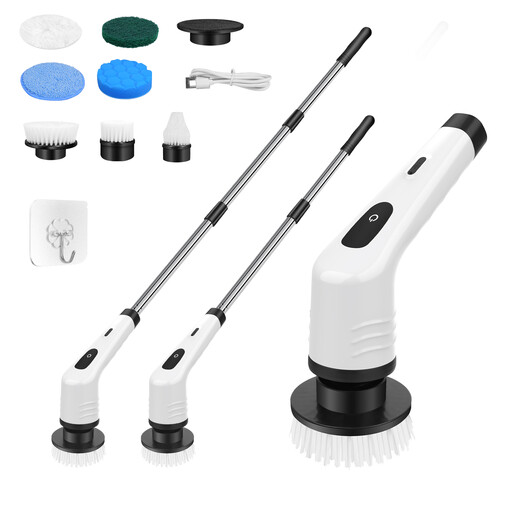 No image available
The product description lists tiles, grout and hobs as possible uses.
The title states that it comes with 7 interchangeable brush heads. The description also mentions a telescopic handle for high and low areas.
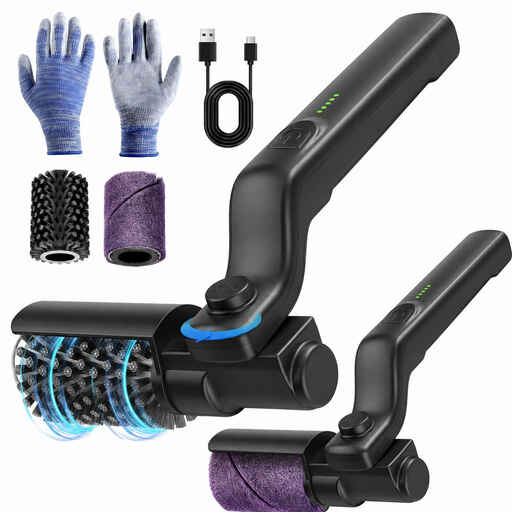 No image available
The description mentions a cleaning pad for hobs; check whether it’s suitable for the surface you want to clean.
The description recommends the metal brush head and scraper for grill grates, and the cleaning pad for hobs.
 No image available
The product title lists tiles, bathrooms and kitchens among its uses; the description also mentions tight spaces.
The title states that it has 3 speed settings and an LCD screen. Despite the stated IPX6 rating, the product description warns you not to submerge the main unit.
Not without first checking the materials and which head is suitable. Bosch lists tiles and grout as uses for the UniversalBrush, but describes a soft brush and a kitchen pad as different accessories. Choose the brush and cleaning product to suit the finish and care instructions. For example, Kärcher warns that products containing acids or solvents can damage natural stone.
It depends on the space around the grout lines and the size of the tiled area. RYOBI specifies a 15 cm round head for the R18CPS-0. For narrow grout lines and corners, compare the head shape with the available working space before choosing.
No. Check what’s included with the exact version. According to RYOBI, the RDS4-0 and R18CPS-0 are sold without a battery, and accessories described as separate products are not automatically included with every set.
These are water-resistance ratings specified by manufacturers for particular models. Don’t assume that every component or charging operation is safe in water. Bosch specifies IPX5 for the UniversalBrush, while RYOBI lists IPX7 for the RDS4-0. Follow the instructions for the exact appliance when using, cleaning and charging it.
If a product is faulty, the seller must provide an appropriate solution. The Dutch Government states that the Netherlands has no fixed statutory warranty period. For an online purchase from a business, you’ll usually have 14 days to change your mind, although there are exceptions. This cooling-off period is separate from your rights if a product is faulty.