
Cleaning grout and edges
You mainly want to tackle localised dirt by the threshold, in tile grout or in corners, and are looking for a small, precise brush head.


A compact electric brush is ideal for grout lines, corners and a small area by the threshold. A model with an adjustable handle is more practical if you also want to scrub a larger tiled outdoor area while standing. First identify the tile finish, then check the brush, water-use instructions and what’s included: a wide or stiff brush head isn’t automatically suitable for every type of tile.
You mainly want to tackle localised dirt by the threshold, in tile grout or in corners, and are looking for a small, precise brush head.
You also want to clean a larger tiled area by the front door and value an adjustable handle more than a very small brush head.
You’re not sure what finish your tiles have, or you want to avoid damaging a delicate surface with a brush that’s too stiff.
Best for: grout lines, corners and dirt along a small threshold.
Bear in mind: you’ll be working close to the floor, and a larger area will take more strokes.
Best for: a larger tiled outdoor area that you want to clean while standing.
Bear in mind: a larger brush is less manoeuvrable around narrow edges and won’t necessarily replace a grout brush.
First identify the tile material and finish, then choose a brush to suit. Also check whether the brush head can reach the areas you want to clean and what the instructions allow when cleaning with water.
| What to consider | Check | Who it matters to |
|---|---|---|
| Grout, edges and corners | The shape of the brush head supplied and whether a detail brush is available for the exact model. | If you mainly want to remove dirt from grout and along the threshold, look for a brush head that lets you work precisely. Around 36% of consumers tackling this entrance-cleaning job prioritise grout and edges. |
| A larger entrance area | The handle, brush width, suitable brush and room to manoeuvre by the front door. | If you want to scrub a larger area without repeatedly bending down, an adjustable handle is worth considering. Around 29% of consumers prioritise a larger area and being able to work standing up. |
| The tile finish | The tile material and the manufacturer’s care advice; first test a suitable brush gently in an inconspicuous spot. | If you don’t know the finish, you’ll want to avoid damaging the tile with the wrong brush. Around 21% of consumers are most concerned about protecting their tiles. |
| Wet use and accessories | The water-use instructions for the exact model and whether the suitable brush, battery and charger are included. | If you want to clean with water, you’ll need to know what the instructions allow and which parts you need. Around 14% of consumers prioritise water use and a complete set. |
The brush needs to suit the finish. Atlas Concorde advises against using stiff brushes on polished porcelain, as they can scratch the finish.
Identify the material and finish before choosing a brush, and follow the tile manufacturer’s care advice.
Einhell states that the PICOBELLA 18/215 and 18/90 are supplied without a battery or charger. Ryobi states that the R18TPS-0 is supplied without a battery.
Check what’s included with the exact version and whether you already have the required battery and charger.
A haze left by grouting may be cement residue. The tile and the type of deposit determine how to deal with it.
First establish whether it is cement residue. Forbo Eurocol advises trying to remove a light haze with a dry cloth first.
The UniversalBrush is a hand-held model for tiles, grout and hard-to-reach areas, among other things.
The PICOBELLA 18/90 is a hand-held model for robust tiles and other surfaces; the PICOBELLA 18/215 has an adjustable handle for larger stone surfaces.
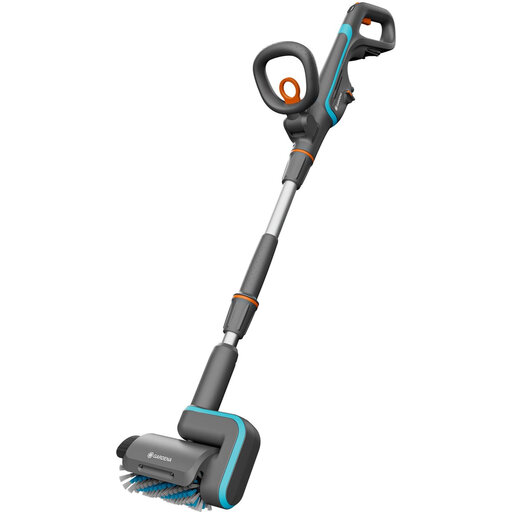
The R18TPS-0 is a telescopic cordless scrubber for situations where reach and an adjustable brush angle matter.
This selection at Joybuy covers electric brushes for tiled entrance areas: two models for targeted cleaning and a cordless patio model for larger outdoor areas.
 No image available
Could suit targeted tile cleaning if you want to choose between different brush heads.
The product name lists 7 interchangeable heads, rechargeable operation and an LED charging indicator. Check which head is suitable for your tile finish.
 No image available
Could suit tile cleaning if you want to use a choice of different brush heads.
The product name lists 7 brush heads, 3 speeds, an LCD screen and a stand. The product information warns against immersing the main unit.
 No image available
Could suit a larger outdoor area by the entrance if you’re looking for a cordless patio model.
The product name lists 18V and cordless operation. The product information states that the battery and charger are not included; also check which brush comes with the version.
No, follow the water-use instructions for the exact model. Bosch lists IPX5 for the UniversalBrush, Einhell lists IPX4 for the PICOBELLA 18/90 and Ryobi lists IPX7 for the R18TPS-0. Don’t assume the rating for one model tells you how to use another.
First identify the finish and follow the tile manufacturer’s advice. Atlas Concorde advises against using stiff brushes on polished porcelain, as they can scratch the finish; a brush for stone won’t necessarily be suitable.
Don’t automatically treat suspected cement residue as ordinary dirt that needs more vigorous scrubbing. Forbo Eurocol advises trying a dry cloth first for a light haze. For stubborn residue, only use a product that the manufacturer says is suitable for the tile and grout you’ve identified.
It depends on the exact version. Einhell states that the PICOBELLA 18/215 and 18/90 are supplied without a battery or charger, while the Ryobi R18TPS-0 is supplied without a battery. Also check whether the brush you need is included in the box.
For an online distance purchase from a business in the Netherlands, you generally have a 14-day cooling-off period. You’re also entitled to a product that meets the required standards; if there’s a problem, the seller is your point of contact for the statutory guarantee. The Netherlands does not have a fixed statutory guarantee period of two years.