
Cleaning narrow tile edges
After moving, you want to tackle dirt along skirting boards, in corners and in grout lines; the shape of the brush head determines whether you can reach it. Bosch DIY describes a precision brush for hard-to-reach places.


For narrow grout lines and corners after moving, a compact detail brush is a good fit. For longer, easily accessible stretches of tile, a larger brush head or telescopic scrubber may be more practical. Choose based on the tile finish, the brush heads and battery included, and the water protection suited to how you plan to use it. Recurring mould also calls for attention to damp or ventilation: scrubbing won’t fix the underlying cause.
After moving, you want to tackle dirt along skirting boards, in corners and in grout lines; the shape of the brush head determines whether you can reach it. Bosch DIY describes a precision brush for hard-to-reach places.
You don’t want to risk damaging a possibly polished finish with a brush that’s too hard, so first identify your tile finish. Atlas Concorde advises against hard brushes on polished porcelain.
You also have larger or harder-to-reach areas to clean, and are weighing up a wider brush head or handle against precision along the edge. Ryobi Netherlands describes models with a larger head and a telescopic handle.
Choose this if: you mainly need to reach narrow grout lines, sealant edges or tight corners.
Bear in mind: a small head means more passes over longer stretches; also check which heads are included with that version.
Choose this if: you want to clean larger, easily accessible tiled areas as well as edges. Ryobi lists a 15 cm round brush head for the R18CPS-0.
Bear in mind: check that the head can reach the narrowest edge or grout line; this model is part of the ONE+ battery system.
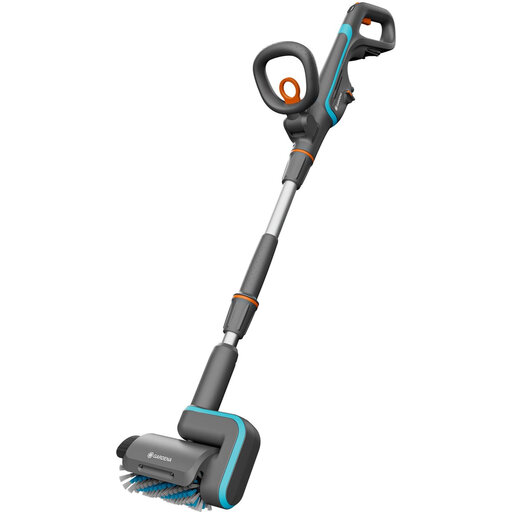
Consider this if: you mainly want to clean easily accessible tiled areas that are high up or low down. Ryobi describes an extendable reach of 1 to 1.4 m for its ONE+ telescopic scrubber.
Bear in mind: a larger head isn’t necessarily suitable for narrow edge profiles; check the version and whether a battery is included.
| What to consider | What should you check? | Which consumers? |
|---|---|---|
| Precision around grout lines and corners | Compare the shape of the head and any included detail brush with the width and accessibility of the edge. Bosch DIY describes a precision brush for tight spaces. | If I mainly need to reach narrow grout lines along skirting boards and in corners, I want a head that fits the profile. Consumers who put precision first when buying make up around 36%. |
| Protecting the tile finish | Identify the finish, follow the care instructions and test carefully in an inconspicuous spot. Atlas Concorde advises against hard brushes on polished porcelain. | If my tiles are delicate or polished, I want to avoid damaging the finish with a hard brush head. Around 29% of consumers prioritise choosing a brush that suits the finish. |
| Reach and size of the job | Decide whether you’ll mainly be cleaning grout lines and corners, larger areas or high- and low-level spots; Ryobi describes both a 15 cm head and an extendable handle. | If you want to tackle longer stretches or hard-to-reach areas, greater reach may matter more than working in a tight corner. For around 21% of consumers, reach is the top priority. |
| What’s included in the set | Check which battery, charger and brushes are included with the exact model number. Ryobi states that the battery must be purchased separately for the RDS4-0 and R18TPS-0. | If I don’t already have a compatible battery or brush heads, I want to know what I need to get cleaning straight away. Around 14% of consumers mainly look for a complete set. |
A 15 cm round head, such as the one Ryobi describes for the R18CPS-0, isn’t necessarily suitable for a tight corner or edge profile.
First measure or assess the tightest spot you need to reach, and check which heads are actually included with your chosen version.
You may also need a separate detail brush for a narrow grout line.
Atlas Concorde specifically warns against using hard brushes on polished porcelain because they may cause scratches; this warning doesn’t automatically apply to every tile finish.
Check the type of tile and its care instructions, then carefully test a suitable head in an inconspicuous spot.
Ryobi states that the battery isn’t included with models such as the RDS4-0 and R18TPS-0.
Check the full model number and package contents, including the battery, charger and brushes.
Without a compatible battery and, if needed, a suitable charger, you won’t be able to use the appliance straight away.
Milieu Centraal notes that recurring or widespread mould may be linked to an underlying damp or ventilation problem.
Clean the area, but also check whether damp or ventilation needs attention; a scrubber won’t fix a structural problem.
Bosch DIY describes the UniversalBrush as a compact handheld model for tiles, grout lines and tight spaces.
Ryobi offers models for detailed cleaning, larger surfaces and jobs higher up or close to the ground.
According to the manufacturer, the Household System is a compact brush appliance with different head shapes for grout lines and tight spaces.
The Versa PC10-1/10 is a compact scrubber with interchangeable brushes and pads.
Joybuy product picks for electric cleaning brushes for tiles and bathrooms; check that each model’s brush heads and reach suit your tile edges.
 No image available
The product description lists bathroom grout and tiles as suitable uses; the pointed and small flat brush heads mentioned may be useful for narrow edges.
The description mentions a telescopic handle, a rechargeable design and an LED charging-status indicator.
 No image available
The product description mentions a battery-powered rotary brush for surfaces including stone, and a telescopic extension tube for reaching higher or lower areas.
According to the description, the water flow has three settings. The battery and charger aren’t included.
 No image available
The product description lists tiles and tight spaces as suitable uses and mentions seven brush heads.
The product name lists three speed settings and an LCD display. The stated IPX6 rating doesn’t mean you can submerge the main unit.
First identify the finish and follow the care instructions for your tiles. Atlas Concorde recommends gentle cleaning for porcelain tiles and specifically warns against hard brushes on polished porcelain. Start by testing a suitable head in an inconspicuous spot.
That depends on the exact model and its instructions. Bosch DIY lists IPX5 splash protection for the UniversalBrush; Ryobi lists IPX7 for the RDS4-0 and R18CPS-0. Don’t assume that one model’s water protection applies to another model or to charging it.
As well as cleaning, look into whether damp or ventilation could be a factor. Milieu Centraal notes that recurring or widespread mould may be linked to an underlying cause, such as a leak or inadequate ventilation.
According to ACM ConsuWijzer, online purchases generally come with a statutory cooling-off period of up to 14 days after delivery, with some exceptions. You’re also entitled to a statutory guarantee if a product doesn’t perform as you could reasonably expect under normal use; an additional commercial guarantee doesn’t replace this right.