
For grout and edges
You mainly want to clean between the tiles and around the tap. A suitably small head can help; Bosch DIY Nederland and RYOBI Nederland describe models for cleaning tiles, grout and detailed areas.


For grout and the space around the tap, an electric handheld brush with a suitable detail head is often more practical than a wide brush. A compact round head may be more convenient for the open tiled area. Compare the head with the narrowest part of your vanity and check what’s included in the set, along with the instructions on water exposure for the exact model. For light, regular dirt, a cloth or hand brush may be all you need.
You mainly want to clean between the tiles and around the tap. A suitably small head can help; Bosch DIY Nederland and RYOBI Nederland describe models for cleaning tiles, grout and detailed areas.
You want to clean the open tiled area regularly and would rather not store a large appliance. RYOBI Nederland also describes a compact scrubber with a 5 cm round head.
You want to remove dirt without damaging an unfamiliar tile finish or grout with an unsuitable brush. Consumentenbond and Milieu Centraal recommend taking the material and type of dirt into account when cleaning.
First, decide which area is trickiest: the narrow grout lines and edges, or the open tiled surface. Then choose a suitable head and check that it’s included in the set you’re considering.
| What to consider | What to look for | Who this matters to |
|---|---|---|
| Grout and edges | Compare the shape and size of the head with your grout lines and the space around the tap; check which detail heads are included. | If I mainly want to reach narrow grout lines and edges around the tap, I’m looking for a head that will actually fit. Around 40% of consumers prioritise grout and tight edges. |
| Small tiled area | Check the head size and the available space on the vanity; ‘compact’ doesn’t necessarily mean the brush will fit around the tap. | If you want to clean a small vanity quickly and have limited storage space, focus on a manageable head. Around 30% of consumers prioritise compact cleaning and storage. |
| Protecting tiles and grout | Identify the material, choose a suitable head and try the method on an inconspicuous area first. Consumentenbond and Milieu Centraal stress that both the material and the type of dirt matter. | If I’m not sure what the finish or grout is made of, I want to start gently and check how it responds to the brush I’ve chosen. Around 20% of consumers prioritise protecting the material. |
| Set contents and water instructions | Check the exact model code, the battery and charging cable supplied, and the water instructions for that model. Bosch DIY Nederland specifies IPX5 for the UniversalBrush; RYOBI Nederland specifies IPX7 for the RSCR4-120G and RDS4-0. | If you don’t want to discover later that the battery is missing or the set isn’t suitable, check what’s included and how the product can be used around water beforehand. Around 10% of consumers make set contents and power supply their main priority. |
RYOBI Nederland lists a 15 cm head for the R18CPS-0 and a 5 cm head for the RSCR4-120G. Neither size alone proves that the head will fit into your grout lines or beside the tap.
Measure the available space on your vanity and choose based on the narrowest area you want to clean.
You may also need a separate detail brush for grout and the edges around the tap.
According to the Dutch product pages, the RYOBI RDS4-0 and R18CPS-0 are sold without a battery, while the RSCR4-120G is listed with a battery and charging cable.
Compare the exact model code and box contents, and check whether you already have a compatible battery and charger.
A model without the required battery isn’t ready to use straight away.
Bosch DIY Nederland specifies IPX5 for the UniversalBrush, while RYOBI Nederland specifies IPX7 for the 4V models mentioned. These ratings aren’t interchangeable and don’t, on their own, mean you can submerge an appliance.
Follow the water instructions for the exact model, including while cleaning and charging it.
According to Bosch DIY Nederland, the UniversalBrush is a rechargeable handheld brush for tasks including cleaning tiles, grout and hard-to-reach areas in the bathroom.
The Dutch range includes a 4V detail brush, a compact scrubber with a round head and larger ONE+ scrubbers.
The manufacturer describes the Household System as a compact, AA-battery-powered brush with different head shapes for areas including grout and taps.
The Versa PC10-1/10 offers an example of an approach combining an interchangeable brush and pads for different cleaning jobs.
This selection mainly features rotating brushes for cleaning tiles and bathrooms, as well as a larger battery-powered brush for stone surfaces. Compare the head, set contents and ease of handling with the limited space on your vanity.
 No image available
The product information lists tiles and bathroom grout among its uses, and describes pointed and small flat heads for detailed cleaning.
The title specifies 7 interchangeable brush heads and a rechargeable design.
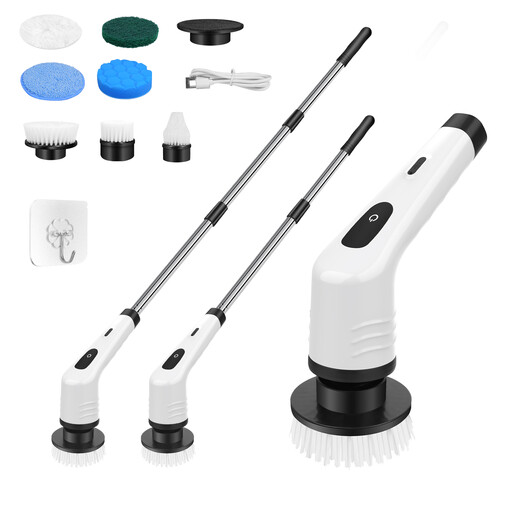 No image available
The product information lists it for use on tiles and in bathrooms, and mentions pointed and small flat heads; check that these shapes suit your grout and tap.
The title specifies 7 interchangeable brush heads and a rechargeable design.
 No image available
The product information lists it for cleaning bathrooms and tiles, including in tight spaces; check whether the heads supplied are suitable for your vanity and grout.
The title specifies 7 brush heads. The product information lists IPX6, but also says the main unit must not be submerged.
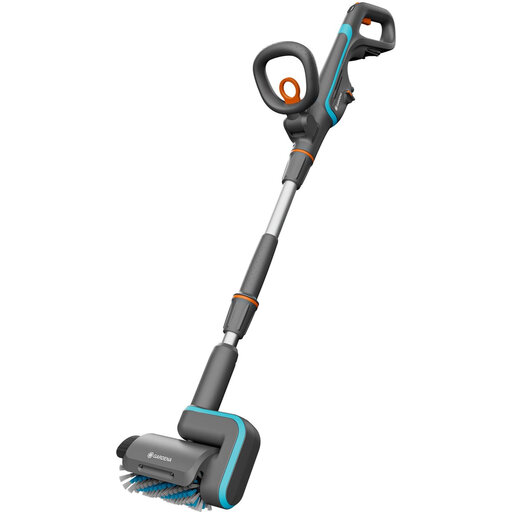 No image available
According to the product information, this battery-powered rotating brush is designed for surfaces including stone; consider whether that suits the small working area of a vanity.
The product information lists a weight of 4 kg and states that the battery and charger aren’t included.
Choose a head shape to suit the area: a round head for the accessible tiled surface and a suitable detail head for narrow grout lines and the edges around taps. Check what’s in the box, as interchangeable heads aren’t necessarily all included.
That depends on the exact model and the manufacturer’s instructions. Bosch DIY Nederland specifies IPX5 splash protection for the UniversalBrush; RYOBI Nederland specifies IPX7 for the RSCR4-120G and RDS4-0. Don’t treat IPX5 as permission to submerge the brush, and follow the instructions for use and care.
Start by cleaning regularly with water and a cleaning product suitable for the material, using a cloth or brush. Consumentenbond explains that regular cleaning can help prevent deposits from building up and becoming harder to remove.
If mould keeps returning or appears in several places, consider moisture and ventilation too. Milieu Centraal lists an underlying cause, such as a leak or insufficient ventilation, as a possible factor; simply changing brushes won’t address it.
When you buy online from a business, you’re generally entitled to a 14-day cooling-off period, although exceptions and the circumstances of the sale matter. A product must also be of satisfactory quality, and the seller must provide a solution if something is wrong. The Dutch government states that there is no single fixed statutory guarantee period for all products in the Netherlands.