
If you mainly clean tiled surfaces
If you mainly want to tackle accessible shower tiles before moving on to another room, but also clean around taps, compare a compact brush with a head that suits the tiled surface.


For accessible shower tiles and the edges around taps, a compact brush is practical. A detail brush is better suited to narrow grout lines, while a model with an extendable handle can help you reach higher parts of the wall. Then choose a head that’s suitable for your tile finish, and check the water protection rating and whether a battery and charger are included. A scrubber won’t repair damaged grout or solve an underlying damp problem.
If you mainly want to tackle accessible shower tiles before moving on to another room, but also clean around taps, compare a compact brush with a head that suits the tiled surface.
Are narrow grout lines and corners the most difficult areas to clean? Look at the shape and availability of a suitable detail brush, and check the condition of the grout first.
Want to clean the top rows of shower tiles without having to stretch so far? An extendable handle may be useful, provided the brush head fits in your shower.
Suitable for: accessible tiled walls and areas around taps.
Keep in mind: you’ll need to reach higher parts of the wall yourself; check which head comes with the model.
Suitable for: narrow grout lines and corners that make up most of the job.
Keep in mind: a small head takes more strokes to cover a large tiled surface.
Suitable for: hard-to-reach higher parts of the wall.
Keep in mind: check that the head fits around fittings and whether the model you choose includes a battery.
Suitable for: anyone who wants to clean other suitable surfaces as well as the shower wall.
Keep in mind: match the brush to your tile finish; a head for robust surfaces isn’t automatically suitable for every type of tile.
| What to consider | What to look for | Who should consider this? |
|---|---|---|
| Tiled surfaces and edges | Check the width of the brush head and whether the brush is suitable for your tile finish. | If I mainly want to clean accessible wall tiles and the edges around taps, the head needs to work well in both areas. This is a concern for around 36% of consumers who see tiled surfaces as their main cleaning task. |
| Grout and corners | Check the shape and compatibility of the detail brush, and inspect the grout beforehand. | If narrow grout lines and corners make up most of the job, I want to clean them precisely without forcing a large brush head into place. Around 29% of consumers see grout as their main purchasing concern. |
| Higher parts of the wall | Check the extension length, the space around fittings, and whether a battery and charger are included. | For high shower tiles, being able to reach without stretching so far can be the deciding factor; the brush also needs to fit in the available space. This matters to around 21% of consumers who prioritise reach. |
| Tile finish and what’s included | Identify your tile material and finish, and check which parts come with the model. | If I want to protect a delicate finish or get started straight away, it’s important to have the right brush and a complete set. Around 14% of consumers prioritise gentle cleaning or what’s included in the set. |
The Joybuy product page for the Einhell PICOBELLA 18/215 doesn’t describe the PICOBELLA 18/90 Li Solo reviewed here. The model numbers and versions are different.
Compare the full model number and intended use before choosing a product.
The Ryobi models reviewed with the -0 suffix and the Einhell Solo are sold without a battery.
Check what’s included with the exact model, and find out whether you’ll need a compatible battery, charger or cable.
If a battery or charger isn’t included, you may need to buy one separately to use the appliance.
The tile finish determines the right approach. Atlas Concorde advises against using stiff brushes on polished porcelain tiles, as they can scratch the finish.
Follow your tile’s care instructions and, if necessary, start with a gentle method.
Choosing a different brush setting alone won’t prevent damage to the finish; match your cleaning method to the surface first.
According to Milieu Centraal, extensive or quickly recurring mould may point to an underlying cause.
If the marks return, check the ventilation and look for possible damp problems too.
Bosch recommends the UniversalBrush for tiles, grout and hard-to-reach areas in the shower.
Ryobi offers separate models for compact scrubbing, detail work and higher parts of the wall.
The PICOBELLA 18/90 Li Solo is designed for anyone who wants to clean a range of suitable surfaces using different types of brushes and pads.
Dremel lists separate Versa detail brushes for tasks including cleaning tile grout and corners.
These electric cleaning brushes are described as suitable for cleaning tiles or bathrooms. Before use, check that the brush head and cleaning method are right for your grout and tile finish.
 No image available
The product name lists tiles and bathrooms among its uses; check that the included head is suitable for your grout and tile finish.
The product name specifies seven interchangeable brush heads and a rechargeable design.
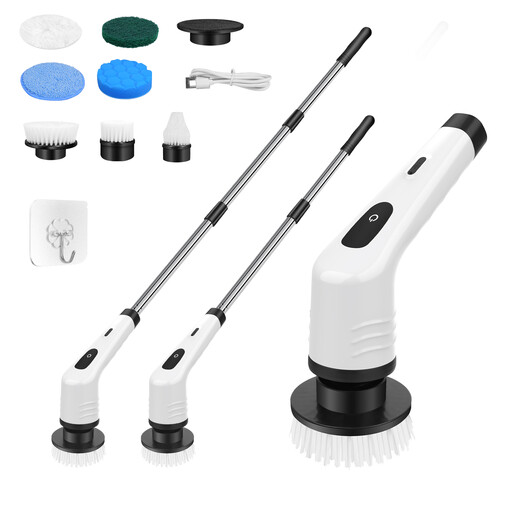 No image available
The product name lists tiles and bathrooms among its uses; check that the included head is suitable for your grout and tile finish.
The product name specifies seven interchangeable brush heads and a rechargeable design. This version is white.
 No image available
The product information lists tiles, bathrooms and hard-to-reach areas among its uses; choose a head that’s suitable for the surface.
The product name specifies seven brush heads, three speeds and a stand. The product information specifies IPX6 and warns against immersing the main unit.
No. Don’t assume you can submerge a brush just because it’s described as water-resistant. Bosch specifies IPX5 splash protection for the UniversalBrush; Ryobi specifies IPX7, with a limit of up to 1 metre for 30 minutes, for the RSCR4-0 and RTS4-0 reviewed here. Follow the instructions for your exact model, including while it’s charging.
Start gently and follow the care instructions for your tiles. Tile manufacturer Atlas Concorde advises against using stiff brushes and powdered cleaners on polished porcelain tiles, as they can scratch the finish. This advice doesn’t automatically apply to other tile materials.
Check for damp and ventilation problems too. Milieu Centraal points out that extensive or quickly recurring mould may indicate an underlying cause; scrubbing alone won’t address it.
In the Netherlands, consumer purchases are covered by a statutory guarantee. According to the Dutch government, the seller must provide a solution if a product is faulty; there’s no fixed statutory guarantee period that applies to all products in the Netherlands. A manufacturer’s guarantee is separate.
No. Dutch government guidance advises against using bleach with any other cleaning product, even if traces of another product remain on the surface. Bleach also isn’t a limescale remover.