
Cleaning high tiled walls
You want to reach the top row of tiles without having to use a compact handheld brush above shoulder height. Compare the usable pole length, head angle and controls; Leebein lists these adjustable features for the YMG-818.


For high tiled walls, an electric brush with a suitable extension pole is more practical if a handheld model cannot reach the top properly. For accessible grouting, edges and corners, a compact handheld model or a narrow brush head may be more convenient. Check the usable length, head angle, brushes supplied and the water-resistance limits of the exact model. Bosch lists IPX5 splash protection for the UniversalBrush, but its manual says not to submerge it.
You want to reach the top row of tiles without having to use a compact handheld brush above shoulder height. Compare the usable pole length, head angle and controls; Leebein lists these adjustable features for the YMG-818.
You mainly need to remove grime along grout lines, edges or pipes, and want a suitably narrow brush head rather than just a large flat brush. Bosch lists tiles and grouting as uses for the UniversalBrush.
You’re working somewhere the brush may get wet and want to check the water resistance and usage limits of the exact device. Bosch lists IPX5 for the UniversalBrush; its manual says not to submerge it.
For a tiled wall in an upstairs flat, your choice mainly comes down to reach, water exposure, the right brush head and whether replacement heads are available.
Choose this when: the high sections of the wall are the main job and you can reach the whole wall from a comfortable working position.
Trade-off: check that the head can follow the edge of the wall and that the brush feels comfortable to control at full length.
Choose this when: grouting, edges and accessible areas matter more than large, high sections of wall.
Trade-off: a handheld model won’t extend your reach, so check that you can clean the areas you need to without stretching uncomfortably.
| What to consider | What should you check? | Who is this important for? |
|---|---|---|
| Reach and control at height | Measure the wall height and compare it with your comfortable working reach and the usable length of the pole and brush head. Check that the head can move along the edge of the wall. | I want to reach the top row of tiles without scrubbing above a comfortable working height. Around 36% of consumers say reach and control at height are their top priority. |
| Water resistance and usage | Read the IP rating and the manual for the exact model. Bosch lists IPX5 for the UniversalBrush, but its manual says not to submerge it. | When cleaning a wet wall, I want to know in advance how much water exposure the device can handle. Water-resistant use is the top priority for around 29% of consumers. |
| Brush head for tiles, grouting and finishes | Compare the brush heads supplied with the areas you want to clean. Skrub warns that its abrasive attachment can cause scratches; test a brush head on an inconspicuous area first. | I want a brush head that suits the grouting and tile finish, without an unnecessary risk of scratches. Around 21% of consumers prioritise choosing the right brush head and protecting the surface. |
| Attachments and faults | Check which brushes come with the exact model and whether replacement attachments are available for it. Keep the product description and proof of purchase. | If I use the brush regularly, I want to know whether suitable heads can be replaced and what to do if it develops a fault. Around 14% of consumers prioritise maintenance and spare parts. |
The head angle, position of the controls and your working position all affect whether you can reach the top edge too.
Measure the wall and consider your complete working position, not just the stated length of the pole on its own.
A splash-resistance rating doesn’t automatically mean you can submerge the device. Bosch lists IPX5 for the UniversalBrush, but its manual says not to submerge it.
Check the usage limits for the exact model, including when cleaning the device itself.
An abrasive attachment can cause scratches; Skrub’s warning applies to the specific attachment in question.
Choose a brush head that suits the surface, start gently and test it on an inconspicuous area first.
GoScrub lists a separate brush set for the Cleaning King V2. This doesn’t confirm that the set fits other models.
Before ordering replacements, check the full model name and the compatibility information.
The UniversalBrush is a compact, cordless handheld brush for accessible tiled areas, grouting and tight spaces.
The YMG-818 is an example of a rotating brush with an adjustable pole and head angle, designed to help you adapt the reach.
Skrub describes an electric brush with a pole and attachments for different cleaning tasks.
GoScrub lists attachments for detail cleaning within the Cleaning King system.
This selection includes a cordless electric brush and a set of brush heads for use with a compatible drill. Check which option suits your tools, the height of your wall and the attachments you need.
 No image available
According to the product information, this cordless brush is suitable for tasks including cleaning tiles and comes with seven brush heads.
The product name mentions an LCD screen and three speeds. The product information lists IPX6, but also warns that the main unit must not be submerged.
 No image available
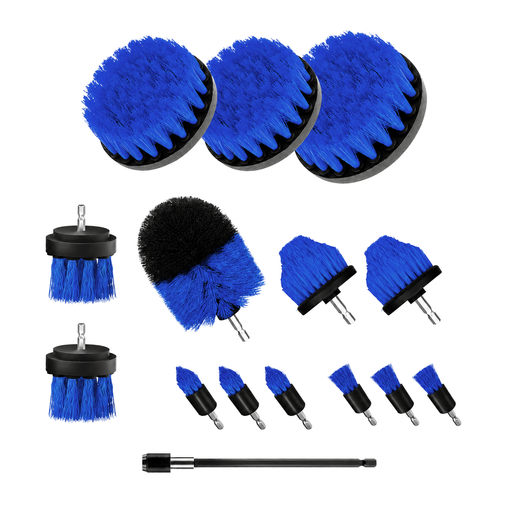
This set may suit tiled walls and grouting if you already have a compatible drill or electric screwdriver; the brush heads are not a standalone electric scrubber.
The description lists heads in different sizes and an extension for hard-to-reach areas. Choose a brush firmness that suits the surface. For the hard heads, the product information recommends use on wear-resistant surfaces and wearing safety glasses.
No. The IPX5 rating alone doesn’t mean you can do that. Bosch says the UniversalBrush is suitable for splashes, but its manual says not to submerge it. For other models, follow the instructions in their own manuals.
Choose an attachment that suits the surface and test it on an inconspicuous area first. Skrub specifically warns that its abrasive attachment can cause scratches; Bosch also recommends testing the UniversalBrush on an inconspicuous area first.
Scrubbing alone won’t address a possible underlying cause. Milieu Centraal lists poor ventilation or a leak as possible causes of recurring mould. If mould appears in several places without an obvious cause, the organisation recommends seeking expert help.
According to the Dutch government, the retailer must provide a solution if a product is faulty. The Netherlands doesn’t have a fixed general statutory guarantee period of two years; what you’re entitled to expect depends, among other things, on the product and the sales information.
No. According to the European Commission, CE marking isn’t a safety approval from the EU; it’s the manufacturer’s declaration that the relevant requirements have been met. Not every product needs to carry a CE mark, and the requirements depend on the exact brush and any charger.