
Grout and corner cleaner
You mainly want to remove dirt from narrow spaces next to the cooker. A small head and good reach matter more than quickly scrubbing a large area.


For narrow grout lines and corners next to the cooker, a compact detail brush is a sensible choice. If you also want to clean small areas of tile, a handheld model with suitable interchangeable heads may be a better fit. A long handle is worth considering if you also need extra reach for larger surfaces, but check that it fits your working and storage space, and see which heads and power supply are included.
You mainly want to remove dirt from narrow spaces next to the cooker. A small head and good reach matter more than quickly scrubbing a large area.
You want one compact appliance for both tiles and grout, and have little room for a long-handled tool or several appliances. Bosch DIY describes the UniversalBrush as suitable for use on tiles and grout.
You want to avoid damaging the hob or another nearby finish with a brush head or cleaning product. Choose the right approach for each surface and check the care instructions.
Best for: reaching narrow grout lines, edges and corners next to the cooker.
Consider: a small head is less suited to large tiled areas. Check whether the detail head you need is included.
Best for: switching between cleaning tiled areas and grout, while working close to the splashback.
Consider: a wide head won’t automatically reach narrow grout lines. Check which accessories come with the model.
Best for: when extra reach is also important for cleaning larger areas.
Consider: check that you can manoeuvre the handle around the cooker and have somewhere to store the appliance.
Best for: light dirt that you remove regularly, or if you want to check which approach is right for the surface first.
Consider: you’ll need to do the scrubbing by hand, but won’t need a battery or extra attachments.
| What to consider | What to look for | Who is this important for? |
|---|---|---|
| Narrow grout lines and corners | Check the shape of the head and whether the detail brush you need is included. | I want to remove dirt from narrow grout lines and corners next to the cooker; around 36% of consumers prioritise this reach. |
| Compact to use and store | Compare the shape of the appliance with the space around the cooker and where you plan to store it. | If my kitchen has little worktop or storage space, I don’t want an awkward appliance; around 29% of consumers prioritise compactness. |
| Suitable for each surface | Check the care instructions for the hob and tiles separately; don’t use an abrasive head on induction glass. | I want to clean the tiled wall without damaging the nearby hob; around 21% of consumers put protecting surfaces first. |
| Complete set | Check whether the battery, charger and brush head you want are included, and whether the accessories fit the model. | I want to know in advance which parts I’ll need to get started; around 14% of consumers focus mainly on getting a complete set. |
Tiles and hob glass don’t necessarily need the same cleaning method. The Consumers’ Association advises against using brushes with an abrasive coating on induction glass.
Treat the hob and tiled wall as separate surfaces. For glass, follow the recommended non-scratch cleaning method.
The RYOBI RDS4-0 is sold without a battery, while Bosch lists the precision brush as a separate accessory.
Check what’s included and whether the parts are compatible with your chosen model before comparing versions.
Extra reach won’t necessarily make it easier to manoeuvre beside a cooker when space is limited.
Measure the space around the splashback and consider whether you’ll need the handle for other surfaces too.
The UniversalBrush is a handheld model for small cleaning jobs; a precision brush is available separately.
The RDS4-0 is designed for detail work, while the RSCR4-0 has a 5 cm round brush for small areas.
The Versa is designed for cleaning jobs with interchangeable accessories, but the availability of the power unit is a separate consideration.
These products include electric brushes with a long handle, interchangeable heads or attachments for cleaning kitchens and tiles. For each model, check that the attachment you choose is suitable for your grout and the nearby hob.
 No image available
The product information describes this model as having an adjustable handle; check that you can manoeuvre and store it around the cooker.
The product name describes a rechargeable brush with 7 interchangeable heads for tiles, kitchen surfaces and more.
 No image available
A handheld model for cleaning kitchen surfaces and tiles. Check whether the included heads are suitable for narrow grout lines and the finish you want to clean.
The product name lists 3 speeds, an LCD screen and a stand.
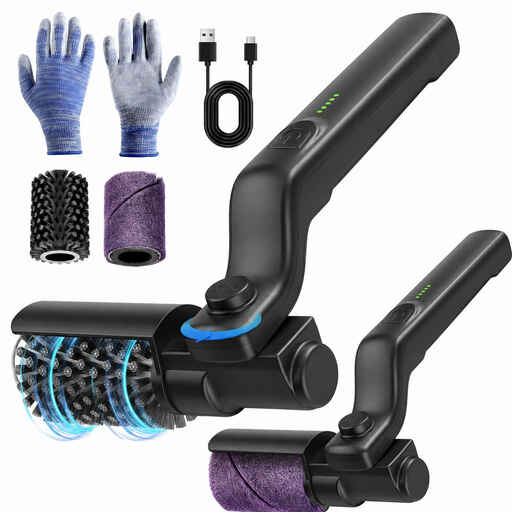 No image available
The product name lists attachments for grill plates and kitchen surfaces. Check that the attachment you intend to use is suitable for tiles and grout; don’t assume it’s safe to use on hob glass.
Clean the tiled wall and hob separately. The Consumers’ Association recommends a non-scratch cloth for induction glass and advises against brushes with an abrasive coating. For dirt in edges, it suggests using a fine brush. Follow your hob’s care instructions too.
Don’t rely on the water-resistant label alone. Bosch DIY lists IPX5 splash protection for the UniversalBrush, while RYOBI lists an IPX7 rating for the RDS4-0. Follow the instructions for use and cleaning for your chosen appliance, paying particular attention to the charging port.
It depends on the version. RYOBI sells the RDS4-0 without a battery, while Bosch DIY lists the precision brush as a separate accessory. Check what’s included with the model you choose.
If a product is faulty, you can contact the seller, according to the Dutch government; there is no fixed statutory guarantee period that applies to every product. When you buy online from a business, you’ll generally have a 14-day cooling-off period, subject to conditions and exceptions. Check which rules apply to your purchase.