
Cook with limited kitchen space
You want to slice salami and then clear your worktop again. Compare the space the slicer takes up while in use with where you plan to store it; FRITEL and DOMO describe foldable models.


For a small kitchen, your choice mainly depends on how much space you have for slicing and storing the machine. A foldable slicer may be easier to put away after use, while a slim, fixed model is designed to stay on your worktop. Then check whether the specific model is suitable for sliced meats, how the food holder and carriage work, and how to clean the parts according to the instructions. Manufacturer specifications are not the same as an independent slicing test.
You want to slice salami and then clear your worktop again. Compare the space the slicer takes up while in use with where you plan to store it; FRITEL and DOMO describe foldable models.
You want to assess the slicing thickness, carriage and food holder for your needs. Check the details for the exact model; motor power alone doesn’t show how evenly it will slice salami.
You want to know which parts can be removed and how to clean them according to the instructions. The Netherlands Nutrition Centre advises keeping raw and cooked food separate and using clean utensils.
Start by considering how much space you can leave clear while slicing and where you’ll store the machine. Then compare how it handles salami, how it is cleaned and how it is operated.
| What to consider | What should you check? | Who is this important for? |
|---|---|---|
| Space in use and for storage | Measure the assembled slicer and the space needed to move the carriage. Compare this with your storage space; foldable models still take up room while you’re slicing. | If you want to clear your worktop after slicing, consider both the space needed in use and for storage. Around 40% of consumers put space at the top of their list of buying concerns. |
| Holding salami and slice thickness | Check whether the manufacturer mentions sliced meats, what slicing thickness range is specified and whether a food holder is included. | These features matter if you want to adjust the thickness of your salami slices and guide shorter pieces safely. Around 30% of consumers put slicing options first. |
| Cleaning after use | Check which parts can be removed and follow the cleaning instructions for the specific model. Don’t assume it is dishwasher-safe. | If you want to clean the parts thoroughly after slicing and keep ready-to-eat meats separate, focus on the cleaning method. Around 20% of consumers put cleaning first. |
| Safe operation on a small worktop | Check that the slicer can stand securely, and look at the food holder, switch and space available to operate it. Follow the instructions. | If you want to keep your hands away from the blade while slicing, the setup and controls are important factors to consider. Around 10% of consumers put safe operation at the top of their buying concerns. |
The slicer and its moving carriage also need to fit on your worktop while you’re slicing.
Before buying, measure the footprint when assembled and the clear space beside the appliance.
FRITEL says the blade on the FRITEL SL 3110 can be removed, but that the model is not dishwasher-safe.
Follow the cleaning instructions for your exact model and version.
The Dutch government states that there is no fixed statutory two-year warranty period for all products in the Netherlands. If a product is faulty, contact the seller.
Keep your proof of purchase and consider any manufacturer’s warranty separately from your statutory rights.
FRITEL describes the SL 3110 as a foldable slicer for foods including charcuterie.
According to ritter, the ritter compact¹ is a slim, non-foldable machine designed to stay in one place on your worktop.
DOMO describes the DO523S as a foldable slicer.
GRAEF describes the MYtiny version reviewed as a foldable machine for anyone short on storage height.
The Severin AS 3915 is a metal slicer supplied with a blade for sliced meats.
These models offer different options for slicing space, storage and sliced meats. Before buying, check which EU requirements apply to the exact version and whether it carries the required CE marking; the marking alone is not an independent test result.
 No image available
FRITEL says this foldable model is suitable for charcuterie, including sliced meats such as salami.
Ø 17 cm serrated blade, adjustable slicing thickness of 0–15 mm and 100 W power. The blade, carriage and food holder can be removed. FRITEL says the model is not dishwasher-safe.
 No image available
An option to compare if you’re looking for a machine that, according to the product description, can slice meat.
The product description specifies a smooth blade for meat, adjustable slicing thickness up to 23 mm and a removable carriage.
 No image available
Compare this model if you’re considering an electric slicer with a removable carriage.
The product description specifies a serrated blade and a removable carriage. Check that the version and blade are suitable for slicing salami.
 No image available
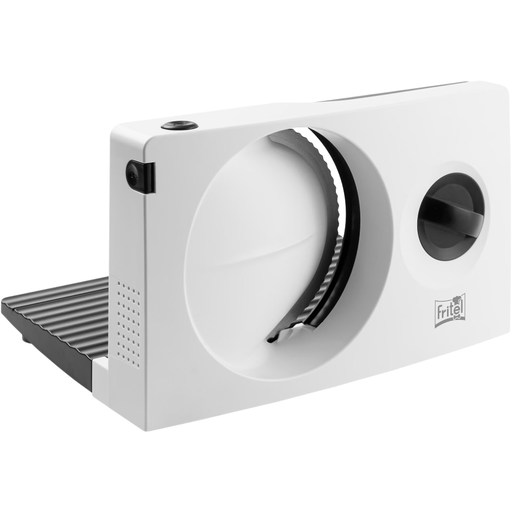
A foldable option if storage is a priority; first check whether the manufacturer says this version is suitable for sliced meats such as salami.
The product name specifies a Ø 17 cm serrated blade, adjustable slicing thickness of 0–15 mm, 100 W power and a foldable design.
Measure the space with the machine assembled and allow room for the carriage. Compare those measurements separately with your storage space: ‘foldable’ doesn’t tell you how much room the appliance needs while slicing.
Unplug the machine before taking it apart or cleaning it, and follow the instructions for the specific model. Use clean utensils and keep raw products separate from ready-to-eat sliced meats, as advised by the Netherlands Nutrition Centre. A removable blade is not automatically dishwasher-safe.
If there’s a fault, contact the seller. The Dutch government explains that there is no fixed statutory two-year warranty period for all products in the Netherlands; a manufacturer’s warranty is separate from your statutory rights.
For products covered by EU rules that require CE marking, the manufacturer must assess the applicable requirements and apply the marking. The European Commission and Your Europe explain this responsibility; a CE logo is not, by itself, an independent test result. Check the product information for the exact version.
The Netherlands Nutrition Centre recommends keeping opened sliced meats in the fridge for an average of 3–5 days. For older people, pregnant women, very young children and people with reduced immunity, it recommends a maximum of 2–3 days. Also follow the packaging instructions and use-by date.