
Fan of thin salami slices
Wants to choose a blade and slice thickness to suit a sharing platter, and checks which blade comes with the exact model.


For salami served at a party, check which blade comes with the machine, how you adjust the slice thickness and whether a food holder can guide small pieces safely. If you’re slicing larger quantities, consider stability and cleaning too. For occasional use, size and storage may matter more. The manufacturer’s specifications describe what a machine can do, but they can’t guarantee the results you’ll get at home.
Wants to choose a blade and slice thickness to suit a sharing platter, and checks which blade comes with the exact model.
Looks for a stable carriage, a food holder and parts that are easy to reach for cleaning after use.
Uses the machine occasionally and wants to know whether it folds away and how to store the blade safely.
Start with the blade type and the slice thickness you want. Then consider how much you’ll be slicing in one go and how much room you have to use and store the machine.
| What to consider | What to look for | Who should pay particular attention? |
|---|---|---|
| Blade and slice thickness | Check which blade is included, the adjustment range and whether an optional second blade is compatible with the full model number. | If I mainly want to control the thickness of salami slices, I check the blade and settings for each version. Around 36% of consumers prioritise the blade and slice thickness. |
| Stable slicing | Check the carriage, food holder and appliance dimensions, and make sure the food you want to slice will fit properly. | When I’m hosting several guests, I want to slice continuously and guide the food securely. Around 29% of consumers focus on stable slicing for larger quantities. |
| Operation and cleaning | Check the food holder and finger guard, as well as the cleaning instructions for the blade and carriage. | When preparing cold meats, I want to clean the parts thoroughly and keep my fingers away from the blade. Around 21% of consumers prioritise safe operation and cleaning. |
| Storage | Compare the appliance’s dimensions with your worktop and storage space, and check how the blade is covered. | If I only use the machine occasionally, I want to know whether I can put it away after a meal without it taking up too much space. Around 14% of consumers focus mainly on the space needed for storage. |
A serrated blade and a smooth blade for cold meats are not the same. Ritter describes its smooth blade as suitable for salami, among other foods; on some versions, this blade may be a separate accessory.
Check what’s included and whether an alternative blade is compatible with the exact model.
A suitable smooth blade may be available separately, so check before choosing a version.
An adjustable thickness setting alone doesn’t tell you how well the machine will slice salami. For the DOMO DO521S, the product description and technical table also give different lower ends for the range.
Check the full model specifications and consider the blade and carriage too. Don’t treat the adjustment range as a guarantee of a particular slice thickness.
Model numbers and blade types can differ, even when product names look similar. For example, the FRITEL SL 3110 is not the same model as the SL 3080.
Compare the full model number, blade type and key specifications before matching a product listing to a model.
Severin describes the AS 3915 as an all-purpose slicer with a cold-meat blade and an adjustable slice thickness of 0–15 mm.
The SL 3080 is a folding slicer with a serrated blade, designed for foods including bread and cold meats.
Magimix describes the T250 as a cold-meat slicer with a double meat clamp.
Graef describes the G50 as a more compact all-purpose slicer with a removable carriage.
According to Ritter, the serano 7 comes with a serrated blade as standard; the brand also offers separate smooth blades for cold meats.
DOMO describes the DO521S as an all-purpose slicer for foods including meat, with a 19 cm blade.
This selection of products at Joybuy includes electric cold-meat slicers with different features for adjusting thickness, guiding food and storage. Before buying, check the CE marking and conformity information for the specific appliance.
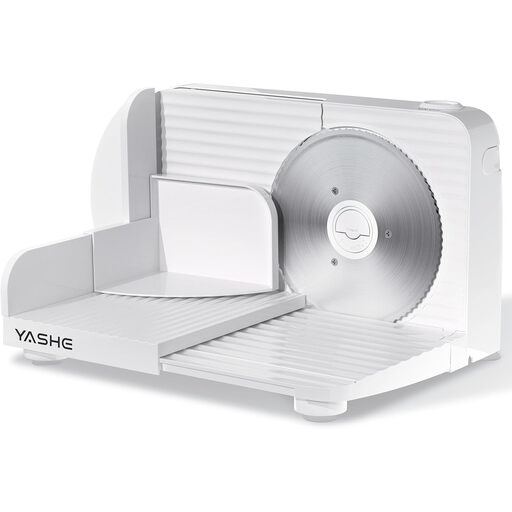 Image unavailable
The folding design may suit you if you want to store the machine compactly after use.
Adjustable thickness: 0–15 mm. 17 cm serrated stainless steel blade. Power: 180 W.
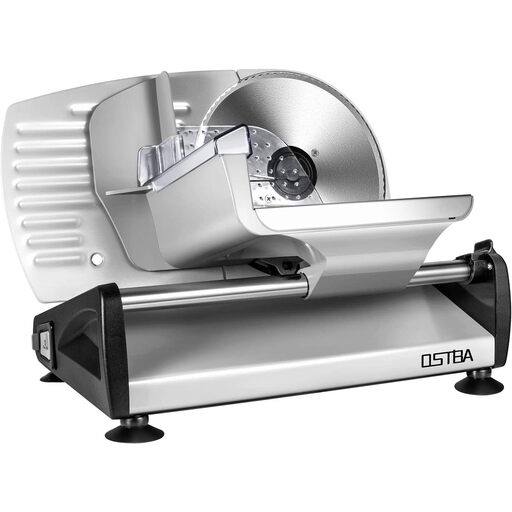 Image unavailable
The listed food pusher can help guide what you’re slicing. Check the manual for instructions on using the child lock.
Adjustable thickness: 0–15 mm. 19 cm blade. Power: 150 W.
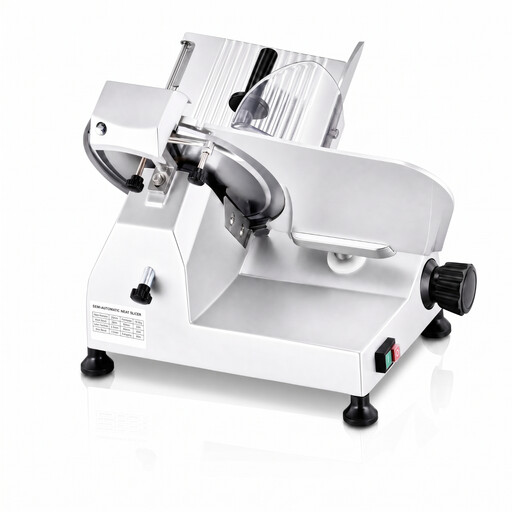 Image unavailable
The adjustable thickness and stated suitability for cold meats may appeal if you want to try different slice thicknesses.
Adjustable thickness: 0–12 mm. 25.4 cm carbon steel blade.
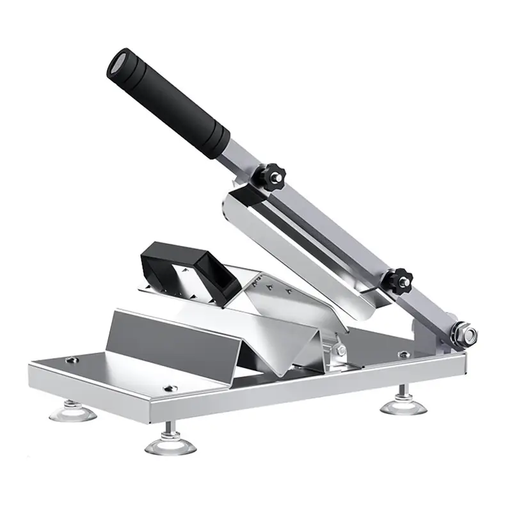 Image unavailable
The product title identifies this as a meat slicer. Check the specifications for the version you’re considering to see whether it meets your needs for slice thickness and food guidance.
The product title states SS304.
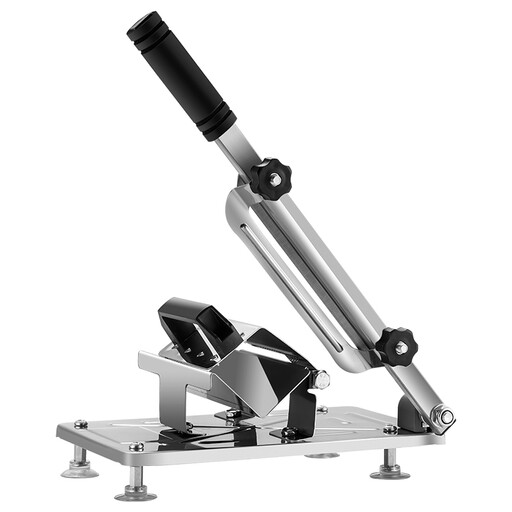 Image unavailable
The extended design is described as suitable for handling larger pieces. Check that the dimensions work for the food you want to slice and the space where you’ll store it.
The product name states that it’s made of stainless steel.
Not necessarily. Ritter describes its smooth blade for cold meats as suitable for salami, among other foods, but that doesn’t mean salami can only be sliced with a smooth blade. Check which blade comes with your model and whether an alternative blade is compatible.
No. An adjustment range alone doesn’t guarantee a particular slice thickness. Check the blade type and model specifications, and remember that the setting and the result may differ.
Use the food holder and follow the manual for the exact model. For the appliances described, Graef advises using the carriage and food holder, except where the shape or size of the food justifies the stated exception.
The NVWA states that electrical consumer products must carry a CE marking. Check the marking and conformity information for the specific appliance; a statement on a product page is not, by itself, an independent inspection.
Voedingscentrum advises keeping cold meats covered in the coldest part of the fridge at 4 °C. Its storage guide gives opened salami a shelf life of 5–7 days, with a shorter period for certain groups. Always follow the packaging instructions too.