
People with limited worktop space
You make small batches of chicken stock and want to know whether the chicken, water and vegetables will fit within the fill limit of a compact cooker.


First, measure your worktop and the space above the cooker. Then choose a capacity that allows your usual quantities of chicken, vegetables and water to stay within the fill limit for the exact model. A compact cooker takes up less space, while a larger one holds more ingredients but also needs more room on your worktop. Before buying, check the user and product documentation for the model you’re considering.
You make small batches of chicken stock and want to know whether the chicken, water and vegetables will fit within the fill limit of a compact cooker.
You want to make more stock at a time and are weighing up the capacity you need against the space the appliance takes up.
After straining the stock, you want to be able to clean the inner pot and lid easily, so you compare materials and cleaning instructions.
The main things to weigh up are the space you have, the amount you want to make and how you’ll clean the cooker afterwards.
| What to consider | What should you check? | Who is this important for? |
|---|---|---|
| Worktop space | Measure the width, depth and clearance above the cooker, then compare these with the dimensions and placement instructions for the exact model. | If I have limited worktop space, I also want room to open the lid and release steam as instructed. Around 36% of consumers give worktop space their top priority. |
| Capacity and fill limit | Estimate the combined amount of chicken, vegetables and water, then check the pressure-cooking fill limit in the manual for the model you’ve chosen. | If I’m making a larger batch, I want all the ingredients to fit within my cooker’s limit. Around 29% of consumers prioritise having enough room to cook. |
| Releasing pressure and opening the cooker | Read the instructions for releasing pressure and opening the cooker, and allow enough clearance around the steam outlet. | If I’m pressure-cooking hot stock, I want to be able to position and use the cooker in line with the safety instructions. Around 21% of consumers give a safe, manageable way to release pressure their top priority. |
| Cleaning the pot and lid | Compare the inner pot material and the cleaning instructions for the pot, lid and removable parts. | If I make stock regularly, I want to know which parts need to be washed by hand and which the manufacturer says are dishwasher-safe. Around 14% of consumers prioritise ease of cleaning and pot material. |
The ingredients and liquid all count towards the maximum fill. According to the Instant Pot manual, the Duo must not be filled beyond two-thirds when pressure-cooking. For a nominal capacity of 3 litres, that means a maximum total fill of 2 litres.
Check the fill limit for the exact model and compare it with the amount of chicken, vegetables and water you plan to use.
You may also need clearance to open the lid and release steam. The Instant Pot manual says to place the appliance on a stable, level surface.
So measure the available height too, and follow the manual’s placement and steam-release instructions.
Functions vary by model; the category name alone doesn’t tell you whether an appliance pressure-cooks.
Check the product description and manual for the exact model to see whether pressure-cooking is explicitly listed.
The 3-litre Duo Mini and 3.8-litre Classic Mini are compact models, but they don’t have the same capacity or features.
The RK-6160 is an electric pressure cooker with a nominal capacity of 6 litres, for anyone considering making a larger batch.
Tefal describes the Turbo Cuisine CY7548 as a multicooker with a pressure-cooking function and a non-stick inner pot.
This selection features larger electric pressure cookers for people considering a greater pot capacity. For the exact model, check the product documentation, fill limit and pressure-release instructions.
 No image available
The 6L capacity may be an option if you’re considering making a larger batch; check that your usual quantity of ingredients will fit within the fill limit.
The product name lists 1000W, 14 cooking functions and a stainless steel inner pot.
Follow the MAX line, and use the 1/2 line for ingredients that expand. Never force the lid open while the cooker is under pressure.
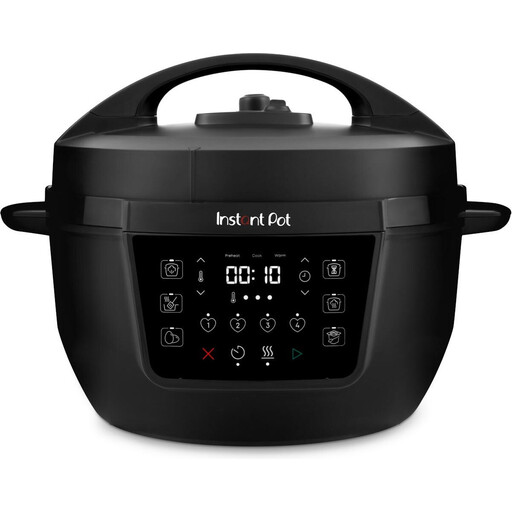 No image available
The 7.1L capacity may suit anyone considering cooking with more ingredients at a time; the usable fill depends on the instructions for this model.
The product name lists a stainless steel inner pot and a 7-in-1 design.
Check the maximum fill and pressure-release instructions in the manual before using the cooker.
 No image available
The 7.6L capacity may be useful if you want to cook a larger batch; compare it with the fill limit for the exact model.
The product name lists 12 preset programmes and a non-stick pot. The product description mentions programmes for poultry and soup/stock.
Follow the MAX line, and use the 1/2 line for ingredients that expand. Never force the lid open while the cooker is under pressure.
No, not according to the pressure-cooking fill limit in the Instant Pot Duo manual. With a nominal capacity of 3 litres, you can fill the cooker to no more than two-thirds: 2 litres in total for the chicken, other ingredients and liquid. That isn’t the same as 2 litres of strained stock.
Allow space for the body of the cooker, as well as enough height to open the lid and release steam as instructed in the manual. The Instant Pot manual says to place the appliance on a stable, level surface; for other models, follow their own instructions.
Check that pressure-cooking is explicitly listed in the product description and manual for the exact model. Don’t rely on the general ‘multicooker’ label alone.
For the exact model, check the product documentation and applicable conformity information, as well as the fill limit and operating instructions. According to Business.gov.nl, a CE mark is not a quality mark or proof of independent testing.
Voedingscentrum recommends covering leftovers and putting them in the fridge or freezer within 2 hours of cooking, once cooled. If needed, divide a larger batch between smaller containers so it can cool down.