
Instructor who wants to demonstrate rolling
Wants participants to try adjusting the thickness and cutting fettuccine for themselves. Marcato and Imperia describe powered rollers with adjustable thickness settings and the option to cut fettuccine.


If you want participants to roll out and cut their own sheets of dough, choose a powered roller. If your main aim is to reduce the manual work involved in mixing and kneading, consider an automatic pasta maker. Whichever type you choose, check that it comes with the right fettuccine disc or cutter, how much dough it can process per batch and how it should be cleaned between uses. An attachment is only suitable if you also have the compatible stand mixer and any additional parts it requires.
Wants participants to try adjusting the thickness and cutting fettuccine for themselves. Marcato and Imperia describe powered rollers with adjustable thickness settings and the option to cut fettuccine.
Wants to reduce the work involved in mixing and kneading, and plan how many batches will fit into the workshop. Philips describes the 7000 Series as featuring integrated scales and automatic preparation.
Wants to use an existing compatible mixer and check whether the roller, cutter and any adapter are also available. KitchenAid and Kenwood describe attachments that only work with compatible stand mixers.
Choose this option if: participants want to roll out sheets of dough and cut their own fettuccine.
Bear in mind: you’ll need to prepare the dough separately.
Choose this option if: reducing the manual work involved in mixing and kneading matters more than teaching participants to roll the dough themselves.
Bear in mind: you’ll need to check whether the model you choose includes a compatible fettuccine disc.
Choose this option if: you already have a compatible mixer and want to use it during the workshop.
Bear in mind: an attachment won’t work on its own and may require a separate roller or adapter.
| What to consider | What should you check? | Who is this important for? |
|---|---|---|
| Rolling and cutting by hand | Check whether the roller has adjustable settings and whether the model includes a fettuccine cutter. | If I want participants to get to grips with shaping and rolling the dough themselves, I focus on the roller and cutter. Around 36% of consumers prioritise this learning goal. |
| Less manual work per batch | Check whether the machine mixes and kneads, and how much dough or pasta it can process per batch. | If you want to make successive batches with less hands-on dough preparation, consider the steps involved in each batch. Around 29% of consumers prioritise this. |
| Using an existing stand mixer | Check compatibility and whether you need a roller or adapter as well as the cutter. | If I want to make use of a mixer I already own, I first check that all the parts are compatible. Around 21% of consumers prioritise compatibility. |
| Cleaning between batches | Check which parts are removable and follow the cleaning instructions for the exact model. | If you want to clean the machine between workshop groups, it helps to have a routine that fits the schedule. Around 14% of consumers consider cleaning the most important factor. |
A powered roller rolls and cuts dough, but you’ll need to prepare the dough separately. Philips also describes the 7000 Series as mixing and kneading automatically.
First decide which steps you want participants to learn for themselves, then choose a machine to match.
Allow extra time and workspace to prepare the dough separately.
An attachment won’t work on its own. With the Kenwood KAX981ME, you’ll first need to roll out the dough using a lasagne roller; certain older fittings may also require an adapter.
Check that the stand mixer and all the necessary parts work together to make the fettuccine you want.
The complete set-up may also require a suitable stand mixer, roller or adapter.
Cleaning instructions vary between systems. Philips and Marcato give different guidance for the models mentioned.
Plan your cleaning routine around the manual for the exact model, including between workshop batches.
Allow time to remove dough residue and clean the parts according to the model-specific instructions.
The 7000 Series is an automatic option if you want to reduce the amount of manual mixing and kneading.
Atlasmotor+ is a motorised roller for workshops where participants make sheets of dough and fettuccine.
According to Imperia, Electric iPasta Classic combines an electric roller with a Duplex cutter for making fettuccine and other pasta shapes.
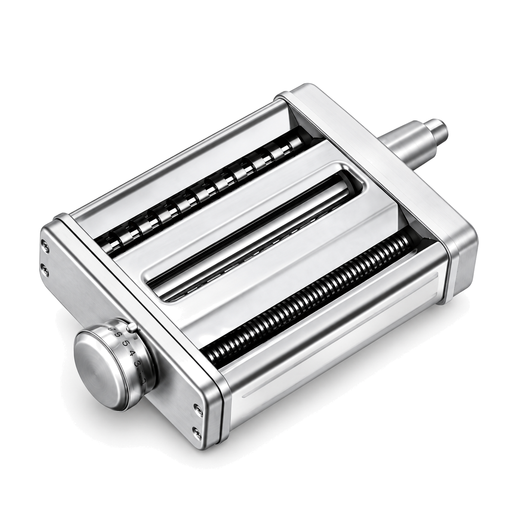
The 5KSM3MPA attachment is designed for those who already use a compatible KitchenAid stand mixer.
KAX981ME is a cutting attachment for a compatible Kenwood stand mixer, provided you already have a suitable dough roller set-up.
This selection includes electric pasta makers and attachments for workshops. For each model, check whether the cutter or shaping disc actually makes fettuccine and what additional machine or parts you’ll need.
 No image available
Could suit a workshop where participants want to adjust the thickness of their dough; check whether a compatible fettuccine cutter is available for this model.
The product details list a 60 W motor and two cutting attachments.
 No image available
Worth considering if you already have a compatible KitchenAid stand mixer and want to roll dough and cut fettuccine.
The product details list a roller, a fettuccine cutter and eight thickness settings. The attachment won’t work on its own and requires a compatible mixer.
 No image available
Could be a good option if you want to reduce the manual mixing and kneading involved in each batch; check whether the available shaping disc is suitable for fettuccine.
The product details list two programmes and a maximum dough capacity of 200 g.
 No image available
Could be a good fit if automatic mixing, kneading and shaping are important to you; check whether the model you choose has a fettuccine disc.
The product details list a capacity of up to 450 g of pasta per batch, along with automatic and manual programmes.
It depends on the exact model. Marcato lists fettuccine as an option for Atlasmotor+, while Imperia says its Duplex cutter can make fettuccine and other shapes. A compatible fettuccine disc is available for the Philips 7000 Series, but check whether it’s included with the model you choose. With the Kenwood KAX981ME, you’ll also need to roll out the dough first using a lasagne roller.
Not as a general rule. Philips says that parts of the 7000 Series mentioned, except the front panel, can be washed in a dishwasher programme below 60 °C. Marcato advises against cleaning Atlas attachments under running water or in the dishwasher. Always follow the instructions for your exact machine.
For a private purchase, the Netherlands Authority for Consumers and Markets (Rijksoverheid) says you’re entitled to a product that meets the terms of your agreement, and you can contact the seller if there’s a fault. The Netherlands has no fixed statutory two-year warranty period. For a business purchase intended for workshop use, check the contractual terms of that purchase.
CE marking is compulsory for electrical products covered by the relevant rules, according to the Netherlands Food and Consumer Product Safety Authority (NVWA). If you sell food or drink to customers as a business, the NVWA says you must meet food safety requirements and have a food safety plan or hygiene code. There are also rules on allergen information for unpackaged food; which food regulations apply depends on how the workshop is run.