
Vandaag of morgen in huis

Kwaliteit gegarandeerd

Welkomstaanbiedingen ontgrendelen: GRATIS bezorging | Tot 80% korting | Gratis 30 dagen JoyPlus-proefperiode
Download de app
An electric meat slicer can save you a great deal of work at home. Cold meats, roasts, bread and cheese can be sliced more evenly than with an ordinary kitchen knife. However, not every electric slicer is suitable for every use. A compact model for slicing bread occasionally has different features from a professional meat slicer for daily use.
Pay particular attention to three common pitfalls:
For bread, cold meats and cheese, adjustable slicing thickness is a practical starting point. Do not just check the maximum range; also look at how the thickness is adjusted. According to the product details, the Fritel SL 3110 offers a range of 0 to 15 mm. The ritter serano⁷ specifies an adjustable thickness of up to 23 mm, while the ritter Sono¹ can slice up to 20 mm.
A stainless-steel cutting blade is important for hygiene, maintenance and durability. A serrated blade is useful for bread and products with a crust. A smooth blade is generally better suited to cold meats and cheese. Some models come with both blade types, so check exactly what is included in the box.
An electric meat slicer is not the same as an electric knife. A slicer usually works with a rotating blade, carriage and thickness adjustment. An electric knife, such as the Fritel EK 3180, uses two reciprocating blades and is intended for items such as roasts, baguettes and cabbage.
For occasional household use, a compact model is often sufficient. If you slice several times a week, motor control, cooling and mechanical stability become more important. Consider:
The Fritel SL 3110 has a geared motor with a power rating of 100 W. The Fritel EK 3180 specifies 150 W. These figures cannot be compared directly because the products use different cutting principles.
A kitchen slicer should stand securely on a flat worktop. Non-slip feet, a food holder and a safety on/off switch help reduce the risk of fingers getting too close to the blade. A removable carriage makes cleaning easier.
Also consider the construction. A foldable model takes up less space in a Dutch kitchen, but check that the hinge and locking mechanism feel sturdy. An all-metal model is generally heavier; this can improve stability, but it does require a permanent storage space.
Always follow the instructions. Unplug the appliance before removing a blade. Do not touch cutting edges, and never immerse a motorised handle or motor housing in water. With an electric knife, a double safety switch is an important feature to check; with a slicer, momentary and continuous switches are useful functions.
The recommendations below are based on the listed product specifications and usage scenarios. Check the current product page, included accessories and availability before buying.

Why it suits this profile: This compact model is designed for home use and, according to the product information, slices bread, cheese, cold meats, vegetables and fruit. Its folding design is helpful when cupboard space is limited.
The slicing thickness is explicitly stated as 0–15 mm. The serrated stainless-steel blade is removable, making cleaning less of a chore.
100 W motor, child-safe on/off switch, removable carriage and folding design. The product details specify a two-year warranty.

Why it suits this profile: The described all-metal construction, angled setup and electronic speed control are well suited to keen cooks who regularly slice a variety of foods.
The product description mentions both a serrated blade for bread and a smooth blade for meat and cheese. The removable carriage makes maintenance easier.
Slicing thickness of up to 23 mm, 24 cm cutting path, collection tray and electronic speed control according to the product information.
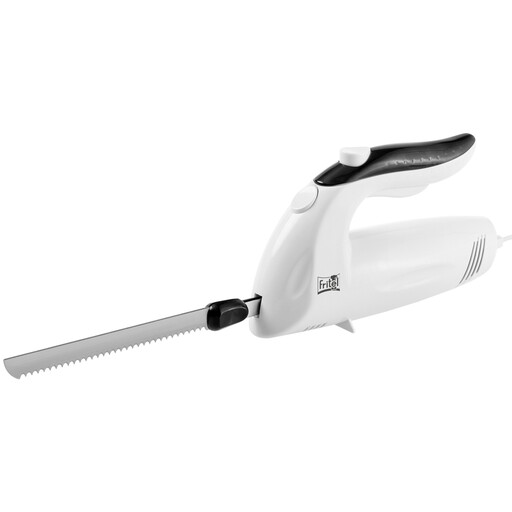
Why it suits this profile: This electric knife is ideal for users who mainly want to portion roasts, roast beef, baguettes or cabbage and do not want to set up a dedicated slicer.
The set includes a meat blade and a blade for frozen foods. According to the description, the double safety switch is designed to prevent accidental activation.
150 W power, ergonomic handle for left- and right-handed use, and two included blades.
We have put together a complete, up-to-date list of products that fully meet these strict selection criteria and the applicable European safety regulations.
Many models can do this, but check the blade and product description. A meat and bread slicer with both serrated and smooth blades is more versatile. A serrated blade generally works better for bread, while a smooth blade may be suitable for cold meats and cheese. Do not use the machine for products that the manufacturer does not state it is suitable for.
Switch off the machine, unplug it and remove the carriage or blade only as instructed in the manual. Wipe the housing with a slightly damp cloth. A removable stainless-steel blade can be cleaned separately more easily, but always check whether it is dishwasher-safe. Dry all parts completely before reassembling the slicer.
Consumption depends on the motor power and how long the machine is used. For short periods of use, the difference in electricity costs is usually limited; the purchase price, blade wear and maintenance have a greater impact. A model with suitable power, sturdy construction and replaceable parts may therefore be more practical for regular use than a cheap machine that needs replacing quickly.
