
Vandaag of morgen in huis

Kwaliteit gegarandeerd

Welkomstaanbiedingen ontgrendelen: GRATIS bezorging | Tot 80% korting | Gratis 30 dagen JoyPlus-proefperiode
Download de app
An electric meat slicer can be useful for bread, cold meats, cheese, vegetables and fruit. You can slice faster and achieve more evenly sized slices than with an ordinary kitchen knife. However, not every electric slicer is suitable for everyday use in a UK household.
Pay particular attention to three common pitfalls:
A good choice therefore starts with the specifications and how you intend to use the machine, rather than its appearance.
The ability to adjust the slicing thickness largely determines how versatile a food slicer is. You may want thicker slices for bread, while cold meats and cheese are often sliced more thinly. Check the following:
A range of 0 to 15 mm is practical for many everyday uses. If you also want to slice thicker pieces of bread or vegetables, consider a model with a wider range.
A serrated blade is generally suitable for bread and various soft or firm foods. Check the blade diameter, the material and, above all, whether the blade can be removed. A removable stainless-steel blade makes maintenance easier.
The carriage also deserves attention. A removable carriage with a food holder helps move food towards the blade in a controlled manner. Also look for:
Bear in mind that “stainless steel” may refer only to the blade, rather than the entire housing. A plastic housing can be lightweight and practical, but requires careful maintenance with intensive use.
A slicer has a sharp, rotating blade. A child-safe on/off switch, a food holder and stable positioning are therefore important. Always place the machine on a flat work surface and keep your fingers away from the blade.
A compact or folding slicer is useful if you have limited space. However, check that the machine locks securely once unfolded and that there is enough space around the carriage. It is only sensible to store the machine immediately after use once it is completely clean and dry.
The selection below is based on verifiable product details, such as slicing thickness, blade diameter, power, dimensions and construction. Product information may vary between versions, so always check the current product page before buying.
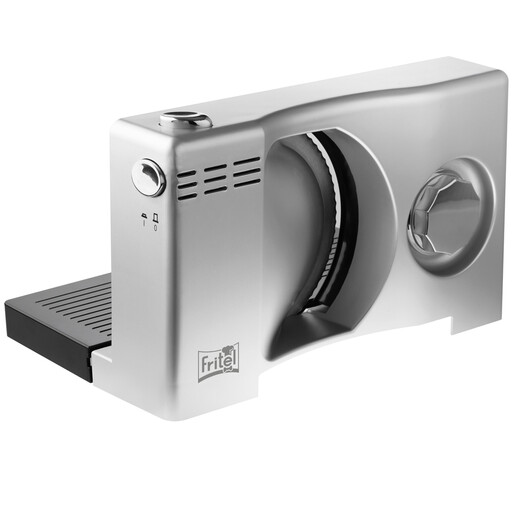
Why it suits this profile: This model is designed for home use and combines bread, cheese and cold meats in one compact electric slicer. Its folding design is well suited to smaller kitchens.
The product details specify an adjustable slicing thickness of 0-15 mm, a child-safe on/off switch and a removable serrated stainless-steel blade.
100 W motor with gear drive, 170 mm blade diameter, removable carriage and folding design.
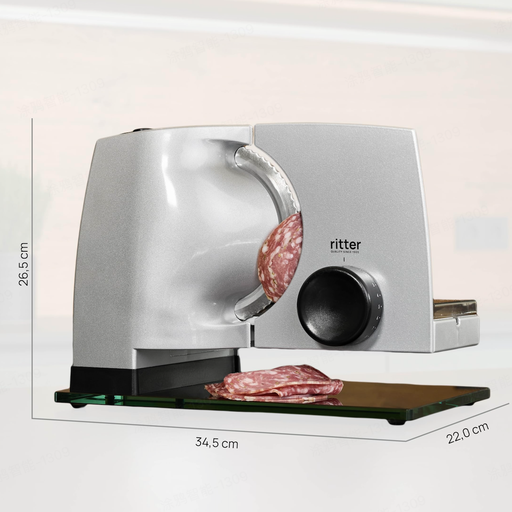
Why it suits this profile: This version is aimed at users who want a food slicer for different types of food and value a metal construction, a glass base plate and a wider slicing range.
The description specifies a removable carriage, a serrated blade and a slicing thickness of up to 20 mm. This makes the key usage limits clearer than simply stating the motor power.
Suspended metal construction, shatter-resistant glass base plate, removable carriage and momentary plus continuous switch.
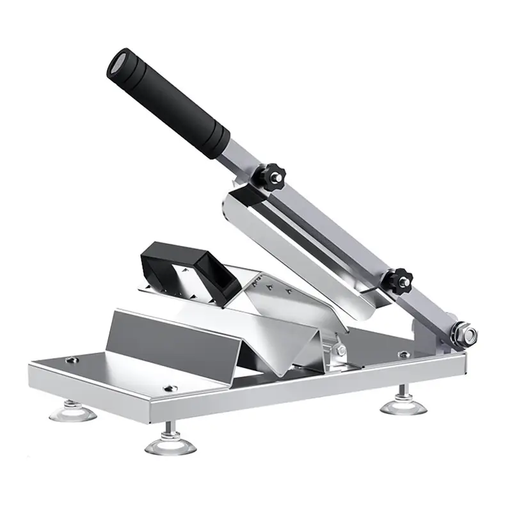
Why it suits this profile: This is a focused option for anyone primarily looking for a meat slicer for home use. The product name specifies SS304 stainless steel; check the product page to see exactly which parts are made from it.
The SS304 designation identifies a specific material type. As further details about slicing thickness, safety features and cleaning are not included in the supplied description, checking these before buying is important.
Designed as a meat slicer and specified as SS304. Compare the dimensions and safety features with your work surface and intended use.
A bread slicer and an electric meat slicer often use a rotating blade and sliding carriage. A bread and meat slicer is suitable when you want to use one appliance for several products. However, check whether the manufacturer explicitly mentions vegetables, fruit and cheese.
A chopper, such as the Kenwood Easy Chop+ CHP62, works differently. This appliance chops ingredients in a 600 ml bowl using two speeds. It is therefore not a replacement for a slicer when you need evenly sized slices.
For manual grating or slicing, products such as a multifunctional vegetable slicer or a 5Five vegetable slicer are alternatives. They do not use a motor, but often take up less space.
Also check the rated power. A 100 W appliance may be sufficient for normal home use, but this alone says nothing about the maximum operating time or suitability for large quantities. For this information, consult the manual and the specifications for the specific model.
We have compiled a complete, up-to-date list of products that fully meet these strict selection criteria and the applicable European safety regulations.
Not automatically. Many models are designed for bread, cold meats, cheese and other prepared foods. Frozen meat can put greater strain on the blade and motor. Only use the appliance for this purpose if the manual expressly permits it.
Switch off the appliance, unplug it and remove only the parts that the manual states are detachable. Wipe the housing with a slightly damp cloth. A removable stainless-steel blade and detachable carriage usually make maintenance easier.
Consumption depends on the power rating and how long the machine is used. A 100 W model theoretically uses 0.1 kWh when running continuously for one hour. In practice, a slicer is usually used for short periods. Calculate the exact cost by multiplying the power in kW by the local electricity price and the length of use.
