
Vandaag of morgen in huis

Kwaliteit gegarandeerd

Welkomstaanbiedingen ontgrendelen: GRATIS bezorging | Tot 80% korting | Gratis 30 dagen JoyPlus-proefperiode
Download de app
An electric meat mincer can help you make burgers, mince, sausages, sauces and fillings. However, it’s not wise to focus only on the highest wattage or the largest number of accessories. A machine that looks powerful on paper may be awkward to use in practice because of a small feed opening, difficult-to-clean parts or limited running time.
As a Joybuy Product Recommendation Officer, I filter the key product specifications and compare them with the most common purchasing pitfalls. This helps you make a more informed choice between a standalone mincer, a home meat mincer or a multifunctional food processor.
Power is often prominently displayed, but it doesn’t automatically tell you how much meat a machine can process continuously. Check the permitted running time, motor protection and instructions on rest periods too. A model with a lower rated power may be sufficient for small portions, while a more powerful machine may be more suitable for families or larger quantities.
Also check whether a stated figure refers to normal power or maximum peak power. For example, the Monsga G100 has a 300-watt motor alongside a stated maximum of 1200 watts. These are not equivalent measurements.
A mincer with accessories may seem appealing if it comes with sausage-making attachments, kibbeh attachments, grating discs or blades. In practice, how easy the parts are to take apart, wash by hand and dry will determine how often you use these features.
Parts that come into contact with raw meat should be cleaned straight away. Check whether the product information clearly states which parts can be removed and whether they’re dishwasher-safe. The motor housing must not be submerged in water on any of these machines.
A food processor with a mincer is handy if you also want to chop, blend, grate or make dough. However, its bowl may not be designed to handle the same quantity or texture as a standalone mincer. If you regularly prepare larger quantities of mince or sausages, a model with separate mincing plates is generally a more sensible choice.
For different textures, fine, medium and coarse mincing plates are useful. Finely minced meat, for example, works well in sauces or smooth fillings; coarsely minced meat may be suitable for burgers. Check the size of the feed tray and collection tray too. A large feed tray means you’ll need to refill it less often, but it takes up more room on your worktop.
A stated capacity isn’t always the same as the recommended amount for continuous use. Follow the instructions and don’t exceed the maximum portion sizes.
Stainless steel mincing plates and blades are practical thanks to their hard-wearing surfaces and ease of cleaning by hand. A metal housing can also make the machine heavier and more stable, but less convenient to store. Check whether “metal” refers to the entire housing or just specific parts.
A pusher, safety lock and overheating protection are useful features. Never use your fingers or cutlery to push ingredients towards the blades or auger. The Kenwood MG700, for example, is stated to have a maximum continuous running time of ten minutes, after which it must be allowed to cool down. Instructions like these matter more than a high wattage alone.
Food processors also require care when it comes to accessories: only use parts designed for your specific model. Switch off the appliance and unplug it before changing or cleaning any parts.
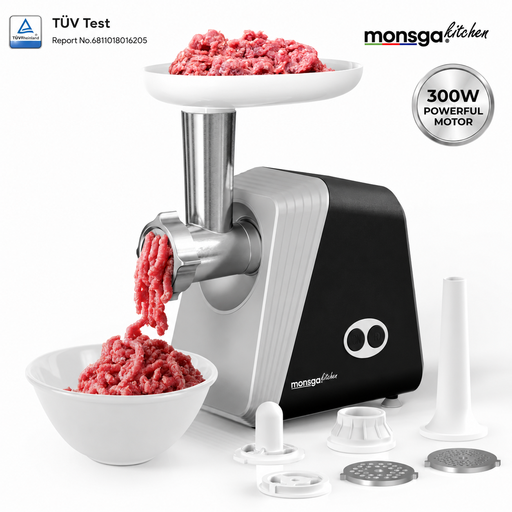
Why it suits this profile: This model is designed for home use and combines three mincing plates with sausage-making and kibbeh accessories. That gives you several ways to prepare food without having to invest in a large food processor straight away.
The product information states both the motor’s normal power and its maximum power. It also specifies that the parts should be washed by hand and stored dry, and that the machine has overheating protection.
Three mincing plates, a sausage filler, a kibbeh attachment and a compact design for the home kitchen.
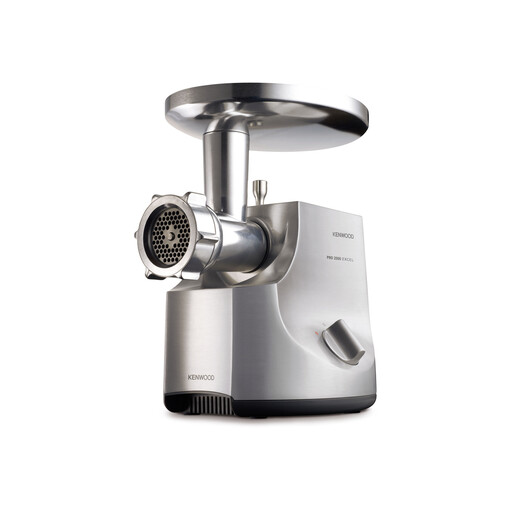
Why it suits this profile: The MG700 is a standalone electric meat mincer with an aluminium housing, stainless steel mincing plates, and sausage-making and kebbe accessories. It’s a good fit for people who process meat regularly.
The specifications list three mincing plates, a collection tray and a maximum continuous running time of ten minutes. This gives you more useful information than a model with a wattage claim alone.
Stated power of 2000 watts, three stainless steel discs, and separate sausage-making and kebbe accessories.
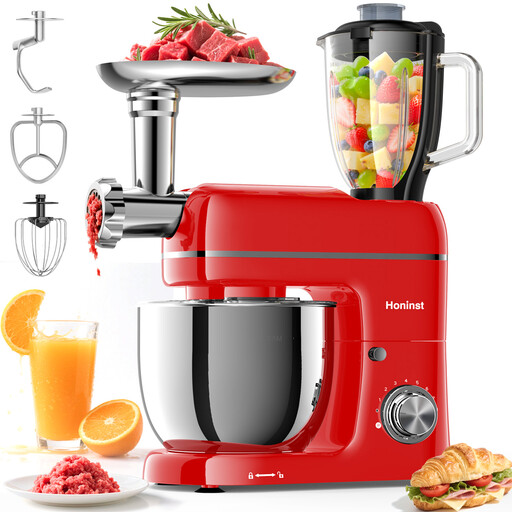
Why it suits this profile: This appliance combines mixing, kneading, blending and mincing. It’s suitable for anyone who wants to make dough, sauces, smoothies and other dishes in one kitchen appliance, as well as mince.
The machine has a safety lock on the tilting head and uses approved accessories. The product information also advises you to stick to the maximum quantities and normal domestic running times.
Stated maximum motor power of 1300 watts, a 6-quart stainless steel bowl and eight speeds with a pulse function.
We’ve put together a complete, up-to-date list of products that meet these strict selection criteria and the applicable European safety regulations.
That depends on the motor, permitted running time and portion size. For everyday family use, a model with several mincing plates, a sturdy collection tray and clear instructions on overheating is practical. Work in batches and let the machine cool down when the instructions say to.
Not every model is designed for this. Some mincers are described as being suitable for vegetables or hard cheese too, while a food processor or separate vegetable chopper may be better for smaller ingredients. For dry spices, a spice grinder with its own grinding mechanism is often more suitable than a meat mincer.
Power consumption depends on the rated power and how long the machine is actually used. A 1000-watt appliance running for ten minutes would theoretically use around 0.17 kWh. In practice, the motor often runs for less time or in short bursts. Cleaning, replacement parts and storage space are therefore just as relevant to the overall cost of use.
