
Vandaag of morgen in huis

Kwaliteit gegarandeerd

Welkomstaanbiedingen ontgrendelen: GRATIS bezorging | Tot 80% korting | Gratis 30 dagen JoyPlus-proefperiode
Download de app
Making your own mince gives you more control over the ingredients, the grind and the portion size. However, not every electric meat grinder is suitable for regular use in a British kitchen. A low price might seem appealing, but awkward cleaning, unclear motor power ratings or missing accessories can quickly make the appliance less practical.
With this buying guide, you can focus on the features that really matter. Afterwards, you’ll see which model suits different usage scenarios, from occasional mince-making to preparing sausages, burgers and kibbeh.
A figure like “1200W” sounds powerful, but check what this number actually means. Some brands quote the maximum peak power, while the continuous power is lower. According to the product description of the Monsga G100, it has a 300W motor with a maximum power of 1200W. That’s useful information: so compare models on both the nominal and maximum power.
For home use, what really matters is whether the motor suits your portion size and how often you’ll use it. A 1200W meat grinder might be interesting for larger quantities, but wattage alone doesn’t tell you everything about throughput or lifespan.
A meat grinder with a sausage filler or a meat grinder with a kibbeh attachment can be handy, but only if you actually use these functions. Check what’s included in the box and whether the accessories are easy to assemble. An appliance with three grinding plates is more flexible than a model with just one plate, as long as you can store and clean the parts properly.
Meat residue can easily get trapped in the grinding unit. Parts that aren’t removable make cleaning more difficult. Also check whether the motor housing can be cleaned with water and whether the blades and grinding plates need to be washed by hand.
A reverse function can help when meat builds up around the worm shaft. This won’t prevent every problem, but it can reduce the need to disassemble the unit during use. Also look for stable placement, dry hands and a clear overload or overheat protection system.
If you’re making a few burgers a week, your requirements are different from someone who meal preps regularly. Look at:
A multifunctional meat grinder with a copper motor is often linked to stable performance in product information. Be cautious with this: according to the product description of the Monsga G100, the appliance has a copper motor and a maximum power of 1200W. The practical capacity then depends on the type of meat, preparation and how long you use it.
A fine grind is suitable for spreadable mince or certain fillings. A medium or coarse grind is often more practical for burgers, meatballs and chilli. A meat grinder with 3 grinding plates therefore offers more choice than a basic model.
Cut the meat into smaller pieces beforehand and remove any tough sinew and bones. Only use the supplied pusher. Hard or sharp objects can damage the motor and grinding parts.
Check which parts are made of metal or plastic and how easily the grinding unit comes apart. Blades and grinding plates are sharp and need to be handled carefully. According to the product information for the Monsga G100, the removable parts should be washed by hand in warm water with mild washing-up liquid. The motor housing must not be submerged.
Allow all parts to dry completely before reassembling or storing them. This helps to prevent odours, moisture problems and premature wear. Before buying, also check whether a Dutch-language manual, warranty information and the seller’s contact details are available. A CE mark and safety information should be verifiable on the product or packaging; don’t settle for just a general marketing claim.
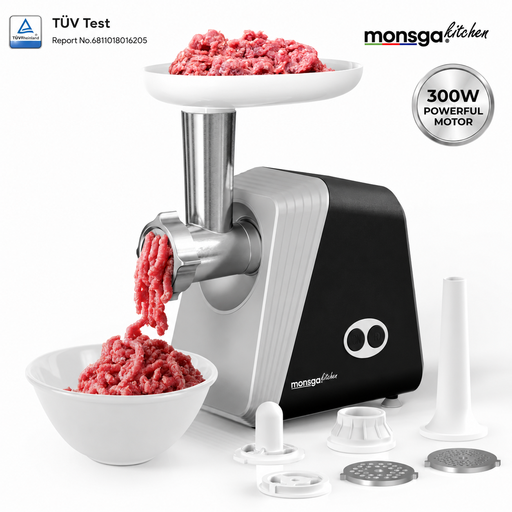
Why this fits the profile: For anyone who wants to make mince, burgers or meatballs at home from time to time, this model offers several basic functions without needing to hunt for separate accessories.
The product description lists both 300W and a maximum of 1200W. This makes it clear that the maximum figure isn’t automatically the continuous power.
Three grinding plates, reverse function, cord storage and accessories for sausages and kibbeh.
Why this fits the profile: If you want to prepare different textures, having fine, medium and coarse grinding plates gives you more control over the result.
The choice of three plates means you don’t need a different appliance for every grind you want.
Suitable for mince, burgers, meatballs, chilli, tacos, sausages and kibbeh according to the product description.
Why this fits the profile: For home cooks who want to make sausages or kibbeh as well as mince, the included filling and shaping accessories are practical.
The reverse function can help when material gets stuck. Work in small batches and follow the safety instructions.
Sausage stuffer, kibbeh attachment, cookie maker, cord storage and protection against overload and overheating.
We’ve put together a full, up-to-date list of products that fully meet these strict selection criteria and current European safety regulations.
An electric meat grinder is not designed for outdoor use, on a wet worktop or without supervision. Keep the motor housing dry and do not let children operate the appliance.
Yes, a model for home use is suitable for small to medium portions, as long as you prepare the meat, follow the recommended operating time and don’t overload the motor. For large quantities in one go, the stated continuous capacity is more important than just the maximum wattage.
Clean the grinding unit after every use. Remove the head, worm shaft, blade, grinding plate, pusher and any filling accessories. Wipe the motor housing with a slightly damp cloth. Allow all parts to dry completely before reassembling.
The consumption depends on the actual power and how long you use it. An appliance that runs for a few minutes per meal typically uses less energy than one that runs continuously for a long time. So look at the nominal power and work with portions that match the appliance’s capacity.
