
Vandaag of morgen in huis

Kwaliteit gegarandeerd

Welkomstaanbiedingen ontgrendelen: GRATIS bezorging | Tot 80% korting | Gratis 30 dagen JoyPlus-proefperiode
Download de app
An electric knife can be useful if you regularly want to cut roast meat, poultry, bread, cake or vegetables into even slices. The reciprocating blades do some of the cutting for you, so you do not need to press as hard as you would with an ordinary kitchen knife.
However, not every model is suitable for the same tasks. A common mistake is buying an electric meat knife when you mainly want to cut bread, or choosing a device without checking how the blades are cleaned. So do not focus solely on the wattage or an attractive product photo.
A higher wattage does not automatically mean that the knife is suitable for every ingredient. The design of the blades, the handle and the recommended uses also play a role. An electric carving knife for meat may be constructed differently from an electric bread knife.
So check:
Food residue can remain between the blades and around the attachment point. A motorised handle must generally not be submerged in water. So check in advance whether the blades are removable and which parts are dishwasher-safe.
The Rommelsbacher EM 150 has removable blades which, according to the product information, are dishwasher-safe. With the Fritel EK 3180, the motorised handle must instead be cleaned with a damp cloth.
An electric knife has sharp, moving blades. A double safety switch or finger guard can make operation more straightforward, but safe use is still essential. Always unplug the appliance before fitting, removing or cleaning the blades.
Do not force the appliance through the food. Let the movement of the blade do the work and keep your fingers away from the cutting edge.
An electric meat knife with a dedicated meat blade is practical for roulades, roasts and poultry. An additional blade set for frozen products increases its versatility, but this does not mean that every product can be cut while completely frozen. Always follow the instructions for use.
Stainless steel blades are a common choice for kitchen appliances. Also look for an integrated finger guard and a safe release mechanism. The Rommelsbacher EM 150 comes with two 15 cm blade sets, both featuring finger guards.
The stated power rating is a technical point of comparison, not a guarantee of a particular cutting result. The Fritel EK 3180 has a power rating of 150 W, while the Rommelsbacher EM 150 has 120 W. Also consider the weight, the shape of the handle and the length of the mains cable.
A long handle can be comfortable when working with larger pieces of meat. However, a 1-metre cable means you will need a socket close to the worktop. The Rommelsbacher has a 1.40-metre cable.
You use a compact electric knife directly above a chopping board. An electric food slicer with a carriage is more suitable for repeatedly slicing meat, cheese or bread. For example, according to the product description, the ritter serano⁷ has a removable carriage, a 24 cm cutting track and an adjustable cutting thickness of up to 23 mm.
So first decide whether you want a portable knife or a fixed machine. An electric meat slicer takes up more space, but may be suitable if you often cut a large number of slices one after another.
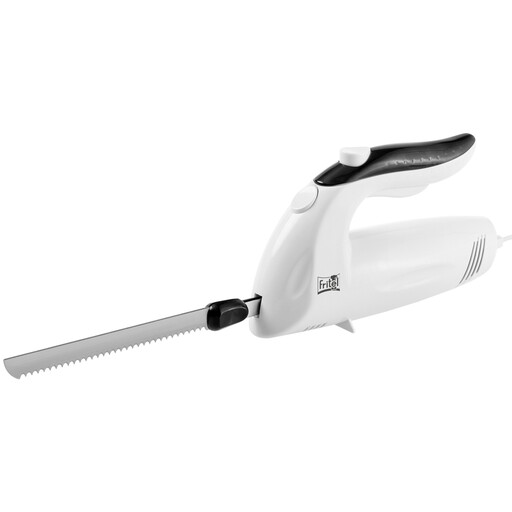
Why it suits this profile: This model is designed for general kitchen use, from roast meat and roast beef to baguettes and cabbage. The large handle is suitable for both left- and right-handed users.
The packaging contains two blade sets: a meat blade and a blade for frozen products. The double safety switch helps prevent accidental activation.
150 W power, two blades included and an ergonomically shaped handle. Cable length: 1 metre.
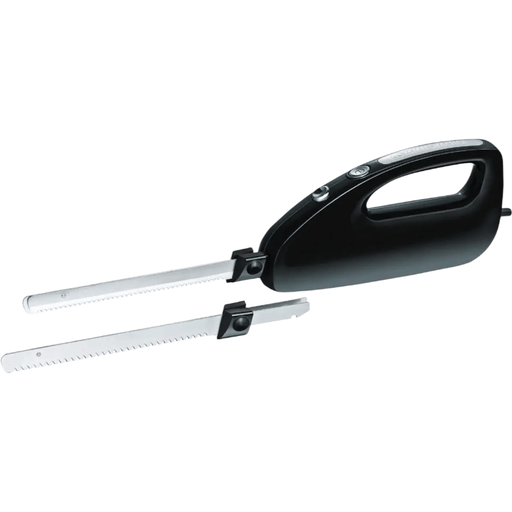
Why it suits this profile: A versatile electric knife for households that alternate between slicing bread, meat, poultry, cake and lightly thawed frozen products.
The two blade sets are removable and, according to the product information, dishwasher-safe. The blades feature finger guards and a separate release button.
120 W motor, two 15 cm stainless steel blade sets, finger guards and a 1.40-metre cable.
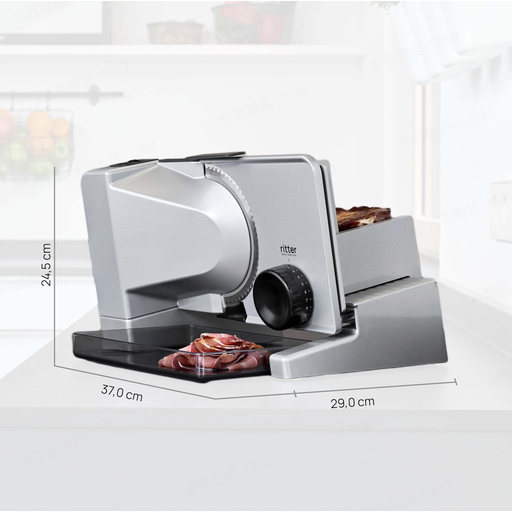
Why it suits this profile: This freestanding electric slicer is ideal for users who regularly prepare several slices of meat, bread or cheese in succession and have room for a larger appliance.
Here, you are deliberately choosing a machine with a carriage rather than a handheld knife. The adjustable cutting thickness and two blade types make it easier to choose the right setting for each ingredient.
Cutting thickness of up to 23 mm, 24 cm cutting track, smooth blade for meat and serrated blade for bread according to the product description.
We have put together a complete, up-to-date list of products that fully meet these strict selection criteria and the applicable European safety regulations.
This varies by model and blade set. Some appliances list frozen products as a suitable use, but hard-frozen meat may be too demanding for the mechanism. Allow the product to thaw slightly as instructed and do not force the blade.
Yes, provided the model is designed for this purpose and has a suitable serrated blade. An electric bread knife can slice baguettes, cake and other baked goods more evenly than a blunt handheld knife. Check whether the bread blade is included.
An electric knife usually operates for only a few minutes at a time. Total consumption depends on the power rating and how long it is used. A 120 W model running for ten minutes theoretically uses around 0.02 kWh. In practice, its electricity consumption is therefore generally limited; cleaning and safe storage are more important considerations for daily use.
