
Vandaag of morgen in huis

Kwaliteit gegarandeerd

Welkomstaanbiedingen ontgrendelen: GRATIS bezorging | Tot 80% korting | Gratis 30 dagen JoyPlus-proefperiode
Download de app
An electric kettle may seem like a simple appliance, but there are big differences between models. A 1.7-litre capacity isn’t automatically practical for a small household, a high wattage doesn’t tell you everything about how it performs, and a glass body needs different care from stainless steel.
For households, families, students and tea lovers, three buying mistakes are particularly worth avoiding:
A 1.7-litre kettle is a good choice for families, shared homes and offices where several cups of tea or coffee are made one after another. A standard mug holds around 250 millilitres. According to the product specifications, a full 1.7-litre kettle can therefore make several servings.
For a student room, office desk or travel, a capacity of 0.4 to 1 litre may be more practical. It takes up less space and you’re less likely to heat more water than you need. Always check the MIN and MAX markings. Too little water may activate the boil-dry protection, while overfilling increases the risk of splashing as the water boils.
A stainless steel kettle often has a sturdy interior and is less prone to breaking. According to the product description, the exterior of double-wall models stays better insulated, although the water inside and the steam remain hot.
A glass kettle lets you see the water level at a glance. Several product descriptions mention borosilicate glass for its heat resistance. However, limescale may be more noticeable on glass, and it needs to be handled and cleaned with care.
When checking whether a kettle is BPA-free, look at exactly which parts are described as BPA-free. Some models specify that the plastic parts which come into contact with water are BPA-free. Don’t assume this applies to every part of the appliance.
A temperature-control kettle is particularly useful for green tea, coffee, baby food or other uses where you don’t always need boiling water. For example, the Midea models in this selection offer several preset temperatures. According to the product specifications, the 1.7-litre model has settings of 40, 60, 70, 80, 90 and 100 °C.
A kettle with a keep-warm function can maintain the selected temperature for a set period. The product information for the 1.7-litre Midea model states that it keeps water warm for up to 60 minutes. Before buying, check whether the keep-warm function starts automatically or needs to be activated manually.
Also look for:

Why it suits this profile: Its 1.5-litre capacity is ideal for everyday use without going straight for an extra-large model. It’s easy to use for tea, coffee and instant meals.
The product information lists automatic shut-off, boil-dry protection and a clearly specified double-wall design. Be sure to check the MIN and MAX markings before use.
1.5-litre capacity, 1500 watts, stainless steel interior and a double-wall design.
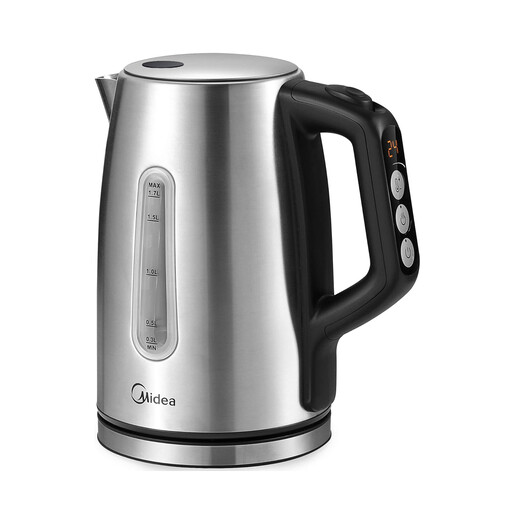
Why it suits this profile: This model combines a generous capacity with temperature selection and a keep-warm function. It’s a good fit for tea lovers and households where people have different preferences.
You don’t have to rely on the boil setting alone: the product specifications list six temperatures from 40 to 100 °C and boil-dry protection.
2200 watts, 1.7 litres, keeps water warm for up to 60 minutes according to the product information, and includes a limescale filter.
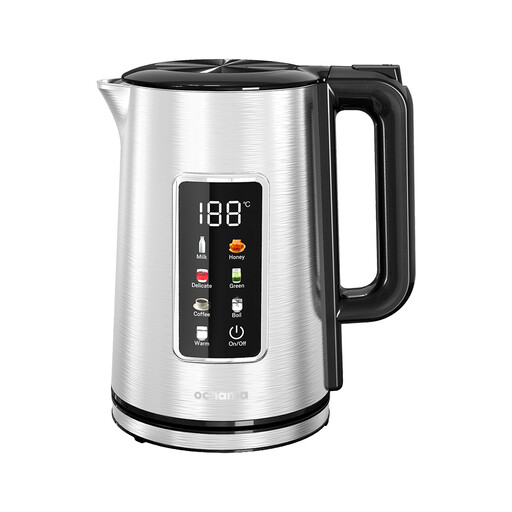
Why it suits this profile: Its generous capacity and high power make it well suited to families and shared kitchens where several servings are needed in quick succession.
The description lists automatic shut-off if the kettle boils dry and a double-wall stainless steel construction. Actual boiling time still depends on the amount of water.
1.7 litres, 2100 watts, temperature display and a cordless kettle with cord storage in the base.
We’ve put together a complete, up-to-date list of products that meet these strict selection criteria and the applicable European safety regulations.
Its lifespan depends on how often you use it, limescale build-up, cleaning and the quality of its components. Regular descaling can help keep the heating element working efficiently. Follow the instructions and switch the kettle off when you don’t need it.
Energy use depends on the wattage and the amount of water. A 2,200-watt model uses more power while heating than a 1,500-watt model, but the overall cost depends mainly on how long it takes to heat the water. So only boil as much water as you need.
Glass makes the water level easy to see, while stainless steel is generally less vulnerable to knocks. Choose glass if visibility is important to you, or stainless steel if you’re looking for a sturdy interior and a simple, understated look. Either way, regular descaling is still necessary.
