
Soup cook who wants a gentle simmer
If you mainly use one pan, look for precise control at low settings. The Consumers’ Association points out that not every hob can maintain an even low temperature for a long time.


For a single pan of mustard soup, a portable hob may be a good fit if your pan, the low-temperature controls and the available space suit the model. A keep-warm function alone does not prove that the soup will simmer evenly. Choose induction only if you have a suitable pan. Consider a ceramic or traditional electric hob if you want to keep using your existing pan. Multiple zones are most useful when you’re cooking with other pans at the same time and your electrical connection can support them.
If you mainly use one pan, look for precise control at low settings. The Consumers’ Association points out that not every hob can maintain an even low temperature for a long time.
You can put a portable hob away after use, but remember to measure the space needed for both the pan and the clearances specified in the instructions while cooking. For example, the instructions for the Inventum KI120T require at least 10 cm of clear space at the sides and rear.
If you want to simmer the soup while cooking another dish, compare the number of zones and check how much power is available when they’re all in use.
Start with your pan and the low-temperature controls. Then work out how much worktop space and how many cooking zones you need, and check that the electrical connection is suitable for your chosen model.
Choose this if: you’re using one pan that’s suitable for induction and the instructions allow enough clear space around the hob.
The trade-off: low-temperature performance varies by model. The Consumers’ Association reports that not every hob it tested can maintain the same low temperature for a long time.
Choose this if: you want to use a pan that isn’t suitable for induction.
The trade-off: check the controls and any residual-heat indicator on the specific model. According to the manufacturer’s data sheet, the Rommelsbacher CT 1800/E has a residual-heat indicator.
Choose this if: you want to use an existing pan and prefer a simple dial control.
The trade-off: Rommelsbacher says a cast-iron hotplate heats up more slowly and retains heat for longer, so turn it down in good time.
| What to consider | What to look for | Who it matters to |
|---|---|---|
| Controlled simmering | Look for a simmering test of the exact model; otherwise, check how you can adjust the low setting. | I want to keep the mustard soup on a low heat for a long time and adjust it if needed; around 36% of consumers say controlled simmering is their main buying priority. |
| Limited worktop space | Measure the hob, the pan and the clearances required by the instructions. | If I have limited worktop space, I want to be able to put the portable hob away after use without overlooking the ventilation clearance; around 29% of consumers prioritise finding a suitable spot on the worktop. |
| Keeping your pan and connection | Check the base of the pan and the permitted pan size, as well as the model’s plug type and connection rating. | I want to use my current pan and know in advance whether my electrical connection is suitable; around 21% of consumers prioritise keeping their pan and using their existing connection. |
| Cooking at the same time | Compare the number of zones, pan sizes and power available when several zones are in use. | If I’m making soup and a side dish at the same time, I want to know what two pans can handle together; around 14% of consumers choose a hob mainly with simultaneous cooking in mind. |
A keep-warm setting isn’t always adjustable, and it doesn’t tell you how evenly a hob maintains heat on a low cooking setting.
Look for a simmering test of the exact model and check separately which low settings you can select.
A pan base that isn’t suitable for induction, or a pan size that doesn’t match the cooking zone, can affect how well the hob works.
Check the base and permitted pan size before choosing a model. If necessary, compare ceramic or traditional electric hobs.
If your current pan isn’t suitable, you may need another one.
A powerful built-in hob may need a different connection from a portable single-zone hob.
Compare the connection rating and installation instructions with your kitchen, and ask for advice about the connection if needed.
Your installation may need an adjustment to the circuit or connection; what’s required depends on your existing kitchen.
The pan and the specified ventilation clearance may need extra space while the hob is in use.
Measure the complete set-up and allow for the clearances in the instructions for your chosen model.
The models reviewed include a portable single-zone induction hob, as well as hobs with multiple zones.
The models reviewed include both a portable induction hob and a traditional electric hob with a dial control.
The CT 1800/E is an example of a portable ceramic hob for anyone who isn’t looking for an induction model.
The Serie 4 PIE661BB5E model reviewed is a built-in induction hob with multiple zones.
This selection includes induction hobs with one or two zones and a built-in ceramic hob. Check the pan, set-up and electrical connection for each version.
 Image unavailable
Could suit you if you want to cook the soup alongside a second pan; check how power is shared between the zones.
Two cooking zones; 5 temperature settings.
 Image unavailable
A portable single-zone hob could suit you if you want to use one pan and put the hob away after use.
5 heat settings; 1000 W.
 Image unavailable
A single-zone induction hob could suit you for one pan; check that its base is suitable for induction.
Model JCL02M; 220V/240V/2100.
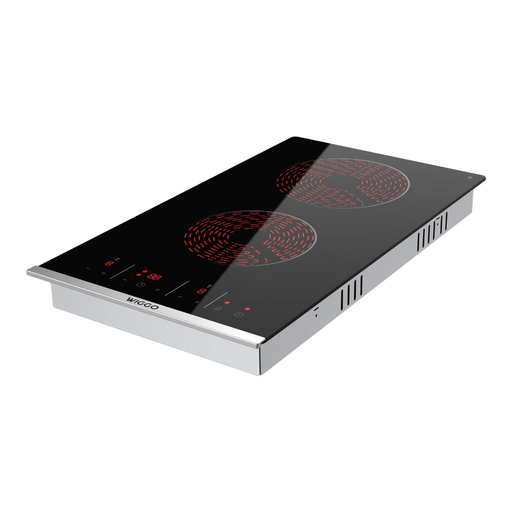 Image unavailable
A ceramic model could suit you if you don’t want to use an induction pan. Bear in mind that it’s a built-in model and check the installation requirements.
Built-in model; the version described has a cable without a plug.
 Image unavailable
A portable single-zone hob could suit you for one pan; check that its flat, induction-compatible base is within the permitted pan size.
2000 W; cooking zone Ø 26 cm; 10 power settings; timer; suitable for pans of 12–26 cm.
No. Inventum describes the KI120T’s keep-warm function as a separate setting with a temperature that can’t be adjusted. To simmer soup, check how the hob performs on a suitable low cooking setting. The Consumers’ Association reports that not all the induction hobs it tested can maintain the same low temperature for a long time.
Check that the pan base is magnetic, flat and conducts heat, and that the pan size suits the cooking zone. Consult the permitted pan sizes for your chosen model; don’t assume that every metal pan is suitable.
First check the connection rating and installation instructions for the exact model. According to the Consumers’ Association, an induction hob with a connection rating above 3,65 kW needs a more powerful connection and a five-pin Perilex connection. Make sure it’s installed appropriately.
If an electric hob is placed on the market in the Netherlands and falls under the Electrical Equipment Decree, it must meet the relevant safety requirements and carry a CE marking when its rated AC voltage is 50–1.000 V. The Netherlands Food and Consumer Product Safety Authority (NVWA) states this requirement. A CE marking alone doesn’t prove that a specific version meets every requirement.
No. A timer isn’t a substitute for keeping an eye on the hob while cooking. The Netherlands Fire Service advises staying nearby and keeping flammable materials away.