If you make onion gravy in one pan and have little worktop space, a freestanding single-zone hob may be enough. If you want to make gravy and a side dish at the same time, a two-zone model is more practical, provided both pans fit and the electrical connection can support it. Induction responds more quickly when you turn the heat down, but you’ll need a compatible pan. Ceramic and cast-iron hobs are alternatives, though they retain more heat or offer less responsive heat control. Before buying, check the pan size, electrical connection and product marking for the exact model.
Which hob is right for you?
One-pan cook with limited worktop space
You fry the onion and simmer the gravy in the same pan. A stowable single-zone hob may be enough, as long as the pan and electrical connection are suitable. The Netherlands Nutrition Centre describes frying onion as part of making onion sauce.
Cook who uses two pans at once
You want to make a side dish as well as the gravy. Compare the space available for pans on two-zone hobs, and check how much power is available when you use both zones at once.
Cook who wants to keep their existing pans
First check whether your gravy pan is suitable for induction. If it isn’t, ceramic or cast-iron zones may be suitable, provided the pan base and electrical connection are right. Milieu Centraal recommends checking that an induction pan has a magnetisable layer in its base.
What should you look for when buying?
When making onion gravy, you fry the onion and then simmer the sauce. Being able to turn the heat down quickly is therefore an important feature to consider. However, a stated setting or timer doesn’t prove how evenly the gravy will simmer in your pan. The Netherlands Nutrition Centre explains that ceramic hobs respond more slowly after heating up.
Freestanding single-zone induction hob
Suitable for: cooking the onion and gravy one after the other in the same induction-compatible pan, when you want to clear the space after cooking.
Bear in mind: you can’t heat a second pan at the same time; check the pan size supported by the model.
Freestanding two-zone induction hob
Suitable for: making gravy and a side dish at the same time, provided both pans fit on the hob.
Bear in mind: it takes up more worktop space. If you have a limited single-phase connection, you may not be able to cook on both zones at high settings at the same time.
Ceramic hob
Suitable for: anyone looking for a smooth hob who has a pan suitable for the model, but not for induction.
Bear in mind: the zone itself gets hot, retains residual heat after being switched off and responds more slowly when you turn the heat down.
Electric hob with cast-iron hotplates
Suitable for: anyone who prefers a freestanding hob with rotary controls and doesn’t want to use an induction-compatible pan.
Bear in mind: the hotplates stay hot and, according to Inventum, are harder to clean than induction hobs.
Slim built-in induction hob
Suitable for: anyone who wants a permanent cooking spot and has, or plans to get, a worktop with a suitably sized cut-out.
Bear in mind: check the cut-out, ventilation and electrical connection; having a plug doesn’t remove the need for built-in installation.
| What to consider |
What to check before buying |
Who it matters to |
| Gentle frying and simmering |
Check the controls and low settings on the exact model, and keep an eye on the pan while cooking. |
When I make onion and gravy one after the other in the same pan, I want to be able to turn down the heat without relying on a particular setting to make the gravy simmer evenly by itself. Around 28% of consumers rank simmer control as their top buying concern. |
| Worktop space and storage |
Measure the hob, pan and available space; compare a freestanding hob with a built-in model. |
In a small kitchen, I want to be able to use one pan and clear the worktop afterwards if needed. Around 22% of consumers say limited worktop space is their main buying concern. |
| Electrical connection |
Check the plug, rated power, socket and circuit load; have any changes assessed by a professional. |
I want to know in advance whether my existing kitchen electrics can handle the hob, even when other appliances are switched on at the same time. Around 22% of consumers rank the electrical connection first. |
| Existing gravy pan |
Test the base with a magnet, compare its diameter with the model instructions and, for ceramic hobs, check that the base is flat enough. |
If I want to keep using my current pan, I first check that it’s suitable for the chosen heating method and zone. Around 17% of consumers say keeping their existing pan is their main buying concern. |
| Using two pans at once |
Compare the zones, the space between them, the combined power and the controls for each zone. |
I regularly want to make a second dish alongside the gravy, so I need space for two pans. Around 11% of consumers rank cooking two dishes at once as their top buying concern. |
Common buying mistakes
-
Assuming temperature settings guarantee an even simmer
A timer or a stated number of settings isn’t an independent test of how onion gravy cooks in your pan.
Use the controls to help you choose, and keep an eye on the pan while you cook.
-
Assuming two hotplates means two zones at full power
With a limited single-phase connection, using several zones at a high setting may be restricted.
Compare the combined rated power and the circuit, not just the number of zones. The Consumers’ Association explains that induction hobs above 3.65 kW may require a higher-capacity connection.
-
Confusing a smooth ceramic hob with induction
A ceramic zone with heating elements gets hot itself and cools down more slowly; induction, on the other hand, requires a compatible pan.
Check the heating technology in the specifications and make sure it suits your pan and your preferred level of heat control.
Brands and models to consider
Inventum
The models mentioned range from a freestanding single-zone induction hob to two-zone induction and cast-iron hotplates.
- Inventum lists a timer and a suitable pan size of 15–20 cm for the KI120T; the VKI3010ZWA has 14 cm and 17 cm zones.
- Inventum says the cast-iron KP602B is harder to clean than an induction hob.
ETNA
The KI129ZT is a slim, built-in two-zone induction hob for a permanent cooking spot.
- ETNA lists a width of 29 cm, a plug and timers for each zone.
- Check that the cut-out and worktop installation are suitable; these specifications alone don’t indicate how well it simmers.
Princess
The 303021 is a freestanding two-hotplate ceramic hob for anyone who doesn’t want to use induction.
- Princess lists individual thermostats and 16 cm and 19 cm zones.
- Ceramic heating retains residual heat and responds more slowly when you turn the heat down.
IKEA
The TILLREDA 805.901.55 is a stowable single-zone induction hob for a small cooking space.
- IKEA lists a 170 mm zone and a rated power of 2000 W; you can put the hob away when you’re not using it.
- You’ll need a suitable magnetic pan, and you can’t heat two pans at once on this hob.
Severin
The DK 1031 is a freestanding two-zone induction hob.
- Severin lists 3400 W, a plug and a timer.
- These specifications aren’t an independent simmering test; check that the connection is suitable for the model and your kitchen.
Joybuy products for one or two pans
This selection includes freestanding induction hobs with one or two zones, plus a built-in two-zone model. Before buying, check the product marking and connection details for the exact model; a CE marking isn’t an independent quality mark.
 No image available
MELISSA induction hob, 1 zone, 2000 W
A single-zone model for making onion and gravy one after the other in one pan.
Lists 10 heat settings and a temperature range of 60–240 °C; induction requires a pan with a magnetisable base.
Joybuy
 No image available
Induction hob with 2 zones, 5 temperature settings
Could be suitable if you want to make gravy and a second dish at the same time and have space for two pans.
The description lists separate controls for each zone; induction requires pans with a magnetisable base.
Joybuy
 No image available
Portable induction hob, 1 zone, 1000 W
A portable single-zone hob for anyone who uses one pan and wants to keep their cooking space compact.
The title lists five power settings; induction requires a pan with a magnetisable base.
Joybuy
 No image available
Joyami JCL02M induction cooker (220V/240V/2100)
A single-zone model for making onion and gravy one after the other in the same pan.
The description lists temperature control and touch controls; check the exact electrical specifications before connecting it. Induction requires a pan with a magnetisable base.
Joybuy
 No image available
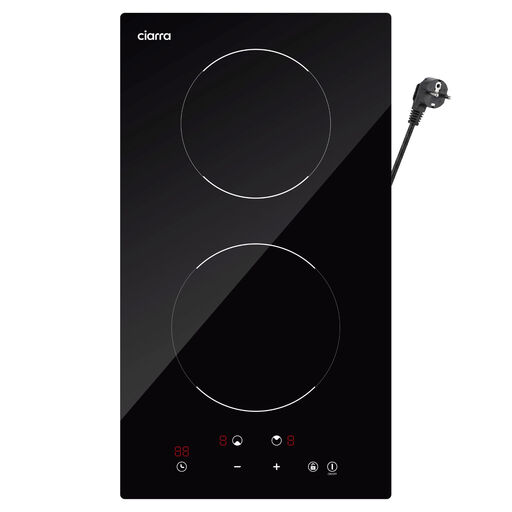
Ciarra CRGDBIH2 built-in induction hob, 2 zones, 3000 W
A built-in two-zone model for anyone who wants to make gravy and a second dish at the same time and has a permanent cooking spot.
The product description lists nine power levels, individual timers and a 270 × 490 mm cut-out; professional installation is recommended. Induction requires suitable pans.
Joybuy
Frequently asked questions
Can I use my current gravy pan on an induction hob?
Check that the pan base is magnetisable and falls within the sizes supported by your chosen model. A magnet test is a useful first check, but it doesn’t replace the model instructions.
Can I always use a hob with a standard plug without making any changes?
Not without checking the hob and the electrical circuit. Using other high-power appliances on the same circuit at the same time may be a limitation. For induction hobs above 3.65 kW, the Consumers’ Association describes the need for a higher-capacity connection; have the installation assessed by a qualified professional.
Which legal product marking should I check?
Electrical equipment covered by the EU Low Voltage Directive, including equipment for 50–1,000 V AC, must have a CE marking when placed on the EU market. Business.gov.nl explains that CE isn’t a quality mark. The marking alone doesn’t show that a specific item meets all the applicable requirements.
How do I clean an induction hob after cooking?
Use a cloth or non-scratch sponge, and follow the model’s instructions on cleaning products. Check the residual heat indicator before touching the surface; the Consumers’ Association recommends using non-abrasive cleaning materials.
Who can help if a hob develops a fault too soon during normal use?
The retailer is your point of contact for your statutory rights. ACM ConsuWijzer explains that, under the applicable conditions, the retailer must resolve at no cost any issue with a product that doesn’t meet what you could reasonably expect. This could mean a repair or replacement. A manufacturer’s guarantee doesn’t automatically limit those rights.


